


TL;DR
A personal injury calculator can give you a rough idea of what your case may be worth. But your medical bills, lost pay, pain, injuries, and changes to your life all matter too.
When an accident happens, one of the biggest questions is, “How much is my case worth?”
That is a fair question to ask. Maybe you were in a car crash, slipped and fell, or got hurt because someone else made a mistake.
Now, medical bills are piling up, and you’re worried about how to pay them.
Many people look for a personal injury case calculator in California. They type in their medical expenses and lost wages, hoping to get a number that shows their case’s value. It seems easy, right? But here’s the thing: your injury isn’t just about numbers.
A personal injury settlement calculator won’t tell you how you wake up at night because your back hurts. It can’t explain that you stopped playing games with your kids or that you’re scared to drive again. These feelings matter too.
California law lets you ask for money for losses caused by someone else’s mistakes. These losses can be bills you’ve paid, money you’ve lost, and even things you can’t show on a receipt.
So, what should you think about to understand what your injury claim might be worth?
Let’s start with the basics.
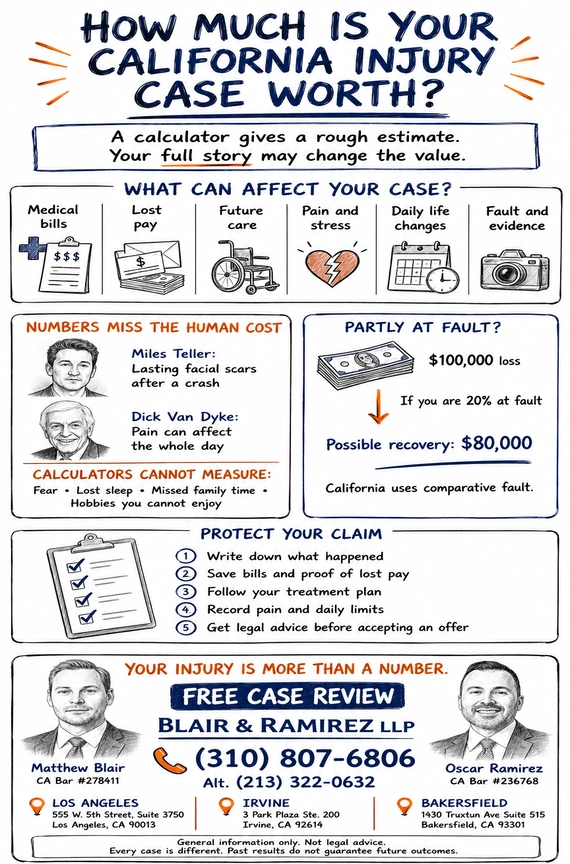
How Much Is My Injury Case Worth?
There isn’t just one right answer. Why? Because every injury affects people in different ways.
Let’s think about two people who have had similar car accidents. The first person has a sore neck, but after a few weeks, the pain goes away. They go back to work and feel normal again. The second person, however, has a serious neck injury. They need treatment for months, miss work, and can’t lift their young child. They might even need more help in the future.
Both experienced the same accident, but their lives are very different afterward. That difference matters when figuring out how much an injury claim is worth.
You should ask yourself a few important questions:
- How badly did I get hurt?
- How long have I needed treatment?
- Did I miss work?
- Will I need more care?
- Can I still do the things I did before?
These questions give you a clearer picture than just a number from a calculator.
Actor Miles Teller understands how an accident can leave lasting scars.
When he was 20, he was in a bad car crash and talked about the scars he still has. He said, “I got scars on my face. I still have two rocks in my face.”
A scar is easy to see. But:
- What about pain that nobody else can see?
- What about fear?
- What about lost sleep?
- What about missing work or giving up things you love?
These parts of an injury are important, too.
Is an Injury Settlement Calculator Accurate?
You may have seen settlement calculators online. You enter your injury, add your medical bills and lost wages, and get a number.
But can you trust that number to show the true value of your case? Not by itself.
A calculator can help you list your losses, but it can’t see your whole situation.
Let’s say you hurt your shoulder in a crash. You have $8,000 in medical bills and missed six weeks of work. Your doctor says you might need surgery, and you can’t play baseball anymore. Plus, you still struggle to sleep because of the pain.
Would a calculator know all these details? Probably not.
What if the other driver says you were partly at fault? What if the insurance company questions your medical bills? What if your injury gets worse? A calculator can’t answer these questions.
The California Supreme Court looked at these issues in Howell v. Hamilton Meats. The court decided that the biggest number on a bill doesn’t always tell the whole story.
That’s why an online calculator should just be a starting point, not the final answer.
How Do You Estimate Injury Compensation?
Start by making a simple list.
What did the accident cost you?
|
Loss |
Simple example |
|
Medical bills |
Hospital visits, medicine, therapy, surgery |
|
Lost pay |
Money you lost because you could not work |
|
Future care |
Treatment you may need later |
|
Pain |
Physical pain from your injury |
|
Daily problems |
Trouble walking, sleeping, driving, or lifting |
|
Life changes |
Giving up sports, hobbies, or family activities |
Now, let’s think about a person named Maria.
Maria got hurt in a crash. She spends $12,000 on medical care, misses two months of work, and can’t drive for several weeks. She stops running because her knee hurts.
Is her case worth just $12,000? Not necessarily.
Why? Because $12,000 only shows part of the story.
Her lost pay matters, her future treatment matters, her pain matters, and the things she can no longer do matter.
That’s why you shouldn’t only look at your medical bills and think, “That’s what my case is worth.” The number may be much more complicated.
What Factors Affect Injury Case Value?
Many things can change the value of an injury claim. Here are some things to consider:
- How serious is the injury?
A small injury that heals quickly usually has different losses than a serious injury that lasts for years.
- How long will you hurt?
Two weeks of pain is not the same as two years of pain.
- How much treatment do you need?
Did you stay in the hospital? Do you need physical therapy, surgery, or more treatment later?
- Did you lose money?
If you couldn’t work, you might have lost pay. What if you can’t go back to the same job?
- How did the accident affect your life?
Can you still play with your kids? Can you exercise? Can you sleep? Can you enjoy your favorite hobbies?
These questions matter because an injury can change your daily life. California also looks at who is at fault.
What does that mean? Think about a loss of $100,000.
If the injured person is found to be partly responsible, they might get less money. This idea is called comparative fault. In a case called Li v. Yellow Cab Co., the California Supreme Court decided that a person’s share of fault can reduce the amount they can recover.
So, here’s another important question: Who caused the accident, and what proof do we have?
How Can an Injury Claim Guide Help?
An injury claim guide can help you ask the right questions. Start here:
Start here.
- What happened? Write down what happened while you still remember it clearly.
- Who caused it? Was another driver speeding? Did someone break a safety rule? Did something dangerous cause your fall?
- What did the injury cost you? Keep track of medical bills, medicine, travel to appointments, and lost pay.
- How did your life change? This is easy to forget. Maybe you used to walk your dog every morning, but now you can’t. Maybe you played soccer every Saturday, but now you sit on the sidelines. Maybe you used to pick up your toddler every night, but now you can’t lift them.
Those details tell the story of your injury.
And stories matter because numbers can’t show everything. Actor Dick Van Dyke learned that after a car accident in 2023. More than a week later, he said he was doing “pretty good” but was “sore all over.”
“Sore all over” sounds simple, but think about it:
- What does that mean when you wake up?
- What does it mean when you get dressed?
- What does it mean when you climb stairs?
- What does it mean when you try to sleep?
Pain can follow you through the whole day. That’s why injury claims need more than just a calculator.
Why Can’t One Number Tell Your Story?
We all want simple answers. Ten dollars. Ten thousand dollars. One hundred thousand dollars.
But injury cases don’t always work this way. Your case may depend on things that change over time.
Maybe you thought your injury was minor, but then the pain got worse. Maybe you went back to work, but then realized you couldn’t keep up. Maybe you thought physical therapy would fix everything, but your doctor recommended more treatment.
What happens then? The number changes.
That’s why searching for a calculator for an injury can be useful, but you should be careful about what the result means. It’s just a rough tool, not a promise. It doesn’t know your medical history, your work history, or your pain. And it doesn’t know what happened to you.
Frequently Asked Questions
Key Takeaways
- An online calculator can help you list your losses, but it can’t tell you exactly what your case is worth.
- Medical bills are just one part of an injury claim.
- Lost pay, future care, pain, and changes to your daily life can also matter.
- Who is at fault can affect how much money you may recover in California.
- Your real story is more important than a number provided by a website.
Your Injury Is More Than a Number
A calculator can add up numbers, but it cannot tell your story. It doesn’t feel your pain and can’t see you struggling to climb the stairs. It doesn’t know that you stopped playing with your kids or whether you will need more treatment in the coming months.
That’s why understanding your legal options after an accident takes more than just entering a few numbers into a website.
Blair & Ramirez LLP can help you understand your options and look at the facts that can affect your claim. If you want to talk about what happened, request a free case review to get a clearer view of your situation. Contact Blair & Ramirez LLP to discuss your legal options.
This article is for general information only and is not legal advice. Every case is unique and needs to be evaluated based on its specific facts and circumstances. Past results do not guarantee or predict similar outcomes in future cases.