

TL;DR
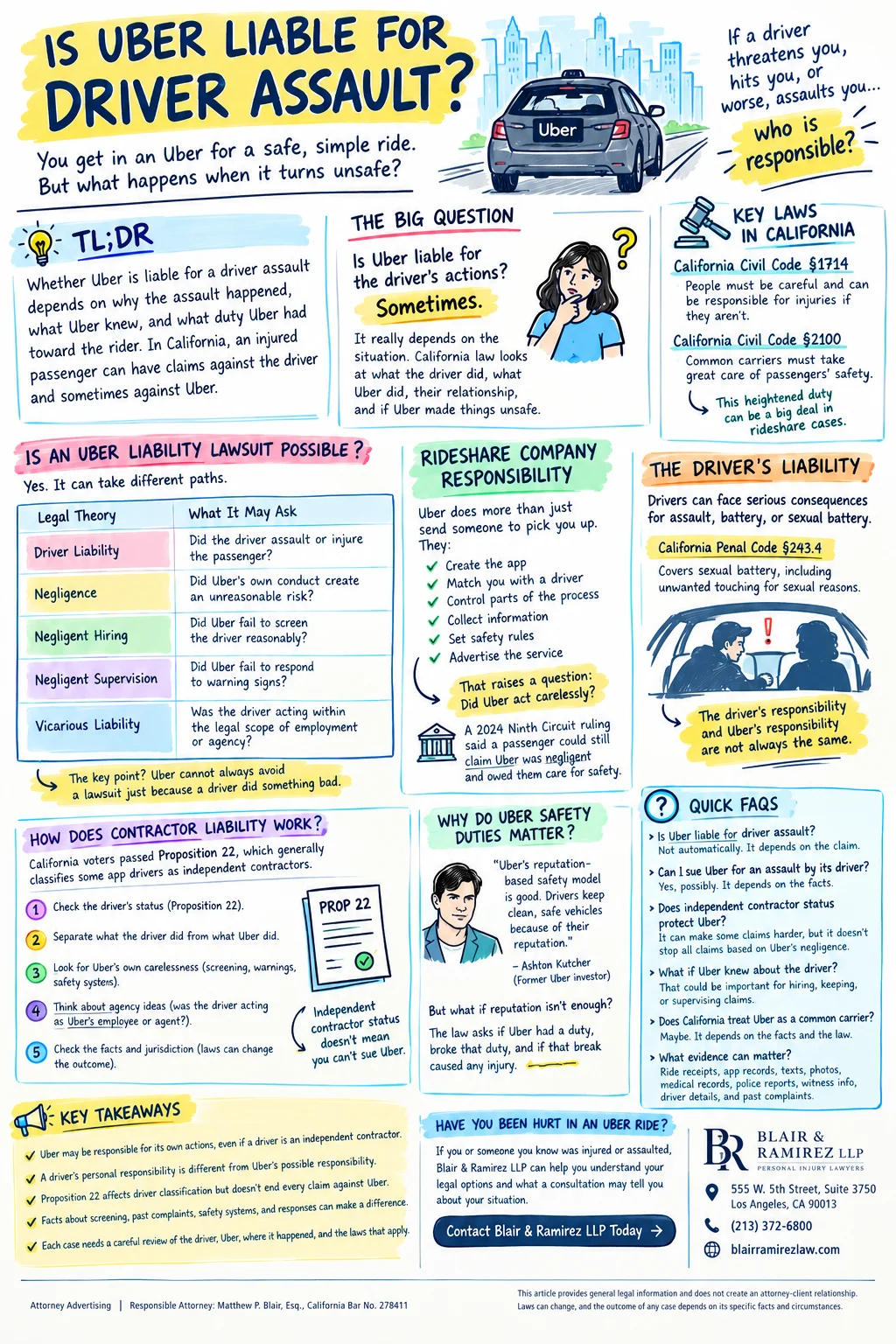
Whether Uber is liable for driver assault depends on why the assault happened, what Uber knew, and what duty Uber had toward the rider. In California, an injured passenger can have claims against the driver and sometimes against Uber.
When you get into Uber, you just want something easy. You want to go home, relax, maybe check your phone, or look out the window.
But what if something bad happens?
What if the driver threatens you, hits you, or tries to hurt you? In the worst cases, what if they sexually assault you?
Now, you think, who is responsible for what happened?
So, is Uber liable for the driver’s actions? The quick answer is sometimes. It really depends on the situation. California law looks at what the driver did, what Uber did, their relationship, and if Uber made things unsafe.
Is an Uber Liability Lawsuit Possible?
An Uber liability lawsuit can take different paths. You might say the driver hurt you directly. Or you could argue that Uber did not do a good job in checking or managing its drivers.
California Civil Code §1714 says people have to be careful and can be responsible for injuries if they were not careful.
Another law, California Civil Code §2100, says that if you carry passengers for money, you must take great care of their safety. This heightened duty can be a big deal in rideshare cases.
| Legal theory | What it may ask |
|---|---|
| Driver liability | Did the driver assault or injure the passenger? |
| Negligence | Did Uber’s own conduct create an unreasonable risk? |
| Negligent hiring | Did Uber fail to screen the driver reasonably? |
| Negligent supervision | Did Uber fail to respond to warning signs? |
| Vicarious liability | Was the driver acting within the legal scope of employment or agency? |
The key point? Uber cannot always avoid a lawsuit just because a driver is the one who did something bad.
Why Does Rideshare Company Responsibility Matter?
Think about the difference between a stranger attacking you on the street and someone you met through a rideshare app.
Uber did more than just send someone to pick you up. They created the app, matched you with the driver, controlled parts of the process, collected information, set safety rules, and advertised the service to everyone.
This does not mean Uber is to blame for everything a driver does. But it raises a new question: Did Uber act carelessly?
A 2024 Ninth Circuit ruling about a sexual assault by a person pretending to be an Uber driver shows how this works. The court said that even if Uber didn’t seem responsible, the passenger could still claim Uber was negligent and owed them care for safety.
That is an important legal point. One way to hold Uber responsible might close, but another way might still be open.
Why Do Uber Drivers Face Liability?
The driver is still very important in these cases. Just because drivers are independent contractors does not mean they have no responsibility if they hurt someone.
If a driver hits a passenger, threatens them, or does something like sexual battery, they face serious consequences.
California law deals with assault, battery, and sexual battery. For example, California Penal Code §243.4 covers sexual battery, which includes unwanted touching for sexual reasons.
What does it mean?
Let’s think of a passenger who argues with a driver about where to go. The driver gets angry and hits the passenger. The driver could be responsible for the injuries. But for the passenger to claim against Uber, it needs a different legal approach.
That difference is important.
The driver’s responsibility and Uber’s responsibility are not always the same question.
How Does Contractor Liability Work?
This is where things get tricky.
California voters passed Proposition 22, which generally says that some app drivers are independent contractors, not employees. California Business and Professions Code §7451 explains the rules about this.
In 2024, the California Supreme Court supported Proposition 22 in a case called Castellanos v. State of California.
But keep this in mind: just because the driver is an independent contractor does not mean you cannot sue Uber.
Here are steps to think about:
- Check the driver’s status. Do the independent contractor rules from Proposition 22 apply to this driver?
- Separate what the driver did from what Uber did. What happened with the driver? What did Uber do or not do?
- Look for Uber’s own carelessness. Did Uber’s checks, warnings, safety systems, or actions create a dangerous situation?
- Think about agency ideas. Was the driver acting as Uber’s employee or agent when this happened?
- Check the facts and jurisdiction. The place where the assault happened and the laws in that state can change how things look.
California’s Supreme Court says that figuring out if someone is an employee and if they can be blamed for harm are different questions. In the Dynamex cases, the court created the ABC test to classify workers, while Proposition 22 later set rules for app drivers.
How Can I Sue Uber?
If you are wondering if you can sue Uber for what a driver did, don’t just look at the label “independent contractor.”
Ask better questions.
- Did Uber know about earlier complaints?
- Did they have information about the driver’s past?
- Did they have safety rules that should have applied?
- Did anyone ignore a warning?
- Did the assault happen while the ride was happening?
- Did Uber’s actions or their platform make it more dangerous?
Those facts can matter.
In 2024, a California Court of Appeal decided on many cases about Uber where passengers claimed sexual assault. The court talked about claims of negligence and poor safety practices. In the end, they said some cases that happened outside California should be handled in those places.
California Supreme Court cases also show why the type of legal claim is important. In Lisa M. v. Henry Mayo Newhall Memorial Hospital, the court looked at whether a company could be responsible for an employee’s sexual assault and studied whether the act was connected to the employee’s work.
That does not mean every Uber assault case will end the same way. This means lawyers and courts must look carefully at how work, the assault, and the legal claims connect.
Why Do Uber Safety Duties Matter?
This is where people start to pay attention.
Actor and former Uber investor Ashton Kutcher said Uber’s reputation-based safety model is good, stating that drivers keep clean, safe vehicles because of their reputation.
That sounds good, but what if reputation isn’t enough?
Later, Kutcher talked about sexual harassment and said that people accused of sexual assault should not get “hall passes.” His comments are not legal proof, but they raise important questions: What should a company do when safety is a big part of its service?
The law asks if Uber had a duty to keep passengers safe, if they broke that duty, and if that break caused any injury. This is a more important question than just whether Uber calls its drivers independent contractors.
Frequently Asked Questions
Key Takeaways
- Uber may be responsible for its own actions, even if a driver is classified as an independent contractor.
- A driver’s personal responsibility is different from Uber’s possible responsibility.
- California’s Proposition 22 affects driver classification but does not end every claim against Uber.
- Facts about how Uber checks drivers, past complaints, safety systems, and their responses can make a difference.
- Each assault case needs careful review of the driver, Uber, where it happened, and the laws that apply.
When a Ride Becomes a Legal Question
An Uber ride can seem ordinary right up to the point it isn’t.
If a driver hurts you, the legal question isn’t just, “Was the driver an independent contractor?” It might be much bigger: what did the driver do, what did Uber do, what did Uber know, and what responsibility did the law give to each of them?
To understand if Uber is responsible for a driver assault, you need to look deeper than just the app and understand the facts.
If you or someone you know got hurt or assaulted during an Uber ride, Blair & Ramirez LLP can help you figure out your legal options. Contact Blair & Ramirez LLP today.
Attorney Advertising: This article shares general legal information and does not create an attorney-client relationship. Laws can change, and what happens in a case depends on its specific facts and situations.