


TL;DR
If you’re asking, “Do I need a lawyer to sue Uber for assault?” the answer depends on your facts, arbitration rules, and evidence. Uber isn’t automatically liable, and the legal path can change based on who the attacker was and how the incident occurred.
A rideshare trip should be boring. You tap a button. A car arrives. You get in. You go where you need to go. Then you get out.
So, what happens when the person who was supposed to get you home becomes the danger? Or when someone pretends to be your Uber driver and uses the Uber name to get you into a car? Suddenly, the question is not just what happened. It is who may be responsible, what legal claim fits the facts, and where that claim must be brought.
That is why the question “do I need a lawyer to sue Uber for assault” has a harder answer than a simple yes or no.
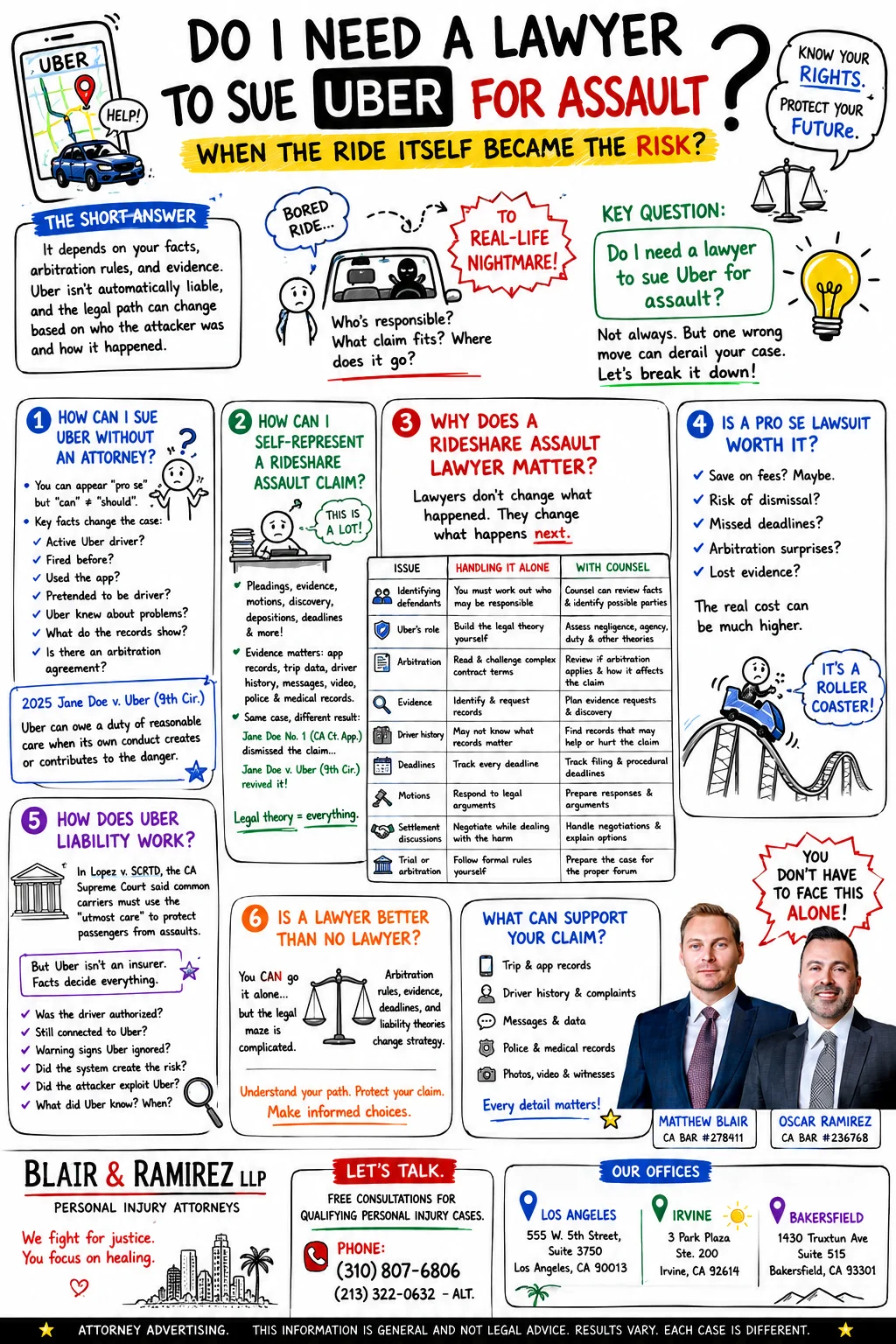
How Can I Sue Uber Without an Attorney?
Technically, a person can represent themselves. That is called appearing “pro se.” But “can” and “should” are very different questions.
Consider what a rideshare assault claim may involve:
- Was the attacker an active Uber driver?
- Had Uber fired the driver before?
- Did the driver use the Uber app?
- Did the person pretend to be a driver?
- Did Uber know about earlier safety problems?
- What did the company’s records show?
- Was there an arbitration agreement?
Those questions can change the case.
The 2025 Jane Doe v. Uber Technologies decision shows why. The Ninth Circuit rejected the plaintiff’s theory that Uber was automatically vicariously liable for the attacker’s conduct. But it revived her negligence claim, finding that Uber could owe a general duty of reasonable care where its own conduct created or contributed to the danger.
That is a big distinction. The issue was not simply, “Was an Uber driver bad?” The court asked whether Uber’s own conduct helped create the risk.
And there is another problem. Uber’s current U.S. terms require arbitration for many disputes tied to personal injury. But there is an exception: Individual claims of sexual assault and sexual harassment are carved out. These claims are exempt from mandatory arbitration. They may proceed in court, subject to the specific terms and applicable exceptions.
So, the better question may not be, “Can I file a lawsuit?” It may be, “What legal path applies to my claim?”
How Can I Self-Represent a Rideshare Assault Claim?
Self-representation may look simple from the outside. Write the complaint. File it. Tell your story. Wait for the other side to respond.
Real cases rarely work that way.
A rideshare assault lawsuit can involve pleadings, evidence rules, motions, discovery, depositions, arbitration questions, deadlines, and arguments about duty and liability. You may also have to deal with Uber’s lawyers while you are still trying to recover from what happened.
Think about the evidence. A rider may remember the driver’s face. But what about app records? Trip data? Driver records? Vehicle information? Messages? Prior complaints? Camera footage? Police records? Medical records?
Who asks for those records? What exactly should the request say? What happens if Uber objects?
These are not small details.
The earlier California case, Jane Doe No. 1 v. Uber Technologies, involved women who alleged that attackers abducted and sexually assaulted them after posing as authorized Uber drivers. The California Court of Appeal rejected their negligence theory at that stage, finding that the pleaded facts did not establish the required duty under the theory presented.
But the legal story did not end there. The later Ninth Circuit decision in Jane Doe v. Uber took a different view of the negligence question on the facts before it and revived that claim.
Why mention the same case twice? Because it shows something important: the legal theory matters. A claim can turn on how the plaintiff frames Uber’s conduct, what evidence supports that theory, and what court is deciding the issue.
Why Does a Rideshare Assault Lawyer Matter?
A lawyer does not change what happened. But legal help can change how the facts get organized, tested, and presented.
|
Issue |
Handling It Alone |
With Rideshare Assault Counsel |
|
Identifying possible defendants |
You must work out who may be legally responsible |
Counsel can review the facts and identify possible parties |
|
Uber’s role |
You must build the legal theory yourself |
Counsel can assess negligence, agency, duty, and other theories |
|
Arbitration |
You must read and challenge complex contract terms yourself |
Counsel can review whether arbitration applies and how it affects the claim |
|
Evidence |
You must identify and request records |
Counsel can plan evidence requests and discovery |
|
Driver history |
You may not know what records matter |
Counsel can identify records that may support or weaken a claim |
|
Deadlines |
You must track every deadline |
Counsel can track filing and procedural deadlines |
|
Motions |
You must respond to legal arguments |
Counsel can prepare responses and arguments |
|
Settlement discussions |
You negotiate while dealing with the underlying harm |
Counsel can handle negotiations and explain available options |
|
Trial or arbitration |
You must follow formal rules yourself |
Counsel can prepare the case for the proper forum |
This is where the phrase “do I need a lawyer to sue Uber for assault” becomes more useful. The question is not whether every injured person must have a lawyer. The question is whether the case has enough legal and factual complexity that professional guidance could make a meaningful difference.
And rideshare assault claims can be complex.
Is a Pro Se Rideshare Assault Lawsuit Worth It?
Sometimes a person wants to handle a legal matter alone because legal fees sound scary. That concern is fair.
But cost is only one side of the decision. What could happen if an important claim gets dismissed? What if a deadline passes? What if an arbitration clause changes the entire process? What if evidence disappears because nobody asks for it in time?
Los Angeles actor Corey Sligh learned a much more basic lesson about how quickly a normal evening can turn into something terrifying. In 2014, Sligh told ABC News that two men hit him with a car in West Hollywood and that one then attacked him. “I’m just truly thankful I’m alive,” he said.
Actress Elaine Hendrix has also spoken about the long tail of a Los Angeles traffic injury. After being hit by a car while riding a bicycle in 1992, she later described the experience as “a roller coaster” because of the lasting injuries.
Neither story involves Uber. That is the point.
An injury does not end when the ambulance leaves. Pain can affect work. Fear can affect travel. Medical care can continue. A person can look fine while still dealing with the effects years later.
An assault inside a rideshare vehicle can carry that same kind of long shadow. A legal claim therefore needs to account for more than the first hospital bill.
How Does Uber Liability Work?
This is where the legal argument gets interesting.
California Supreme Court precedent recognizes that common carriers have duties toward passengers. In Lopez v. Southern California Rapid Transit District, the court held that public and private common carriers have a duty of utmost care and diligence to protect passengers from assaults by fellow passengers, while also stressing that carriers are not automatic insurers of passenger safety.
But whether Uber fits every part of that rule in every assault case is not something a headline can settle.
The more recent Jane Doe litigation (cited above) shows the fight. The Ninth Circuit concluded in 2025 that, under the facts before it, Uber owed the rider a duty of reasonable care because the plaintiff alleged that Uber’s own conduct created or contributed to the risk that a predator could pose as an Uber driver.
That does not mean Uber automatically loses every assault case. It does not mean every driver’s criminal act becomes Uber’s legal responsibility. And it does not mean every claim belongs in court.
It means the facts matter.
Was the driver authorized? Was the driver still connected to Uber? Did Uber receive warning signs? Did the company’s system contribute to the risk? Did the attacker exploit the Uber platform? What did Uber know, and when?
Those questions can become the heart of the case.
Is a Lawyer Better Than No Lawyer?
There is no universal answer. A person may legally represent themselves in some proceedings. But a complex rideshare assault claim can demand far more than telling a clear story.
The current Uber terms alone show why. Uber says covered disputes generally go to individual binding arbitration, and the agreement includes claims involving personal injury, including sexual assault and harassment claims connected to use of its services.
That can change the entire strategy.
A person asking “do I need a lawyer to sue Uber for assault” should first understand whether there is a court lawsuit to file, whether arbitration applies, what claims may exist, and what evidence supports them.
That is a very different task from filling out a form.
Frequently Asked Questions
Key Takeaways
- Uber may face a negligence claim when its own conduct helped create or contribute to an unreasonable risk of assault.
- Uber’s current U.S. terms contain a broad arbitration agreement that can affect how some injury and assault claims proceed.
- Representing yourself is possible in some settings, but rideshare assault claims can involve difficult evidence and liability questions.
- The difference between an authorized driver, a former driver, and an impostor can matter greatly.
- A consultation can help a person understand the legal options before deciding how to proceed.
When the Ride Becomes the Risk, Know Your Options
Nobody gets into a rideshare expecting to become part of a legal case.
But if an assault happens, the legal questions can become complicated very quickly. Who caused the harm? Did Uber’s conduct contribute to the risk? Does an arbitration agreement apply? What evidence exists? What deadline controls?
Those are questions worth answering before making a major legal decision.
At Blair & Ramirez LLP, we represent people in personal injury matters and offer free consultations for qualifying personal injury cases. Our Los Angeles office is at 555 W. 5th Street, Suite 3750, Los Angeles, CA 90013. Contact us to discuss what happened and understand the legal options that may be available in your situation.
Attorney Advertising. This article provides general information, not legal advice. The facts and law governing each case are different.