

TL;DR
A rideshare accident lawyer can help explain the insurance and liability questions that may arise after a Lyft or Uber crash. California’s rules change depending on what the driver was doing in the app, so the details of the trip can matter.
If you were looking for a rideshare accident lawyer, you probably didn’t expect your Lyft ride to turn into something you’re still replaying in your head.
One minute it’s just a normal trip: quiet road, phone in hand, and nothing unusual.
Then everything snaps. A sudden impact, metal screaming, your body thrown forward, and that heavy silence right after a crash where nobody knows what just happened.
You sit there stunned, trying to understand if you’re hurt, if anyone else is, and why a routine ride suddenly feels like chaos you didn’t choose.
It Starts Like Any Other Ride
Most rideshare trips are forgettable.
You open the app. A driver arrives. You get in. And you arrive.
That is the whole point.
But consider a real-life situation described recently on Reddit. One Uber passenger said another driver hit the Uber while the passenger was riding in the back seat. The police report reportedly found the other driver at fault, but the passenger was still unsure which insurance company should handle the injury claim.
That question makes perfect sense.
If you are the passenger, why should you have to understand the insurance arrangements between Uber, the driver, and another motorist?
You shouldn’t have to guess.
The problem is that the answer can depend on facts you may not even know.
Was the driver waiting for a ride request? Had the driver accepted your trip? Were you already inside the car?
Those details can change the insurance picture.
Then the Insurance Questions Begin
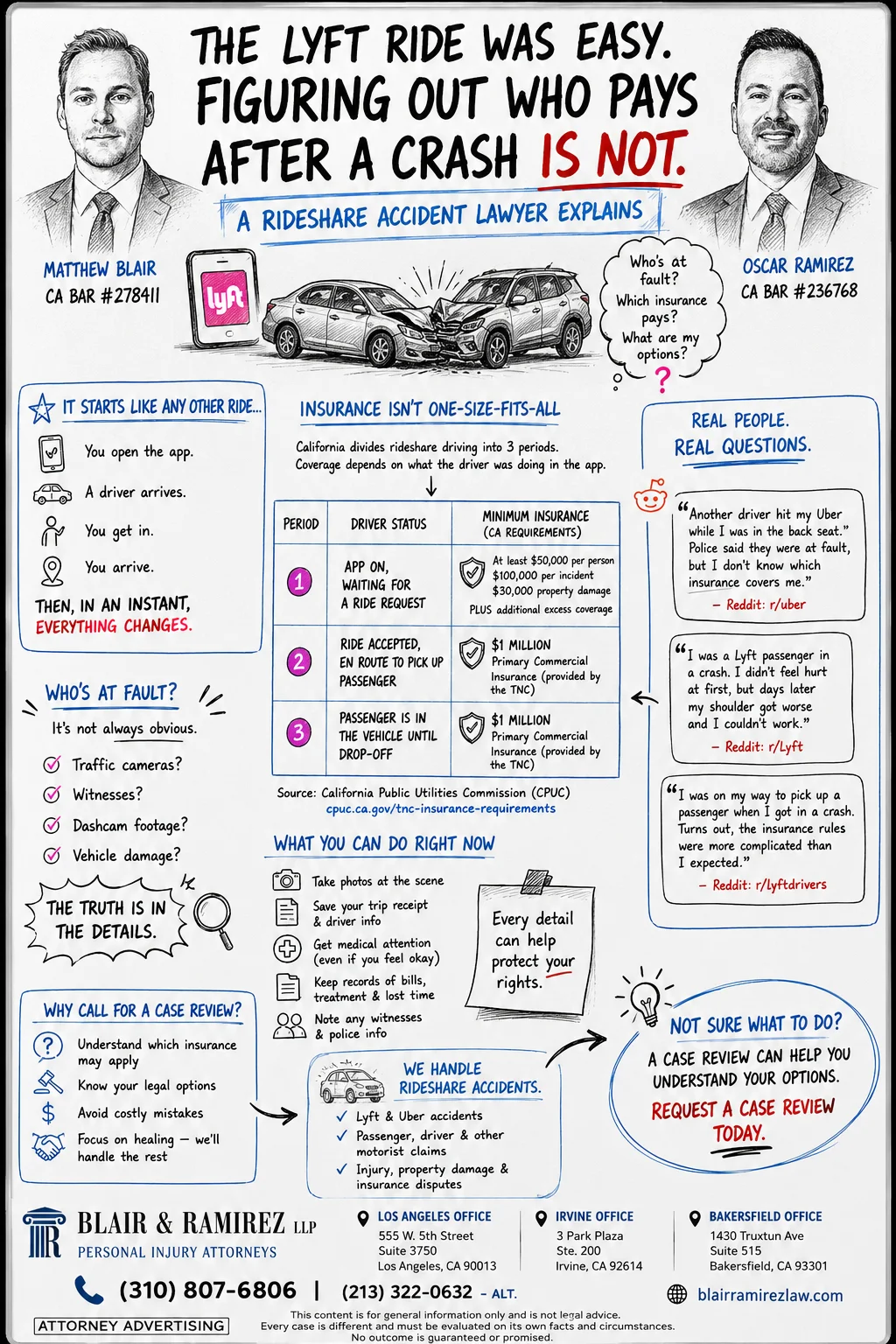
California divides rideshare driving into three periods.
|
Rideshare Period |
Driver Status |
Minimum Insurance Coverage in California |
|
Period 1 |
App is on, waiting for a ride request |
At least $50,000 per person for death and personal injury, $100,000 per incident, $30,000 for property damage, plus additional excess coverage requirements |
|
Period 2 |
Ride accepted, en route to pick up passenger |
$1 million primary commercial insurance (provided by the TNC) |
|
Period 3 |
Passenger is in the vehicle until drop-off |
$1 million primary commercial insurance (provided by the TNC) |
(Source: California Public Utilities Commission)
For Period 1, California requires lower primary coverage with additional excess coverage. For Periods 2 and 3, the California Public Utilities Commission requires at least $1 million in primary commercial insurance provided by the rideshare company.
So, think about two crashes.
In the first, a Lyft driver is cruising around with the app open but has not accepted a passenger.
In the second, that same driver has accepted your ride and is driving to pick you up.
Same driver.
Same car.
Same app.
Different point in the trip.
That is one reason a rideshare accident attorney may need to establish exactly what happened before determining which insurance coverage may apply.
Who Was Driving When It Happened?
Now comes the harder question.
Who caused the crash?
Let’s say you are sitting in the back of a Lyft when a pickup truck changes lanes and hits your vehicle. The Lyft driver says the truck moved into the lane without warning. The truck driver says the Lyft driver was speeding.
Who is telling the truth?
Maybe there is a traffic camera.
Maybe there is a witness.
Maybe the Lyft has a dashcam.
Maybe the damage to both vehicles tells a different story.
That is why we encourage people involved in crashes to preserve what they can. Save the trip receipt. Keep photographs. Record the driver’s information. Keep medical records and bills. Note witness information. Do not assume the details will still be easy to find later.
The California Public Utilities Commission also states that TNC drivers must provide proof of both their personal insurance and their commercial TNC insurance after an accident.
That is not just paperwork.
It can help identify the insurance coverage involved.
Your Body May Tell a Different Story
Here is another common problem.
You feel fine at the crash scene.
So, you go home.
The next morning, your neck hurts.
Two days later, your back hurts.
A week later, you realize you cannot work a full shift without pain.
What changed?
Sometimes an injury simply takes time to become obvious.
One recent Reddit post came from a Lyft passenger whose vehicle was rear-ended. The passenger initially did not plan to see a doctor but later sought medical care after developing a shoulder injury that affected the person’s ability to work.
That is a useful example because it raises a question many people face:
What if the accident affects your life more than you first thought?
Medical treatment may become part of the story. So may missed work, vehicle damage, and other accident-related losses.
At Blair & Ramirez LLP, our rideshare accident practice considers these issues when evaluating injury claims. We handle cases involving Lyft and other rideshare vehicles, including claims involving passengers and other people injured in collisions.
The App May Know What You Don’t
Your memory is important.
But your phone may have something even more useful: a record of the ride.
Think about it.
The app may show when the trip began. It may show the pickup location. It may identify the driver and vehicle. Your receipt can establish the trip. Other records may help establish the timing and circumstances surrounding the collision.
And timing can matter.
At Blair & Ramirez LLP, we look at the circumstances surrounding the collision rather than assuming every rideshare accident follows the same pattern. Our Lyft accident materials only discuss issues such as the driver’s status, insurance coverage, and the circumstances of the crash.
What If the Other Driver Had No Insurance?
There is no universal answer. A person may legally represent themselves in some proceedings. But a complex rideshare assault claim can demand far more than telling a clear story.
The current Uber terms alone show why. Uber says covered disputes generally go to individual binding arbitration, and the agreement includes claims involving personal injury, including sexual assault and harassment claims connected to use of its services.
That can change the entire strategy.
A person asking “do I need a lawyer to sue Uber for assault” should first understand whether there is a court lawsuit to file, whether arbitration applies, what claims may exist, and what evidence supports them.
That is a very different task from filling out a form.
Now make the situation even harder.
The Lyft driver was not at fault.
Another driver caused the crash.
But that driver has little or no insurance.
What happens then?
This is not just a theoretical question.
The answer depends on the facts and the applicable coverage.
California’s TNC rules include specific insurance requirements for rideshare trips, and the state’s insurance framework also addresses uninsured and underinsured motorists.
That is why we do not tell people that every rideshare accident has the same answer.
It doesn’t.
A Lyft accident lawyer may need to look at the driver’s status, the other driver’s insurance, the accident report, the injuries, and the available evidence before explaining what options may exist.
Don’t Let the First Offer Answer Every Question
Suppose an insurance company contacts you.
They make an offer.
It sounds reasonable.
Should you accept it?
That depends.
Have you finished medical treatment? Do you know how much work you may miss? Do you know whether the injury will affect you later? Do you understand exactly what the proposed payment covers?
These are not small questions.
A person searching for a Lyft accident attorney may not be looking for a courtroom battle. They may simply want someone to explain what the insurance company is offering and what legal options may be available.
That is a reasonable reason to request a case review.
At Blair & Ramirez LLP, we handle Uber and Lyft accident claims and provide information about the legal issues that can arise after these collisions.
The first step does not have to be dramatic.
Sometimes it is simply understanding what happened.
Frequently Asked Questions
Key Takeaways
- California uses different insurance requirements depending on the rideshare driver’s status when a collision occurs.
- The question of who caused the crash can affect which insurance coverage becomes relevant.
- Trip receipts, app information, photographs, medical records, and witness accounts may help establish what happened.
- An injury that seems minor immediately after a crash can become more disruptive later, including through medical treatment or missed work.
- A case review can help someone understand potential legal options without requiring an immediate decision about representation.
A Simple Ride Can Leave Complicated Questions
A rideshare trip can be ordinary right up until the moment it isn’t.
You may start the ride thinking about dinner.
Then there is a crash.
Now you are thinking about your neck. Your car. Your paycheck. Your medical bills. The police report. The insurance company.
And one question keeps coming back: Who is supposed to pay for all of this?
There is no single answer for every Uber or Lyft accident. The driver’s status, the cause of the collision, the insurance policies involved, and the nature of the injuries can all matter.
At Blair & Ramirez LLP, we handle rideshare accident matters in California and provide information about the legal issues that may arise after a collision.
If you are trying to understand what happened after an Uber or Lyft accident, contact Blair & Ramirez LLP to request a case review and learn more about your legal options.