


TL;DR
A wrongful termination claim may arise when an employer fires someone for an illegal reason, such as discrimination, retaliation, or violating a basic public policy. It's important to find out what happened and what proof you can find.
Getting fired can make the world tilt.
Let’s say you’re very busy at work. You’re answering emails, finishing tasks, and planning for next month.
Then, out of the blue, your boss says you are fired. They might say it’s because of your performance or because the company is changing. But sometimes, their reasons sound fancy but really don’t make sense.
Then you start to wonder:
- Was this about my work?
- Why did my boss start pointing out my mistakes after I said something about harassment?
- Why did they suddenly notice things they didn’t before?
Those questions are not just emotional reactions. They might show that the reason your boss gave isn’t the real reason you lost your job.
In California, employers usually can fire employees whenever they want, but there are rules. They can’t fire you for illegal reasons, like discrimination or revenge.
So, the big question is: What really happened?
Why Does Wrongful Termination Matter?
Just because you have a bad boss doesn’t mean what they did was against the law.
An employer can usually fire someone for any legal reason, even if it seems unfair. But if someone uses a made-up reason to cover up an illegal one, that’s where it gets serious.
Here are some examples:
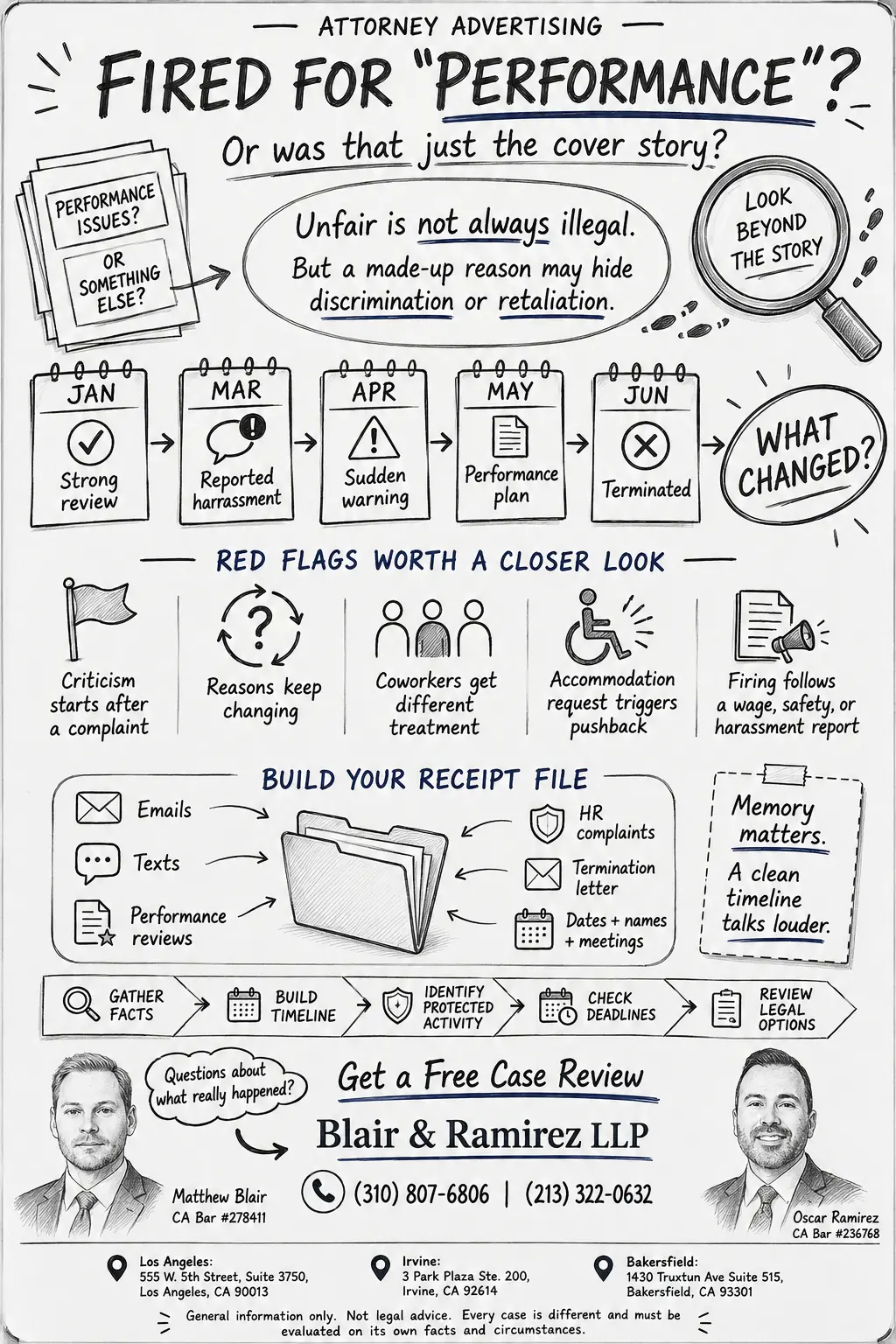
- Let’s say a worker reports sexual harassment, and then a week later, they suddenly hear their work is "not good enough" after getting good reviews for years.
- Or think about someone who reports not getting paid enough. Soon after, their boss cuts their hours and then fires them.
- What about someone who asks for help because of a disability, and all of a sudden, their boss treats them badly?
What changed?
Just because the timing seems strange doesn’t mean it proves you were fired for the wrong reason, but it makes us ask important questions about why you were really fired.
California’s Labor Commission says that if you did something protected (like reporting bad behavior) and then your employer took negative action against you, there’s likely a link between the two.
That is why wrongful termination claims often focus on the story behind your firing, not just the firing itself.
|
What happened? |
Why it may matter |
|
You reported unlawful conduct |
Could involve retaliation |
|
You complained about discrimination |
May trigger legal protection |
|
You requested a protected accommodation |
Retaliation or discrimination may be an issue |
|
You reported certain safety or wage problems |
California law protects many forms of reporting |
|
You were fired soon after protected activity |
Timing may be important evidence |
|
Your employer gave shifting reasons |
May raise questions about pretext |
The facts still matter. Every case needs its own review.
Is Your Firing Unlawful?
Here is where things get tricky.
In California, if you are an at-will employee, it often means your boss can fire you without giving a specific reason. But there are limits.
Sometimes, firing someone breaks important laws. The California Supreme Court case Green v. Ralee Engineering Co. showed that some firings could be against public policy.
There are also laws against discrimination. The Fair Employment and Housing Act says you can’t be fired for things like your race, sex, age, disability, religion, or pregnancy.
So, ask yourself:
- Was I treated differently because of my race, sex, or other protected traits?
- Did I complain about discrimination?
- Did I tell someone about illegal actions?
- Did I ask for my rights under California law?
- Did my boss punish me after that?
These questions can help you decide if your firing was just unfair or illegal.
How Do Employees Prove Retaliation?
This is where evidence becomes incredibly important.
Your memories are valuable, but papers and emails can tell the story much better. Save your emails, keep text messages, and hold onto performance reviews. Write down dates, names, meetings, and what people said.
It’s important because employment cases often rely on timelines.
Consider this simple example:
- January: Employee receives a strong performance review.
- March: Employee reports harassment.
- April: Employee receives a sudden warning.
- May: Employee is placed on a performance plan.
- June: Employee is fired.
Does that automatically prove retaliation? No, but it makes us ask: What changed between January and March?
The case Yanowitz v. L’Oréal USA, Inc. shows why these events matter. The worker said no to a wrong order and faced more problems at work afterward. The court decided that this behavior could show retaliation.
The key point is that retaliation doesn’t always look like someone saying, “I’m firing you because you complained.” Sometimes it looks like sudden changes or new criticism.
How to File a Wrongful Termination Claim?
First, slow down and gather the facts.
Start with your termination letter (if you got one). Collect important emails, texts, reviews, and any complaints you made.
Then, create a timeline. Write down what you reported, what happened after, and when you were fired.
Next, check the possible legal options. In California, if you want to report discrimination under FEHA, you usually have three years to do it. For federal claims, it might be up to 300 days, depending on the situation.
Retaliation claims have different rules too. For many of these, you need to file within one year.
Remember, not all wrongful terminations are the same, and there are different deadlines for different claims.
Possible path: Gather evidence → Build timeline → Identify protected activity → Check deadlines → Review available legal options
And always check which deadline applies to your situation, because one deadline doesn’t fit all.
Is a Wrongful Termination Lawsuit Worth It?
That depends on the facts.
Filing a lawsuit can be serious. It often costs a lot of money. It can be very stressful. And it takes a lot of time. But sometimes it is important if your boss might have broken the law.
But should every worker who is upset about losing their job file a lawsuit? No.
That would be bad advice. The real question is whether the facts support a legal argument and if the possible outcomes make sense for your case.
The Green decision by the Supreme Court is helpful here. It shows that feeling like your firing was unfair isn’t enough. There must be a strong connection to a serious legal issue.
Recent research about workplaces supports this idea.
In January 2026, Thomas H. Davenport and Laks Srinivasan of the Harvard Business Review talked about how some companies were letting workers go based on what they think AI might do in the future instead of the actual work performance of the employees. This research surveyed 1,006 company leaders and raised concerns about layoffs influenced by AI.
The article also discussed the human side of job loss. An executive coach named Dina Denham Smith said that while leaders can’t always take away fear, they can help ease it by being clear and caring in their communication. She said, “Your team members don't expect or need 100% certainty—they need orientation and line of sight.”
This idea is important for workers, too. If a company says you lost your job because of your work, but the facts point to a bigger issue, like discrimination or retaliation, it’s vital to understand what happened.
Sometimes the answer is simple. Other times, it’s not.
Why Talk to a Wrongful Termination Lawyer?
You don’t have to have all the answers before speaking to a lawyer. That’s what a consultation is for.
A wrongful termination lawyer can look at your timeline, review documents, find legal issues, and explain your options. Not every case leads to a lawsuit, but understanding the details can help clarify what to do next.
At Blair & Ramirez LLP, our employment lawyers help workers with wrongful termination, discrimination, retaliation, harassment, and other employment problems. Our goal is to help clients know their rights and seek compensation under California law.
It’s also smart to organize your facts early.
Why? Because evidence can disappear. People forget conversations, emails get lost, and deadlines can pass. Keeping a clear record makes it easier to understand what happened.
Frequently Asked Questions
Key Takeaways
- Feeling your termination is unfair doesn’t always mean it was illegal; the reason is important.
- Discrimination and retaliation can lead to wrongful termination claims.
- Emails, performance reviews, and a clear timeline can help explain what happened.
- California and federal laws have different rules for filing claims and deadlines.
- A consultation can help you understand the best legal options for your situation.
Your Job Ended. Your Questions Don’t Have To.
Getting fired can leave you feeling angry, confused, and worried about what to do next. But you don’t have to guess what it all means.
- Was the reason they gave you the real reason?
- Did things change after you complained?
- Did your boss treat you differently than other workers?
- What records could help explain your situation?
These are important questions to ask.
Blair & Ramirez LLP can help with California employment issues like wrongful termination, discrimination, and related problems. A free consultation can help you explain what happened, look at the facts, and learn about your legal options.
Contact Blair & Ramirez LLP today to request a consultation and get a clearer idea of your options.