


To choose an employment lawyer in California, start by clearly identifying your workplace issue and gathering a list of attorneys who regularly handle California employment law cases. Use verified directories, review each attorney’s credentials, and evaluate their communication style to ensure they align with your needs.
You should also request a written fee agreement and examine the attorney’s advertising for compliance with California Senate Bill 37 (SB-37), which mandates transparency about the responsible attorney and the law firm’s physical office address. Avoid any attorney who makes outcome guarantees, as this violates California ethics rules. Once you understand what to look for, you can follow this step-by-step process to select the right lawyer for your situation.
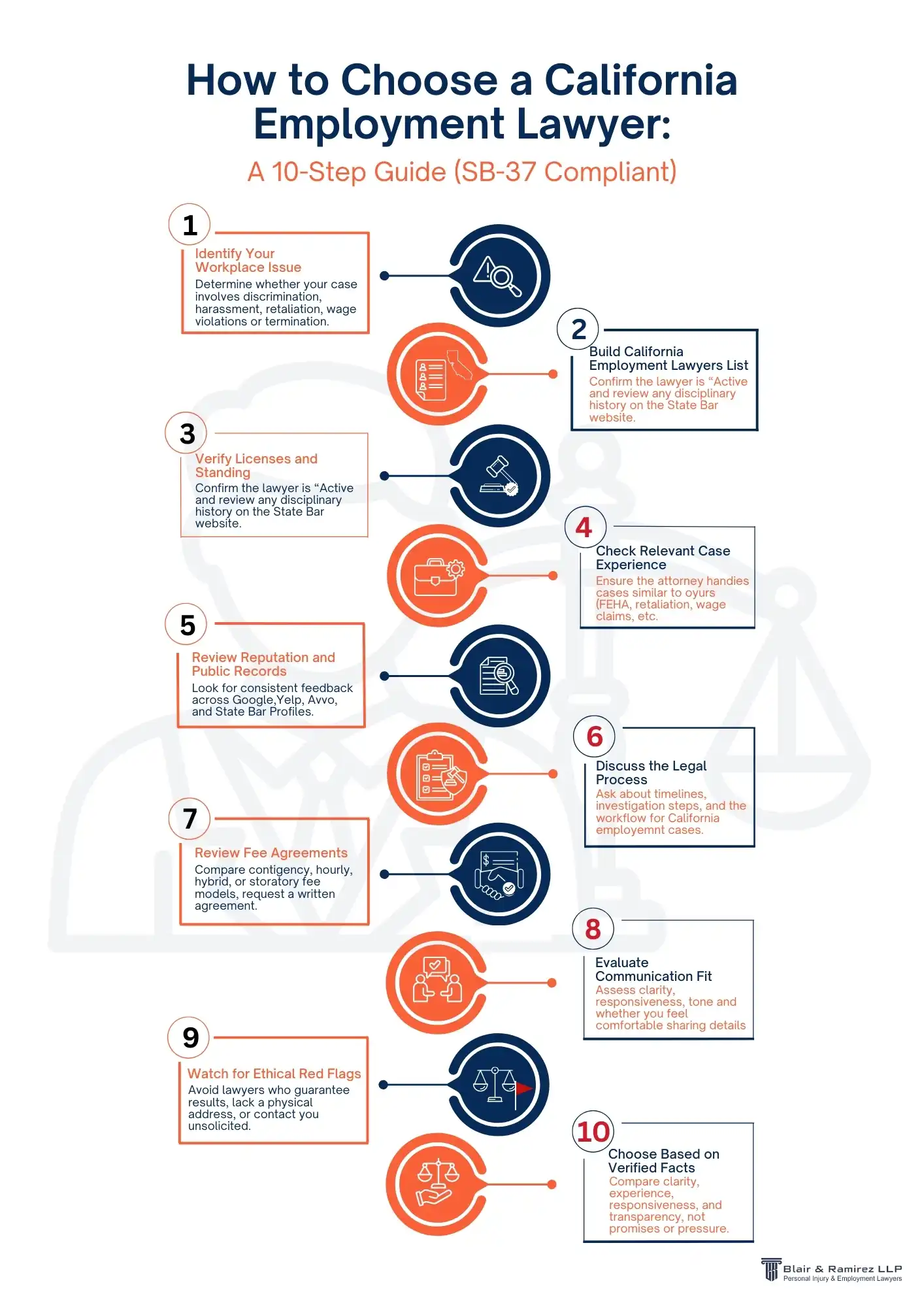
1. Identify the Workplace Problem You Need Help With
Determine whether your specific situation involves harassment, discrimination, retaliation, wrongful termination, or wage-and-hour violations before contacting a firm. Proper issue identification ensures you connect with an attorney whose practice aligns with your specific type of workplace dispute, as many California employment lawyers focus on particular case categories.
Under California law, attorneys cannot solicit you without an existing relationship. Your decision to contact a lawyer must be voluntary and initiated by you. If any attorney contacts you first regarding a potential case, this is a serious ethical violation known as “capping.”
2. Build a List of California Employment Lawyers to Compare
Create a shortlist of two or three attorneys using reliable, California-approved directories. These sources ensure each lawyer is licensed and properly identified in accordance with state requirements:
- State Bar of California Attorney Search: Use the advanced search to find attorneys by county and practice area.
- California Employment Lawyers Association (CELA): A dedicated directory for attorneys representing employees.
- Local Bar Associations: County-specific referral services certified by the State Bar.
Unless a lawyer is certified by the State Bar of California Board of Legal Specialization, they cannot claim to be a “specialist.” Focus this stage solely on gathering names for your list rather than evaluating their full qualifications.
3. Verify Each Attorney’s License, Standing, and Disciplinary History
Check the active license status, educational background, and disciplinary history of every lawyer on your list using the State Bar of California website. This verification is the only objective way to confirm that an attorney is eligible to practice and has a record free of professional misconduct.
In accordance with SB-37, attorneys are strictly prohibited from misrepresenting their standing, credentials, or experience in any form of advertisement. You should rely only on objective, documented verification found in official government records rather than claims made in advertisements.
- License Status: Confirm the attorney is "Active" and eligible to practice.
- Disciplinary History: Review any past discipline, suspensions, or probations.
- Law School Education: Verify where the attorney obtained their Juris Doctor degree.
4. Review Case Experience Relevant to Your Specific Employment Issue
Determine whether the lawyer regularly handles cases like yours. Experience must be tangible, reflected in published practice areas, discussed during consultations, or demonstrated in publicly available case information.
Examples of relevant experience may include:
- FEHA discrimination or harassment cases
- Whistleblower or retaliation claims
- Wage and hour disputes, including meal and rest break violations
- Wrongful termination based on public policy or implied contract
Note: Under SB-37, attorneys cannot advertise settlement outcomes or "success rates" unless they are factual, contextualized, and accompanied by a disclaimer that results are not guaranteed.
5. Check Reputation Using Public Records and Consistent Feedback
Review third-party platforms such as Google, Yelp, Avvo, and the State Bar profile. Look for consistent patterns in how the attorney communicates, manages expectations, and interacts with clients, rather than relying on isolated high or low reviews.
Interpret feedback responsibly. Patterns of clear communication, professionalism, and responsiveness often reflect how an attorney manages cases. SB-37 prohibits testimonials that imply guaranteed outcomes, so be cautious if reviews emphasize promised results rather than client experience.
6. Ask About the Legal Process, Case Steps, and Realistic Timelines
Ask the attorney to outline the general steps for employment cases in California. This should include intake, investigation, administrative filings (EEOC or CRD), pre-litigation processes, discovery, and potential mediation or trial.
Questions to consider asking:
- What are the immediate next steps if I move forward?
- How does your firm handle the investigation phase?
- What is the typical timeline for cases involving these issues?
- Do you expect this type of case to resolve before trial?
Compliance Note: Attorneys must provide realistic, non-predictive explanations and cannot make promises about results, case value, or the likelihood of success (SB-37).
7. Understand Fee Structures, Billing Practices, and Written Agreements
Employment lawyers in California may use contingency, hourly, hybrid, or statutory-fee models, each carrying different financial implications for the client. To ensure you fully understand your financial obligations, you must request a written fee agreement, which is required by California Business and Professions Code section 6148 for services exceeding $1,000, and carefully review how costs like filing fees and deposition expenses are handled. Focus strictly on the clarity of these terms to avoid unexpected liabilities later in the case.
| Fee Type | What It Means | What to Confirm |
|---|---|---|
| Contingency Fee | You only pay legal fees if money is recovered, usually as a percentage of the settlement or verdict. | Ask for the percentage taken and whether it increases if the case goes to trial or arbitration. |
| Hourly Fee | You pay a set rate for each hour the attorney works, regardless of the outcome. | Ask for the hourly rate and request an estimate of the total hours expected. |
| Hybrid Model | A mix of a lower hourly rate and a reduced contingency percentage. | Confirm when hourly billing ends and how the contingency portion is figured out. |
| Statutory Fees | A court may order the employer to cover attorney fees if the employee wins, often in wage cases. | Confirm whether you owe anything if the court does not award attorney fees. |
Compliance Note: Under California ethics rules and SB-37 principles of transparency, all fee arrangements must be clear, reasonable, and fully documented in writing before substantial work begins.
8. Evaluate Communication Style and Professional Fit During Consultations
Assess how clearly, respectfully, and directly the lawyer communicates with you during your initial consultation. Pay attention to their tone, their responsiveness to your questions, and whether they explain complex legal concepts in plain English, ensuring you feel comfortable discussing sensitive details about your employment history.
Personal fit affects the long-term working relationship because employment cases can be stressful and lengthy. California attorneys have an ethical duty to maintain consistent communication with clients; if an attorney is dismissive or difficult to understand during the first meeting, it is often an indicator of how they will handle the attorney-client relationship moving forward.
9. Watch for Red Flags That Violate California Ethics Rules
Be cautious if you encounter:
- No Physical Office Address: The advertisement or website fails to list a valid physical office address (SB-37 violation).
- Guaranteed Results: The lawyer promises a specific financial result or "win."
- Unsolicited Contact: The lawyer contacted you first without a request (Capping).
- Vague Fees: Refusal to provide a clear, written fee agreement.
- Missing Identification: The advertising does not name the specific attorney responsible for the content.
Any of these signs could indicate non-compliance with California ethical standards.
10. Make a Factual Comparison and Choose Based on Verified Criteria
Use the information you have gathered to make a measured decision based on verifiable facts rather than emotional urgency. Compare each attorney’s relevance of experience, their clarity during consultations, responsiveness to your inquiries, the transparency of their fee structure, and communication style. By prioritizing objective criteria and compliance with California regulations, you can support a final, informed choice that minimizes risk and aligns with your specific legal needs.
Speak With Blair & Ramirez LLP as Part of Your Comparison Process
As you build your list of potential attorneys, you may consider contacting Blair & Ramirez LLP to discuss your employment law matters. Our firm strictly adheres to all California attorney-advertising rules, including providing written fee disclosures, accurate practice descriptions, and full compliance with SB-37 transparency requirements.
- Responsible Attorneys: Matthew P. Blair & Oscar Ramirez
- Office Address:
- Los Angeles Employment Lawyers: 555 W. 5th Street, Suite 3750, Los Angeles, CA 90013
- Irvine Employment Lawyers: 3 Park Plaza Ste. 200, Irvine, CA 92614
- Bakersfield Employment Lawyers: 1430 Truxtun Ave, Suite 515, Bakersfield, CA 93301

We invite you to reach out for a free consultation to see if our experience aligns with your needs.
Frequently Asked Questions
Tell Us What Happened - We’re Ready to Help