


TL;DR
Understanding how local courts handle employment cases can help us follow a sometimes confusing legal process. Recent cases in California show that judges pay attention to agreements, claims, and what both sides did before asking the court for help.
Have you ever thought about what happens if someone loses their job? It can bring up a lot of questions. Was the firing legal? Did your employer break a promise? What if you complained about discrimination, harassment, unpaid wages, or unsafe conduct and then lost your job?
Another important question is: how do local courts handle employment cases like these?
The answer isn’t always just “you file a lawsuit, then you see a judge.” In California, employment cases can go down different paths. A court may first decide if the case should even be in court. It might check an agreement that says someone has to go to arbitration, which is a way to settle a dispute outside of court. The court might look closely at what both the employer and the employee did after the lawsuit started.
Recent California cases show how important these details can be.
How Employment Cases Reach Local Courts
A problem at work usually starts long before anyone walks into a courtroom.
Let’s say a worker loses their job after telling someone their boss was being mean. Or maybe an employee feels the company didn’t help them when they asked for special equipment due to a disability. Sometimes, the employer says the employee was fired because they weren’t good at their job.
The first big question is this: What legal claim does the employee have?
A wrongful termination claim doesn’t just mean someone thinks they were fired unfairly. In California, the law protects workers from being fired for certain illegal reasons, like retaliation (getting back at someone) or discrimination (treating someone unfairly because of who they are).
And then there’s the idea of arbitration. Many workers sign papers that include arbitration clauses. These clauses can say that when there’s a problem, it must be solved by an arbitrator instead of a court.
But does signing one of these clauses always mean you can’t go to court? Recent decisions say no.
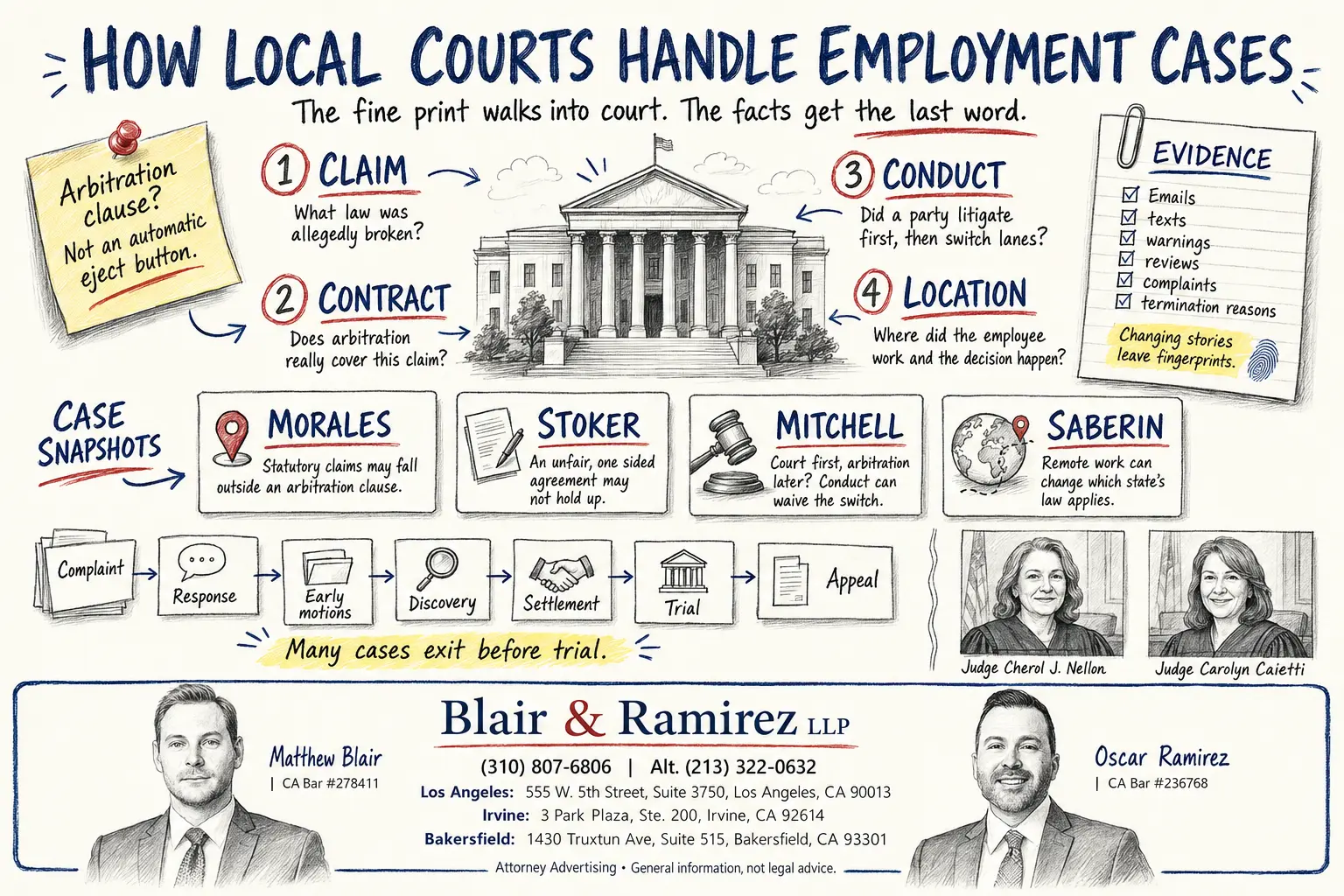
In Morales v. Superior Court, decided August 3, 2026, the California Court of Appeal looked at a case involving Sylvia Morales, who used to work for San Diego Gas & Electric. She claimed she was treated unfairly because of a disability and faced retaliation after she complained.
The trial court told her to go to arbitration, but the Court of Appeal disagreed.
Judge Carolyn M. Caietti carefully studied what the arbitration clause said. Caietti found out that her claims were based on rights that are protected by laws, not just her employment agreement. So, she told the trial court not to let the employer force her to go to arbitration.
This shows an important point: courts don’t just look at the words “employment” and “arbitration.” They read what the agreement covers carefully.
How the Employment Lawsuit Process Works
Once an employment case goes to court, what happens? You can think of it like going through several gates. Here’s how it works:
|
Stage |
What may happen |
|
Complaint |
The employee explains the legal claims |
|
Response |
The employer answers or challenges the claims |
|
Early motions |
The court may decide key legal issues |
|
Discovery |
Both sides gather documents and other evidence |
|
Settlement talks |
The parties may try to resolve the dispute |
|
Trial |
A judge or jury hears the evidence if the case gets that far |
|
Appeal |
A party may challenge certain rulings |
But things don’t always go smoothly from one step to the next.
One side might ask the court to send the case to arbitration, while the other side might disagree with that decision. The court may say that some claims can go ahead while others cannot.
That is why understanding how local courts handle employment cases requires more than knowing the basic lawsuit timeline.
Let’s look at Stoker v. Blue Origin, LLC, decided April 24, 2026.
This case involved Craig Stoker, a former employee who sued Blue Origin. He claimed he faced sexual harassment and was wrongfully fired.
Blue Origin wanted the court to make him go to arbitration.
Judge Cherol J. Nellon said no. The case then went to the California Court of Appeal, which agreed with her decision.
The appellate court found problems with the arbitration agreement. They said it was unfair because it was a “take-it-or-leave-it” contract. It gave too much power to the employer and was not balanced.
This is important because it shows what can happen when a work agreement gives bosses too much control over their employees.
How Do Employment Lawsuits Work
Here is where things get interesting.
Let’s look at why an employment lawsuit isn’t just about what happened at work. Courts also care about what happens after the lawsuit starts.
Consider Mitchell v. Lilac Solutions, Inc., published August 20, 2026.
Four former employees sued their old bosses for wrongful termination and other claims. These employees had signed arbitration agreements.
At first, it seemed like an easy case for arbitration, but it wasn’t.
The defendants (the people being sued) took part in the court case by filing answers and gathering evidence. They acted like they wanted to go through the court process but later wanted to go to arbitration instead.
The Alameda County Superior Court decided that the defendants couldn’t switch to arbitration after they already took part in the court process. The Court of Appeal agreed with this decision.
So, why does this matter? It shows that you can’t simply act like you want to go to court and then change your mind later.
The lesson is clear: actions matter a lot. Courts can look at what both sides did, not just what the papers say.
How Employment Law Court Process Works
When it comes to employment cases, evidence is really important.
This means all kinds of details can make a big difference. For example, we might ask:
- What emails exist?
- What did the manager say?
- Was there a written warning?
- Did the employer give a specific reason for firing the employee?
- Did that reason change later?
We also look at texts, performance reviews, personnel records, complaints, and messages between supervisors. All these details can shape a case and help explain what really happened.
A Case That Raises Questions
There was a recent case that involved a remote worker, which shows a tricky problem California courts sometimes face.
In Saberin v. Alation, Inc., decided on July 30, 2026, a worker lived in Utah but worked for a company based in California. After the worker was arrested in Florida (but was not convicted), the company fired him. He said that the firing was against California laws that protect workers from being fired due to arrests that did not lead to a conviction.
This case raised a tough question: When does California employment law protect someone who works from another state for a California company?
The case began in a court in San Mateo County and then moved to arbitration. The Court of Appeal had to think about whether California law applied at all.
This case shows that where a person works can really matter.
An employer might be based in California, but if an employee works from another state, and the firing decision happens somewhere else, the question becomes complicated. “Which law applies?” is not an easy question to answer.
For employees, knowing the details around their job can matter almost as much as the job itself.
How the Wrongful Termination Process Works
In wrongful termination cases, it’s important to understand why the employer fired the worker:
- Was the employee fired because of discrimination?
- Were they punished for speaking up about something wrong?
- Did they have a disability?
- Or did the employer have a good reason that didn’t relate to any of those issues?
In California, most jobs fall under at-will employment. This means an employer can fire someone for almost any reason, but they can’t violate the law when doing it.
The Morales case (reviewed above) made this clear. Morales didn’t argue that San Diego Gas & Electric broke her employment contract. She argued that her firing violated legal protections. The Court of Appeal treated her claims as separate from any argument about her employment contract.
And Stoker adds another layer. This case involved an arbitration agreement that the court found unfair. The court said the agreement was too broad and didn’t treat the employer and employee fairly. It also identified problems with parts of the agreement about jury trials and group claims.
What Does This Mean for Employees?
For someone who has just lost their job, this means the firing itself is just one part of the story. The reason for the firing matters, the documents are important, how the employer acted matters, and what the employee did matters. Even the exact wording of agreements can play a role.
That’s a lot to think about. But it’s also why carefully checking all the facts is so important.
Frequently Asked Questions
Key Takeaways
- California courts look closely at the specific claims and agreements in employment disputes.
- An arbitration clause does not always mean an employment case must leave court.
- A party’s conduct during litigation can affect whether arbitration remains available.
- Wrongful termination cases often turn on the reason for the termination, not simply the fact that someone lost a job.
- Location can matter, especially when remote work crosses state lines.
When the Fine Print Can Change the Whole Case
Employment disputes rarely have clear answers.
A termination letter might say one thing, but emails might tell a different story. An employment agreement could seem broad but not cover every claim. Plus, what happens during the lawsuit can change everything.
California cases show us this again and again. If you need help understanding your rights after losing your job or dealing with any work problems like discrimination, harassment, retaliation, or unpaid wages, Blair & Ramirez LLP can guide you through your legal options. Our employment lawyers represent employees in workplace disputes in California and help with all stages of litigation.
If you’d like to talk about your specific situation, request a consultation with Blair & Ramirez LLP to understand what options may be available to you.
Attorney Advertising: This article provides general information and is not legal advice. Every employment case is unique, and the outcome depends on specific facts and applicable laws.