

TL;DR
What are the emotional and career impacts of gender discrimination? They can affect how a person feels, earns money, does their job, and moves forward. At Blair & Ramirez LLP, we help people understand their legal options when workplace treatment raises questions about discrimination.
Have you ever watched someone get the chance you worked for?
Maybe you both wanted the same promotion. You had similar skills. You worked just as hard. But your boss picked the other person.
Why?
What if the boss keeps giving the best projects to men? What if a woman gets called “too emotional” for speaking up, while a man gets called “confident” for doing the same thing?
Small things can add up.
At Blair & Ramirez LLP, we work with people who have questions about workplace discrimination, harassment, retaliation, and other employment problems. We know that work is not just about a paycheck. It can affect your confidence, your plans, and your future.
So, what happens when unfair treatment starts changing all three?
Why Do the Emotional Effects of Gender Discrimination Matter?
How does unfair treatment make someone feel?
Think about going to work every day and wondering, “Will I be treated fairly today?”
That question can wear a person down.
A worker may start to feel worried, angry, embarrassed, or unsure of themselves. They may stop speaking up. They may wonder if they are not good enough.
But is the problem really the worker?
Sometimes, the problem may be the way the workplace treats that person.
A recent Supreme Court case, Stanley v. City of Sanford, involved disability discrimination rather than gender discrimination. The Court looked closely at who the federal disability law protects and when an employee can bring a claim. The case shows an important point: workplace rights often depend on the exact words of the law and the facts of the worker’s situation.
Think of it like a school rule. If the rule protects students from being treated unfairly for a certain reason, the reason for the treatment matters.
The same basic idea matters when looking at gender discrimination.
How Can the Career Impact of Workplace Discrimination Grow Over Time?
What happens if the unfair treatment (or workplace discrimination) does not stop?
Maybe you do not get the promotion.
Then you miss the higher salary.
Then you miss the chance to lead a team.
Then another company looks at your work history and sees fewer leadership roles.
See the problem?
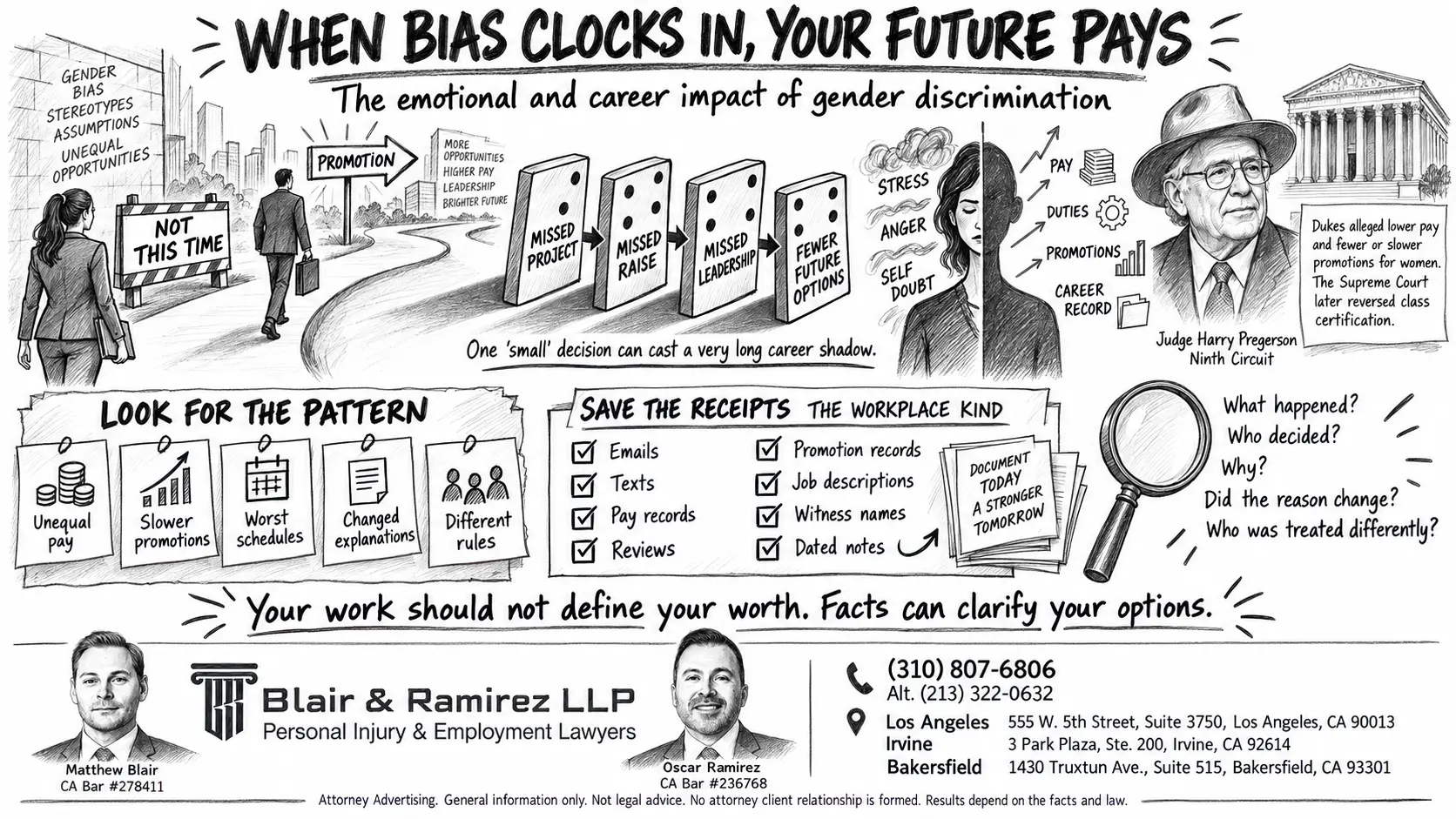
One workplace decision can affect the next one.
The Supreme Court’s Babb v. Wilkie decision involved age discrimination against a federal employee, not gender discrimination. The Court explained that, under the federal-sector age discrimination law at issue, age discrimination can violate the law even when age was not the only reason for the personnel action.
Why does that matter here?
Because workplace decisions can have more than one reason.
A boss might say, “We picked someone else because they had more experience.” But:
- What if other facts tell a different story?
- What if the worker had better results?
- What if the worker had more experience?
- What if the same boss had made similar comments about women before?
The facts matter. The real reason for a decision can matter too.
How Do the Effects of Gender Discrimination at Work Show Up?
Is discrimination always obvious?
No.
- Sometimes it looks like a rude comment.
- Sometimes it looks like a missed promotion.
- Sometimes it looks like lower pay.
- Sometimes it looks like getting the worst schedule again and again.
- And sometimes it looks like nothing unusual at all until you compare what happened to you with what happened to someone else.
The Supreme Court’s Comcast Corp. v. National Association of African American-Owned Media case involved race discrimination under a different federal civil-rights law. The Court focused on causation and explained that the plaintiff had to plausibly show that race was the “but-for” cause of the challenged conduct under that law.
The lesson is simple.
A worker may have to connect the unfair treatment to the protected reason.
For example:
- You: “I was passed over.”
- Important question: “Why?”
- More facts: “Was the other person treated differently?”
- More questions: “Did the manager make comments about women? Did the manager change the rules? Did the worker have the same qualifications?”
The more pieces you have, the clearer the picture may become.
How Can Workplace Gender Discrimination Affects Change a Person’s Future?
What if a worker leaves the job?
Does that mean the problem disappears?
Not always.
The worker may leave with less money, fewer chances, and a damaged work record.
A recent Supreme Court development also shows why the details of an employment claim matter. In Hittle v. City of Stockton, the Court declined to hear the case in March 2025. Justice Clarence Thomas, joined by Justice Neil Gorsuch, wrote a dissent from that denial and discussed concerns about how courts use the McDonnell Douglas framework in Title VII cases.
That case involved religious discrimination, not gender discrimination, and the Court did not issue a new merits ruling.
So, why mention it?
Because it shows how much attention courts continue to give the way discrimination claims are proven.
For a worker, that means one question can become many:
- What happened?
- Who made the decision?
- What reason did they give?
- Did that reason change?
- Were other workers treated differently?
- What documents support the story?
Those details can matter.
What Have Los Angeles Judges Said About Workplace Fairness?
Los Angeles has a long history of employment discrimination cases.
Judge Harry Pregerson, a longtime Ninth Circuit judge, took part in Dukes v. Wal-Mart, a major sex-discrimination class-action case. The women in that case alleged that female workers received less pay and fewer or slower promotions than men. The case later went to the U.S. Supreme Court, which reversed the Ninth Circuit’s class-certification ruling on the Rule 23 issue. So Pregerson’s opinion should be understood as part of that earlier stage of the case, not as the final word on the class-action question.
Judge Stephen Reinhardt also handled important employment discrimination cases while serving on the Ninth Circuit.
Why does this history matter?
Because workplace discrimination does not always look like one big event.
It can appear through patterns.
One person gets the promotion.
Another gets the raise.
Someone else gets the better assignment.
Then you look at the pattern and ask, “Why?”
That question can be important.
What Should You Do If Work Starts Feeling Unfair?
What should you keep?
Start with the basics.
|
What to Keep |
Why It May Matter |
|
Emails |
They may show what people said or decided |
|
Text messages |
They may show comments or changes in treatment |
|
Pay records |
They may help show pay differences |
|
Performance reviews |
They may show your work history |
|
Promotion records |
They may show who received opportunities |
|
Job descriptions |
They may help compare duties |
|
Notes about incidents |
They can help you remember dates and details |
Do not change or destroy records.
Write down what happened while it is still fresh.
- Who was there?
- What was said?
- When did it happen?
- What changed afterward?
These simple details can help you understand what happened.
And remember this: not every unfair workplace event is illegal discrimination. The reason for the treatment, the facts around it, and the law that applies all matter.
Frequently Asked Questions
Key Takeaways
- Gender discrimination can affect more than a person’s feelings.
- It can affect pay, promotions, duties, and future career chances.
- Unfair treatment is not always easy to spot.
- Emails, messages, pay records, reviews, and notes may help explain what happened.
- The law depends on the facts of each situation.
- Understanding your legal options can help you decide what to do next.
Your Work Should Not Define Your Worth
What happens when unfair treatment starts changing how you see yourself?
You may begin to think you are the problem.
But asking questions can be a better first step.
- What happened?
- Why did it happen?
- Was someone else treated differently?
- What records exist?
- What legal protections may apply?
At Blair & Ramirez LLP, we help people understand their options when workplace problems raise serious questions about discrimination, harassment, retaliation, or other employment rights. If you want to understand how the law may apply to your situation, you can request a consultation with us and discuss the facts of your case.
Attorney Advertising. Responsible Attorney: [Insert responsible California-licensed attorney name and State Bar number before publication.] Office: 555 W. 5th Street, Suite 3750, Los Angeles, CA 90013.