

TL;DR
So, why is a rideshare company liable for driver assault? It might depend on what the company knew and what it did to keep riders safe. But that doesn’t mean Uber or Lyft is always responsible for every bad thing that happens.
When you get into an Uber or Lyft, you just want a simple ride. You might be going home after dinner or heading to the airport. Sometimes, you just want to relax and get there safely.
But what happens if the driver starts acting strangely?
- What if the driver locks the doors?
- What if the driver threatens you?
- What if the driver touches you or attacks you?
Suddenly, this ride isn’t just bad; it’s scary.
And that brings up a big question: why is a rideshare company liable for driver assault when the driver is the one causing the harm?
When Is Uber Liable for Driver Assault?
Uber says its drivers are independent contractors. But does that solve everything?
Not really.
A company can still have responsibilities, even when a driver is not a full-time employee.
Think about a simple example: Suppose Uber gets a serious complaint about a driver who threatened a passenger. Uber knows about it, but the driver stays on the app and picks up more riders. Later, another passenger says that the same driver attacked her.
Later, another rider says that the same driver attacked her.
Now what?
A court might ask, what did Uber know? What did Uber do with that information? What steps, if any, did Uber take to keep riders safe?
It’s not just about saying, “The driver did it, so Uber has to pay.” The facts are important.
A recent federal case, Jane Doe v. Uber Technologies, shows this point. The court said Uber can’t automatically be responsible just because someone pretended to be an Uber driver.
But the court also said the person could continue with a claim against Uber for being careless. Why? Because Uber may have a responsibility to keep riders safe when its actions contribute to the problem. That’s a big difference.
So, What Does “Reasonable Care” Mean?
In simple words, it means taking smart steps to lower known dangers.
Let’s think of a store that knows its front door is broken. People keep tripping there, but the store does nothing. If someone gets hurt, the question isn’t just, “Who fell?” It’s also, “Did the store know there was a problem?”
Rideshare cases can raise similar questions:
- Did the company know about earlier complaints?
- Did anyone report threatening actions?
- Did the driver have a history that should have worried people?
- Did the company take the driver off the app?
- Did it put the driver back on the app later?
- Did the company keep riders safe with enough information?
These questions matter.
But there’s more: A company doesn’t have to guess about every terrible thing that might happen. And it’s not always responsible when someone gets hurt.
That’s why courts look closely at all the facts.
Why Might Lyft Be Liable for a Driver Assault?
Lyft has faced its own safety questions too. But not every claim against a rideshare company works out.
Like in Shikha v. Lyft, a Lyft driver was attacked by a passenger who stabbed him during a ride. The driver said Lyft should have checked passengers for criminal records. But the California Court of Appeal rejected that idea.
Why?
The court said Lyft didn’t have to check every passenger’s background. Plus, would checking every record really stop bad things from happening? Maybe. Maybe not. And what about privacy? Some people may have old records but are not dangerous. Others might not have any records at all but could still hurt someone. The court decided that what the driver wanted might go too far.
This case is crucial because it shows that just because something bad happens doesn’t mean Lyft has to be responsible. There must be a stronger link.
How Does a Rideshare Assault Lawsuit Work?
A rideshare assault lawsuit doesn’t only focus on the driver who attacked someone. It can also look at the company and what happened during the ride.
What took place before the ride? What happened during the ride? What happened after the assault? And are there any records?
For instance, if a passenger says the driver sent threatening texts before the ride, that could be important. Or if the passenger reported the driver through the app, that report might matter, too.
Now, if there were earlier complaints about that same driver, it raises another question: Did the company know about the danger before the next rider got in the car?
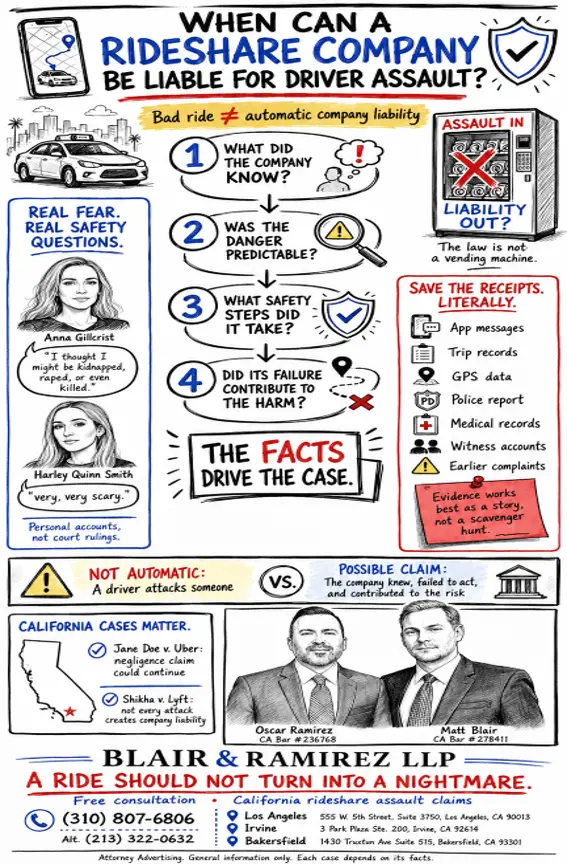
Some types of evidence can include:
|
What may exist |
Why it may matter |
|
App messages |
May show what happened before or during the ride |
|
Trip records |
Can show when and where the ride happened |
|
GPS data |
May help show the driver’s route |
|
Police report |
May document the assault |
|
Medical records |
May show the injuries |
|
Witness accounts |
May support what happened |
|
Earlier complaints |
May show what the company knew |
None of these items automatically win a case. But if you put them together, they might tell a much clearer story.
Why Does Driver Safety Matter?
This issue isn’t just something lawyers argue over. People using rideshare apps have talked about scary rides for years.
For example, actress Anna Gillcrist from Los Angeles shared her scary Lyft experience. She said the driver asked personal questions and didn’t unlock the doors when she asked to leave. She said, “I thought I might be kidnapped, raped, or even killed.”
That is her experience, not a court decision. But why does her story matter? It shows the fear that can come with getting into a stranger’s car.
Another actress, Harley Quinn Smith, experienced a very scary situation when two men in Los Angeles tried to trick her into thinking they were her Uber drivers. She said it was “very, very scary.”
Again, this doesn’t prove Uber was legally responsible for what happened, but it raises other questions: When a rideshare company connects strangers, what safety steps should it take? And what happens when those steps fail?
These questions are at the heart of many discussions about rideshare safety.
How Can a Rideshare Assault Lawyer Help?
After an assault, many people feel confused about what to do next:
- Should they report the driver?
- Should they tell Uber or Lyft about the incident?
- Should they keep the ride information?
- What if the app doesn’t show everything anymore?
- What if the driver sends another message?
- What if there were witnesses?
These details can be very important.
A rideshare assault lawyer can help by looking at the facts and explaining the legal options. This can include checking the driver’s behavior, company records, reports, messages, and other evidence. The goal is not to assume Uber or Lyft is automatically responsible. The goal is to find out the truth.
Take a look at this example: Let’s say a passenger reports a driver for threatening behavior. The company removes that driver. But months later, the same driver comes back, and another passenger reports an attack. That brings up some questions:
- What happened between those two events?
- Why was the driver allowed back?
- What records does the company have?
- Was there a warning?
- Was there a reason to believe another rider could face danger?
These questions are crucial and can shape a case.
What Does California Law Say?
California courts have looked at rideshare safety from different angles.
In the case Jane Doe No. 1 v. Uber Technologies, women said that attackers used fake Uber driver stories to trick them into getting into cars. The California Court of Appeal examined whether Uber’s way of doing business created the risk of those attacks.
The court didn’t just say, “Uber is responsible.”
Instead, it looked to see if the facts showed that Uber had a legal duty to protect the women from that specific danger. This detail matters a lot.
The law doesn’t work like a vending machine. You can’t just put in “assault” and expect to get “company liable” back. That’s not how it goes. Courts ask important questions:
- Was the danger predictable?
- Did the company know about it?
- Did the company create or increase the risk?
- Could the company have taken reasonable steps?
- And did those steps matter to what happened?
These questions can determine the outcome of a case.
Frequently Asked Questions
Key Takeaways
- Uber or Lyft is not automatically responsible for an assault by a driver.
- What the company knew and did can be very important.
- App records, messages, reports, and other evidence may help explain what happened.
- California courts have had different outcomes in rideshare safety cases.
- A free consultation can help someone understand their legal options after a rideshare assault.
A Ride Should Not Turn into a Nightmare
Most people don’t think twice before getting into an Uber or Lyft. Why would they? You open an app, see a name, see a picture, and get in the car. You expect to get home safely.
But when a ride turns into an assault, the questions become much bigger:
- What did the driver do?
- What did the company know?
- Did anyone report the driver before?
- And most importantly, what legal options are available now?
These questions deserve careful answers.
If you or someone you care about experienced an assault during a rideshare trip, Blair & Ramirez LLP can help you understand your legal options through a free consultation. We represent people hurt in Los Angeles and throughout California. You can request a consultation through our website.
Attorney Advertising. This article provides general information and does not create an attorney-client relationship. Each case is different and must be reviewed based on its own facts and circumstances.