


TL;DR
If you’re wondering what steps you should take after a bus accident before calling a lawyer, start with your health and your evidence. Get medical care, take photos, save records, note what happened, collect witness details, and identify the bus and company before learning about your legal options.
A bus ride can feel like one of the safest parts of your day. You sit down. You look out the window. Maybe you check your phone. Then, suddenly, the bus stops hard. You fall. Another car hits the bus. Or the driver makes a sharp turn, and people go flying.
What do you do next? What steps should I take after a bus accident before calling a lawyer?
Start with a few simple things. Get medical care. Take pictures. Write down what happened. Find witnesses. Save your papers. Find out which bus you were riding. These steps may sound small. But later, they may help you explain what happened.
What Should You Do Right After a Bus Accident?
First question: Are you hurt?
If you are, get medical care. Do not brush off pain just because you can still walk.
Why?
Some injuries do not hurt much at first. A person may feel fine after a crash. Then the pain starts that night. Or the next morning.
What if you feel fine?
You should still pay attention to how you feel. If pain, dizziness, swelling, or other symptoms show up, get medical help.
Next question: Can you safely take pictures?
If yes, take pictures of:
- The bus.
- Your injuries.
- Broken items.
- The road, traffic signs, and other vehicles.
Think about a person who falls when a bus stops without warning. What could help show what happened? It could be a photo of the bus, the person’s bruises, or the place where the person fell.
Simple evidence can tell a big part of the story.
The California Supreme Court’s 2025 decision in Gutierrez v. Tostado shows why the facts of an accident matter. The case involved a crash with an ambulance. The court looked closely at the type of duty involved and the facts behind the claim.
The lesson is simple: Do not assume every accident works the same way. The details matter.
How Can You Document the Steps After a Bus Accident?
What if you forget what happened?
That can happen. A crash can be scary. Your mind may race. You may remember the big moment but forget small details.
So, write things down:
- What time did the crash happen?
- Where were you?
- What bus were you riding?
- What was the bus number?
- What route was it on?
- Was the road wet?
- Was traffic heavy?
- Did the bus stop suddenly?
- Did another car hit the bus?
- Did you fall?
Write down what you remember as soon as you can.
Here is a simple way to think about it:
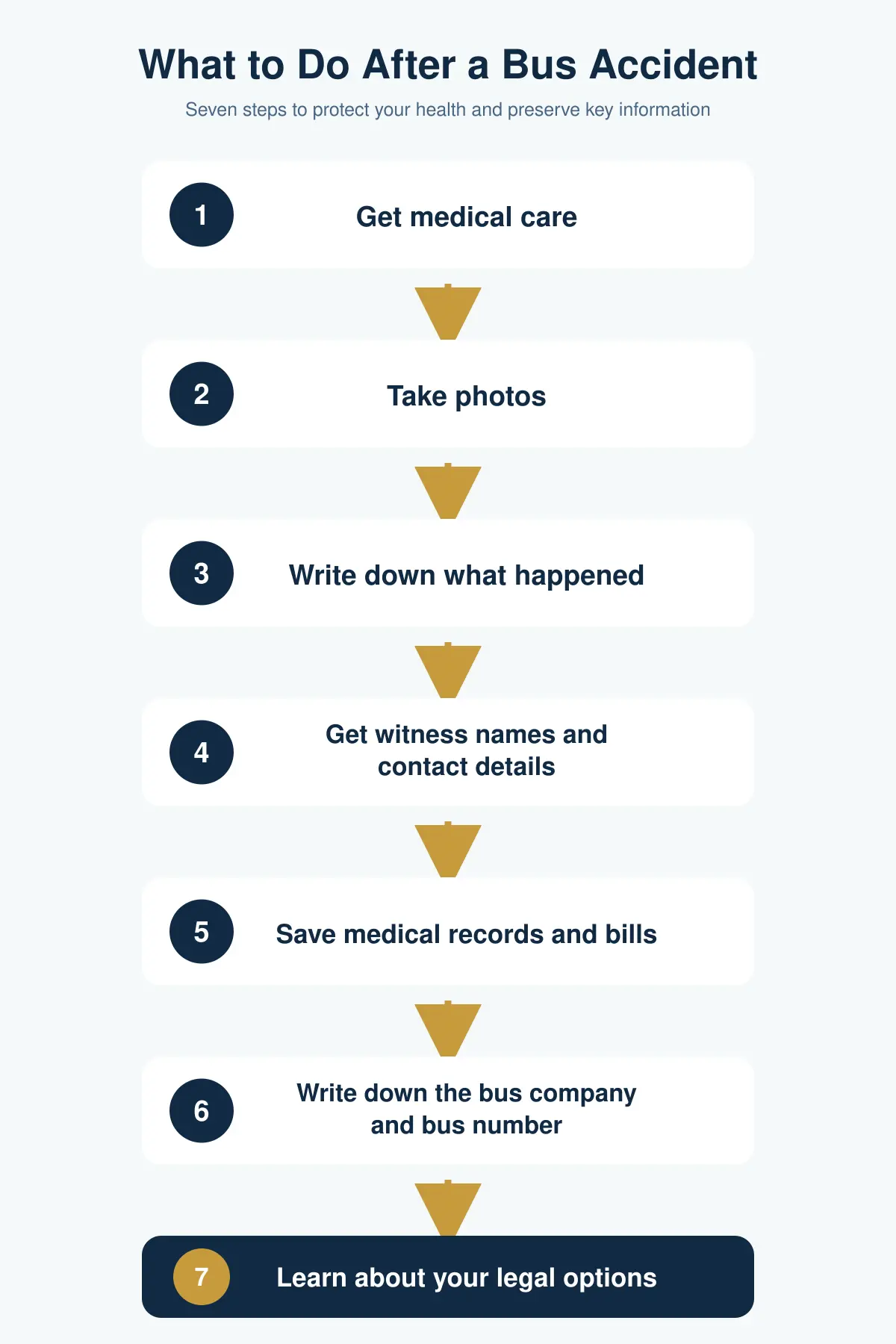
Why save all this?
Let’s say that someone saw the crash. They gave you their phone number. Six months later, you need to find them.
Would you rather have their number?
Of course.
The same idea applies to photos, medical records, and notes.
In Tansavatdi v. City of Rancho Palos Verdes, the California Supreme Court looked at a dangerous roadway and the duty a public entity may have when a roadway creates a danger.
Why does that matter here?
It matters because a bus crash may not be only about the bus.
Could the road have played a part?
Could a missing sign have mattered?
Could a dangerous turn have caused the crash?
Good records can help answer those questions.
Why Does the Bus Company Matter?
Who owned the bus? Who drove it? Who ran the bus service? Was it a city bus? Was it a private bus? Was it a school bus? Was it a shuttle?
These questions matter.
Why?
Because different rules can apply to different defendants.
A city bus and a private bus company are not always treated the same way under California law.
For example, California has special rules for claims against public entities. That can include some government-run bus services.
In Leon v. County of Riverside, the California Supreme Court discussed California’s Government Claims Act. The court explained that claims involving public entities can be controlled by special rules.
So do not stop at, “I was hurt on a bus.”
Ask another question: Who was responsible for that bus?
You may need to know the bus company, bus number, route, and driver. You may also need to know if another driver or a dangerous road played a part.
How Can You Build a Bus Accident Injury Claim?
What should you save?
Almost everything related to the accident.
Now ask yourself: What should I do after a bus accident before filing a claim?
The answer starts with the facts.
You need to know what happened. You need to know what injuries you have. You need to know who may be responsible.
You also need to watch the clock.
Why?
Because legal claims can have deadlines.
But here is the important part: not every bus accident has the same deadline.
In Gutierrez v. Tostado, the California Supreme Court had to decide which time limit applied to the claim. The court looked at the kind of claim involved and the duty at issue.
That is important.
Suppose two people are hurt in two different crashes. Both crashes happen in California. Does that mean they have the same legal deadline?
Not always.
The facts can change the answer.
That is why guessing can cause problems.
How Can a Bus Accident Lawyer Explain Your Options?
You may be thinking, Do I even have a case?
That is a fair question.
You may also wonder:
- Who was at fault?
- Can I make a claim?
- What if the bus driver was at fault?
- What if another driver caused the crash?
- What if the road was dangerous?
- What if I missed work?
- What if my injury gets worse?
These are not questions you have to answer by yourself.
A bus accident lawyer can explain the legal options based on the facts of your case.
Look at Downey v. City of Riverside. The California Supreme Court looked at when a person knew, or should have known, about an injury and the event that caused it.
The case was not about a normal bus accident. But it gives us an important lesson.
When does the clock start?
Sometimes, that question is not as simple as it sounds.
Imagine you get hurt in an accident but do not understand the full cause right away. Does the date you first felt pain answer every legal question?
Not always.
The law can depend on the facts.
That is why understanding your options early can be useful.
Frequently Asked Questions About Bus Accidents
Key Takeaways
- Get medical care if you are hurt.
- Take pictures and save records after the accident.
- Write down what happened while you still remember it.
- Find out who operated the bus and who else may have played a role.
- Learn about your legal options and possible deadlines before deciding what to do next.
The Crash May Last a Moment. The Questions Can Last Much Longer.
A bus accident can happen in seconds. But what comes next can feel confusing.
- Who caused it?
- Who owns the bus?
- How badly are you hurt?
- What should you save?
- What if the bus was run by the city?
- What if another driver caused the crash?
- And what if you are not sure what to do first?
If you are asking, what steps should I take after a bus accident before calling a lawyer?, start with the facts. Get medical care. Take pictures. Write things down. Save your records. Find out who operated the bus.
Blair & Ramirez LLP can help you understand your legal options based on the facts of your accident. Contact Blair & Ramirez LLP to request a free consultation and learn more about your options.