


TL;DR
A personal injury lawyer for amputation injuries looks at more than hospital bills. They also look at future care, lost pay, prosthetics, pain, and how the injury may change everyday life.
Losing a limb changes almost everything.
How do you get dressed? How do you get to work? Can you still do the job you loved? What happens when your prosthetic needs repair?
And then there is the money.
Who pays for all of this?
That question can feel very heavy after a serious accident.
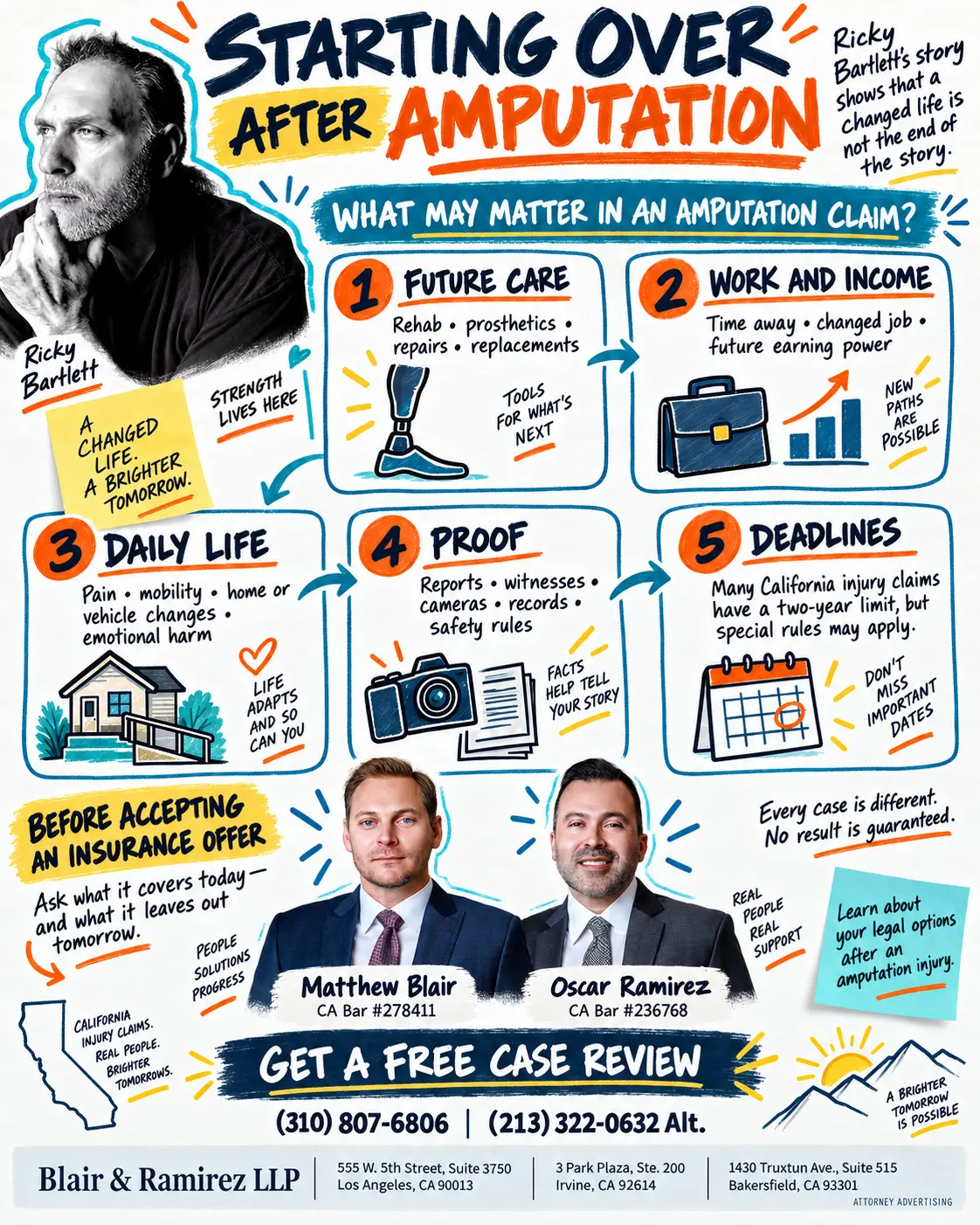
Los Angeles actor Ricky Bartlett knows something about life after amputation. He lost one leg to a serious infection and the other to bone disease. In a recent interview, he talked about phantom pain, acting, and learning to live with a body that had changed. He also talked about becoming more fearless.
That does not mean life has become easy.
It is far from it.
Pain can show up in the middle of work. A simple task can take more time. Things other people never think about can become a daily puzzle.
Now think of an amputation caused by a car crash, unsafe work site, faulty machine, or another person’s careless act.
What happens then?
Why an Amputation Injury Lawyer Looks Beyond the Hospital Bill
Think about a broken phone.
You buy a new one. Problem solved.
An amputation does not work that way.
The first hospital bill may cover surgery. Then comes rehab. Then medicine. Then a prosthetic.
And later?
The prosthetic may need repairs. It may need a replacement. You may need more therapy. You may need changes to your home or car.
So, what does one hospital bill really tell you?
Not much.
California law allows injured people to seek money for certain losses caused by another person’s wrongful act. Those losses can include medical costs, lost earnings, and other harm.
Here is a simple example:
Say Maria loses her leg in a crash caused by another driver. She misses six months of work. She needs therapy. She needs a prosthetic. She may not be able to return to the same job.
Her loss is not just one medical bill. It is a much bigger picture.
Every case is different. There is no magic number.
That matters.
How an Amputation Injury Attorney Looks at the Years Ahead
What will life look like next year?
What about five years from now?
Those questions matter.
A person who loses a leg at age 25 may need care for decades. A person who loses a hand may struggle with a job that once felt easy.
Think about a chef.
A chef loses part of a hand in a machine accident. Can they still chop food? Can they hold a knife? Can they work the same long shifts?
Maybe.
Maybe not.
What about a construction worker who loses a foot?
Can they climb ladders all day? Can they carry heavy tools? Can they safely stand for hours?
Again, it depends.
A good legal review looks at those real-life questions. It can also look at medical care, rehab, prosthetics, lost pay, and future earning power.
At Blair & Ramirez LLP, our amputation injury work can involve these long-term losses, along with the physical and emotional effects of losing a limb.
That is important because an injury does not stop hurting just because the ambulance leaves.
Sometimes, that is when the harder part begins.
Why an Amputation Accident Lawyer Asks What Really Happened
Who caused the accident?
That sounds simple.
It often is not.
- Was the driver speeding?
- Did a company ignore a safety rule?
- Did a machine lack a safety guard?
- Did a product fail?
- Did someone know about a danger and do nothing?
Small details can matter.
Look at a traffic crash.
A driver runs a red light. Another car hits a motorcycle. The rider suffers terrible injuries and later loses a leg.
What caused the crash?
The answer may come from traffic cameras, witness statements, phone records, vehicle data, or police reports.
Now think about a factory.
A worker gets caught in a machine. The machine had a missing safety guard. Was the guard always missing? Did the company know? Did someone remove it?
Those questions can change the case.
A recent California case shows why these details matter.
In 2026, a Los Angeles jury awarded $28 million to a motorcyclist who lost part of his leg after a crash with an L.A. Fire Department truck. The case focused on how the truck entered the intersection and whether the driver followed safety rules.
[Past results do not guarantee or predict a similar outcome in future cases. Each case is different and must be evaluated on its own facts and circumstances.]
The point is not the dollar amount. The point is the questions.
- What happened?
- Who caused it?
- What proof exists?
- And what did the injury really cost?
How an Amputation Compensation Lawyer Looks at the Future
Here is a tough question: What does a prosthetic cost ten years from now?
No one can know the exact number. But we can ask better questions:
- Will it need repairs?
- Will it need replacing?
- Will the person need more therapy?
- Will their needs change?
[Maybe the person will need special equipment at home. Maybe they will need a new car setup. Or maybe they will need help with everyday tasks.]
These costs can add up. And then there is work.
A young electrician loses an arm. The electrician may not be able to do the same work again.
That does not just affect this month’s paycheck.
It may affect years of future income.
That is why a personal injury lawyer for amputation injuries may look at both today’s losses and future losses.
California’s Supreme Court has also recently looked at important personal injury rules.
In Gutierrez v. Tostado, the court considered which time limit applied to a claim involving an ambulance driver. The case shows that the deadline can depend on the type of claim and the duty involved.
Why does that matter here?
Because people often think, “I have two years. I’m fine.”
Maybe. But maybe a special rule applies.
The facts matter. So does the type of defendant.
Is an Amputation Injury Claim Lawyer Needed After an Insurance Offer?
Here is another common question: What if the insurance company sends a check?
Should you take it?
Before answering that, ask these questions:
- What does the check cover?
- Does it cover the hospital?
- What about the next prosthetic?
- What about lost income?
- What about future treatment?
- What if the person cannot return to the same job?
Let’s say someone offers you $50,000 for a house that will need $200,000 in repairs.
The offer may look good at first.
But what did you miss?
A personal injury claim can work the same way.
A settlement offer may cover some losses but not others. Understanding the offer matters before making a decision.
A California Supreme Court case called Whitehead v. City of Oakland also shows why the fine print can matter.
The court looked at whether a liability release protected the city from a claim involving a dangerous road condition. The court’s decision turned on the facts, the legal duty involved, and the wording of the release.
In plain English?
A signature does not always answer every legal question.
The details matter.
How California Law Shapes an Amputation Injury Claim
What if the accident happened at work?
That can bring workers’ compensation rules into the picture.
What if a government vehicle caused the crash?
Different rules may apply.
What if a defective product caused the injury?
The product maker may become part of the legal picture.
What if another driver caused the crash?
That may lead to a different type of personal injury claim.
See the pattern?
There is no single amputation case.
There are many kinds.
And each one has its own facts.
California generally gives people two years to bring many personal injury claims under Code of Civil Procedure section 335.1. But special rules can change the deadline.
So, ask:
- When did the injury happen?
- Who caused it?
- Who are you making a claim against?
- Does a special rule apply?
Those questions can matter a lot.
What Should You Ask After an Amputation?
Start with the basics:
- Who caused the accident?
- What treatment will I need?
- Can I return to my old job?
- What will future care cost?
- What evidence proves what happened?
- What deadline applies?
You do not need all the answers on day one. But you need to know which questions to ask.
Frequently Asked Questions About Amputation Injury Claims
Key Takeaways
- An amputation can create costs that last for years.
- Medical bills are only one part of the picture.
- Lost work, future care, prosthetics, and daily life can matter too.
- California deadlines can vary depending on the claim.
- Every case has different facts, so every claim needs its own review.
A Different Life Does Not Mean the End of the Story
Ricky Bartlett said he became fearless after losing his legs.
That is a powerful idea.
But fearlessness does not pay a medical bill.
It does not buy a prosthetic.
It does not replace six months of lost wages.
And it does not answer the big question: Who should pay when someone else’s careless act causes a life-changing injury?
That question deserves a careful look.
Blair & Ramirez LLP helps people understand their legal options after serious personal injuries, including amputation injuries. A free case review can help you understand what may apply to your situation and what questions deserve attention.
Contact Blair & Ramirez LLP to request a free case review.