


TL;DR
Losing a personal injury case doesn’t always mean your claim was weak. Real discussions on Reddit show that deadlines and courtroom rules can matter just as much as the facts.
Have you ever had an argument where you thought, “I’m definitely right”? Now, think that someone else wins even though you believe you are. It feels really unfair, right? This is similar to how you feel when you lose a personal injury case.
Let’s think about it. A person might get hurt and spend a long time (maybe even years) gathering proof like medical records and receipts. They work hard to show that they need help. But then, sometimes one small mistake or one missing paper changes everything. So, what happens if you lose a personal injury case? Does it mean your case was not strong? Do you have to pay money? Is there still a way to keep fighting?
Many people on Reddit have these same questions. Some are workers who got hurt and wonder why their claims didn’t go through. Others have spent a lot of time preparing their case, only to have it fall apart because of a small mistake. What they learn is that winning in a courtroom isn’t just about being right. It’s also about following the rules and having everything ready on time.
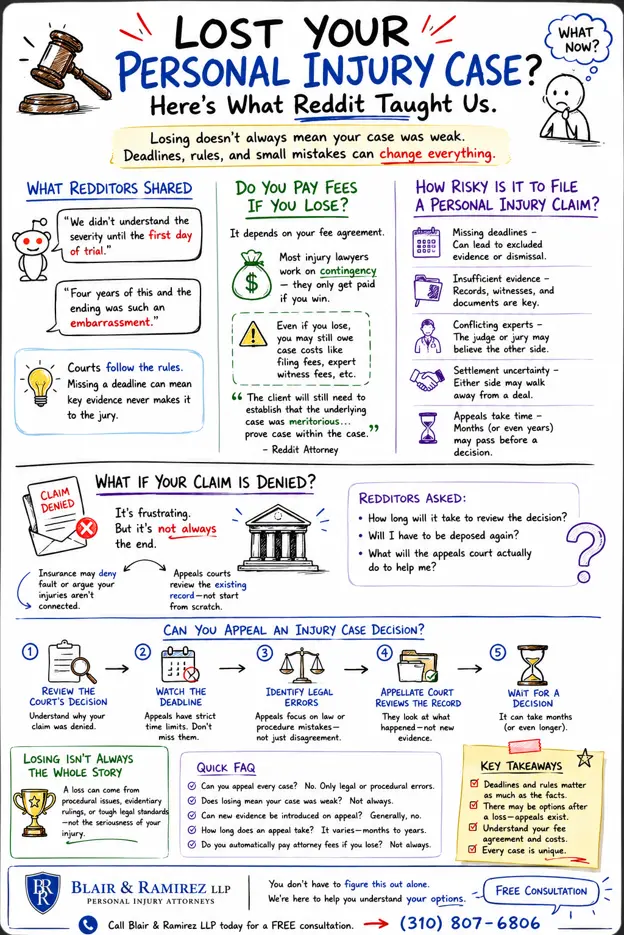
Do You Pay Fees If You Lose an Injury Case?
One of the first things people want to know after losing a personal injury case is if they have to pay anything. The answer is tricky and depends on what deal you made with your lawyer.
In many places, like California, lawyers often charge based on something called a “contingency fee.” This means they only get paid if you receive money for your injury. But remember, some costs like filing fees or expert witness fees might still need to be paid even if you lose.
It’s really important to understand your agreement with your lawyer before going to court.
There’s an interesting story on Reddit from a lawyer who missed two court dates. Because of that, the court threw out his personal injury case. He wrote:
“Had a case dismissed... because I did not docket the case correctly.”
Then he added something even more striking:
“The past week has changed me as an attorney.”
That honesty sparked dozens of responses from other lawyers.
One said how hard it can be:
“The client will still need to establish that the underlying case was meritorious... prove case within the case.”
Think about that for a moment. Losing because of a mistake can make everything feel confusing.
How Risky Is It to File a Personal Injury Claim?
When you file a personal injury claim, you get a chance to ask for money, but it doesn’t mean you will get it. Like any process, there are risks.
Here are some risks to think about:
|
Potential Risk |
Why It Matters |
|
Missing important deadlines |
Courts may exclude evidence or dismiss claims if deadlines aren’t met. |
|
Insufficient evidence |
Medical records, witness statements, and documentation often determine how persuasive a case becomes. |
|
Conflicting expert opinions |
Judges and juries may find one medical expert more credible than another. |
|
Settlement uncertainty |
Either side may choose not to settle before trial. |
|
Appeals can take time |
Even after judgment, additional legal proceedings may extend the process. |
One Reddit post from Utah shows how bad mistakes can get. A family spent four years getting ready for a trial and then found out on the first day that much of their evidence couldn’t be shown because their lawyer forgot to file an important paper. They felt so embarrassed after all that time.
The original poster wrote:
“We did not fully understand the severity of the situation until the first day of trial.”
Later, they added another sentence that captures years of frustration:
“Four years of this and the ending was such an embarrassment.”
Think of spending years organizing medical records, receipts, emails, photographs, and witness statements, only to learn that much of it never reaches the jury.
That’s exactly what happened.
One user responding to the thread explained why the situation became so difficult:
“The court probably didn’t do anything wrong by excluding the evidence.”
That may sound surprising.
But courts stick to the rules for everyone. Missing a filing date doesn’t mean the judge is unfair. It usually means rules were broken, which can limit what can be shown in court.
Not every lost case comes from lawyer mistakes, but it highlights how important preparation and deadlines are.
What if a Personal Injury Claim Is Denied?
Few words feel heavier than “claim denied.”
You might read that letter over and over, wondering if it’s really true.
Sometimes, insurance companies say they aren’t at fault. Other times, they say that injuries aren’t connected to the accident. Each situation is different.
One recent Reddit post shared a story about a worker hurt on the job. A judge saw they were in pain but decided the job didn’t cause it. The worker had lots of questions after the denial:
- “How long will it take for them to review her decision?”
- “Will I have to be deposed again?”
- “What will the appeals court actually do to help me?”
These questions matter because many people haven’t been through an appeal before. It feels strange and hard.
The replies also offered an important reality check. One experienced commenter explained:
“Appeals courts review the existing record.”
This means the appeals court doesn’t start from scratch. It just checks if the law was followed correctly. A denied claim doesn’t automatically mean something went wrong.
Can You Appeal an Injury Case Decision?
Yes, you can if certain things are true.
An appeal doesn’t just mean you disagree with the court’s decision. It really focuses on whether a mistake in the law changed the outcome of the case. Here’s a simple look at how to appeal a decision.
Step 1: Review the Court’s Decision
Start by carefully looking at what the judge decided and why. Understanding the reasons for losing helps you figure out if you should appeal.
Step 2: Watch the Filing Deadline
You need to pay close attention to deadlines. Appeals have strict time limits. If you miss one, you might lose the chance to appeal your case.
Step 3: Identify Possible Legal Errors
When thinking about an appeal, focus on these errors:
- The law wasn’t used correctly.
- Some evidence was not allowed or was wrongly included.
- There were mistakes during the court process that affected the case.
Just not liking the judge’s decision isn’t enough to start an appeal.
Step 4: The Appellate Court Reviews the Record
Here’s something many people find surprising: the appellate court doesn’t look at new evidence. They check what happened earlier in your case. A commenter on Reddit mentioned:
“The existence of evidence supporting your case does not mean you are going to win.”
Why? Because the courts weigh different pieces of evidence and judge their value, not just one part of the case.
Step 5: Wait for a Decision
Appeals can take a long time (sometimes months or even longer). One Reddit user who shared their own experience described waiting through months of uncertainty before finally receiving a decision. They wrote:
“The whole appeal process took 6 months from the Notice of Appeal to the Appeal Order.”
Every appeal is different, so you need to be patient while waiting.
Why Losing a Personal Injury Lawsuit Has Lasting Consequences
Losing isn’t just about the verdict (the final decision). It can leave you with lots of questions. Did you gather enough proof? Should you have asked different things during the trial? Would taking a smaller settlement sooner have been better?
The emotions from losing can stick around long after you leave the courtroom. For example, the Utah Reddit discussion (cited above) shows that reality. After four years of litigation, the family didn’t only lose their case. They described retirement savings disappearing, refinancing a home, and watching years of preparation end in disappointment.
Another person noted:
“The court probably didn’t do anything wrong by excluding the evidence.”
This reminds us that courts have rules. Even when things feel unfair, those rules apply to everyone.
The good news is that losing doesn’t always mean you have no other chances. There may be options like appealing the decision or looking into other legal issues. Each situation is unique and depends on its facts and the law.
Frequently Asked Questions
Key Takeaways
- A personal injury case can lose for legal reasons, not just because the injury wasn’t real.
- A denied claim doesn’t mean all your legal options are gone; there might still be ways to appeal or take other actions.
- Appeals look for legal errors, not to retry the entire case.
- Knowing your fee agreement and costs before starting helps avoid surprises later.
- Every personal injury case is unique, and what you can do depends on the facts and laws that apply to your situation.
When One Verdict Doesn’t Tell the Whole Story
Losing can feel like the end. But, as we see in real stories from Reddit, each case has a different journey. Some people might lose because the proof wasn’t strong enough or due to procedural issues. In certain cases, there might still be some questions to think about after the decision is made.
If you’re unsure about your legal options following a personal injury case or a denied claim, reach out to us at Blair & Ramirez LLP. They can help you understand your situation better. You can ask for a consultation or a free case review. Every case deserves careful attention, and every decision should be based on what’s special about your situation.