


TL;DR
A sexual harassment lawyer in Los Angeles can help you understand what happened, what the law says, and what choices you may have. You do not have to figure it all out by yourself.
Have you ever left work and thought, was that really okay?
Maybe your boss made a sexual joke. Maybe a coworker sent you a strange message. Maybe someone kept asking you out after you said no. Or maybe a manager hinted that saying yes to something personal could help your career.
What do you do then?
Do you stay quiet? Tell HR? Quit? Save the messages? Talk to someone who knows the law?
Those questions can feel scary because work is not just work. It pays the bills. It helps build your career. And when the person making you uncomfortable has power over you, speaking up can feel risky.
That is part of what actor Cate Blanchett talked about in May 2026. She said the #MeToo movement “got killed very quickly” and spoke about a deeper, system-wide problem with abuse in different industries.
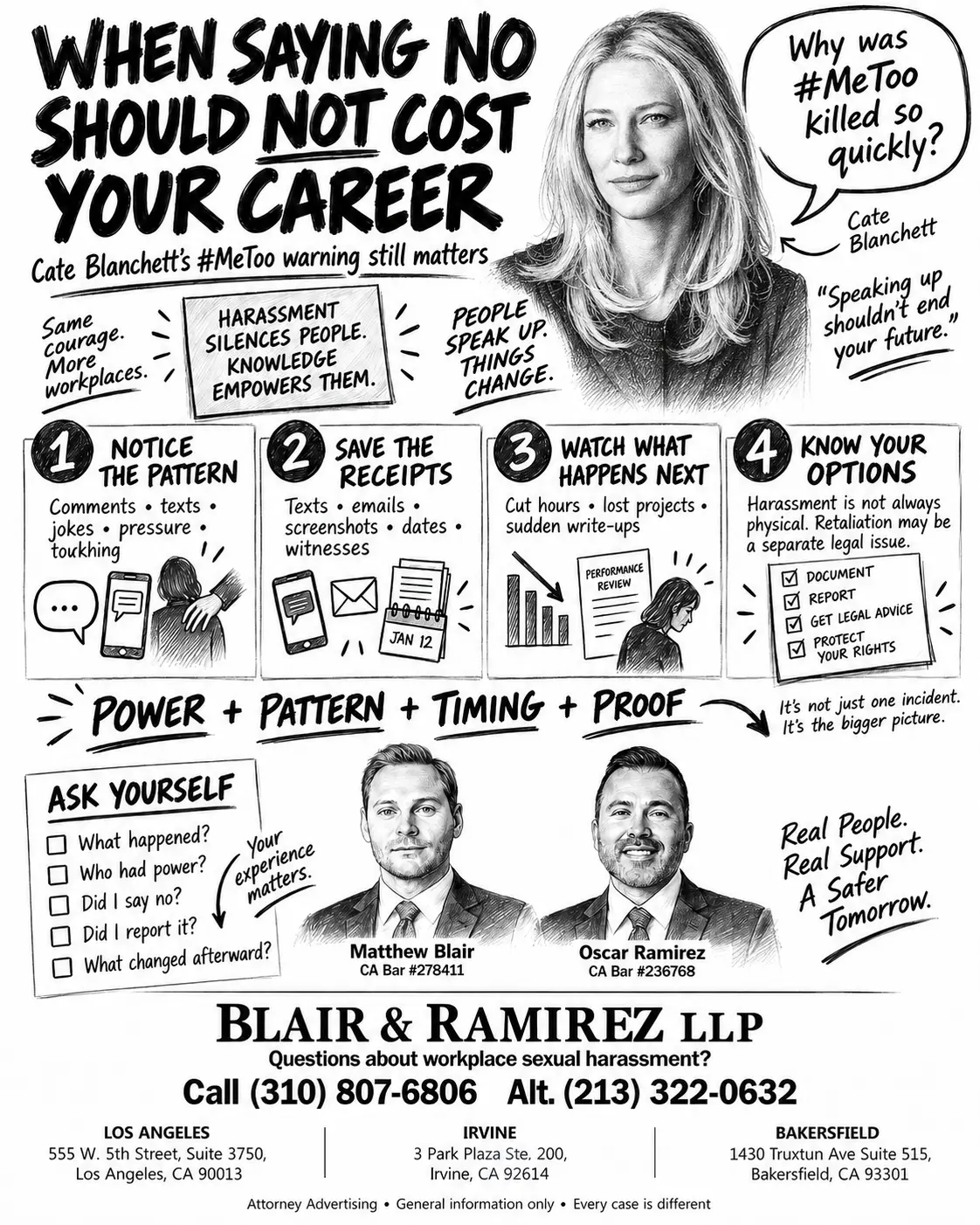
Why Is Workplace Sexual Harassment So Hard to Talk About?
Because people often ask themselves the wrong question first.
They ask, “Was it bad enough?”
But maybe the better question is, “What happened?”
Think about a worker whose boss keeps commenting on her body.
The first comment may seem small. She laughs it off. Then it happens again. Then again.
- What if the boss starts sending late-night messages?
- What if those messages become sexual?
- What if she says, “Please stop,” and the messages continue?
Now the picture looks very different.
California law protects workers from sexual harassment at work. That protection can cover unwanted sexual advances, sexual comments, sexual requests, touching, and other conduct. It can also cover harassment based on sex, gender, sexual orientation, gender identity, gender expression, or pregnancy.
But here is the important part: not every rude or awkward moment is automatically illegal harassment.
So how do you tell the difference?
You look at the full story.
- What was said?
- How often did it happen?
- Who said it?
- Did that person have power over you?
- Did the conduct continue after you said no?
- Did you report it?
- What happened after you reported it?
Those details can change the legal picture.
Is Sexual Harassment Always Physical?
No.
This is one of the biggest things people get wrong.
Someone does not have to touch you for sexual harassment to become a serious legal issue.
- What about sexual texts?
- What about unwanted photos?
- What about repeated sexual jokes?
- What about a boss asking for a date again and again?
- What about someone saying, “Go out with me, and I can help you get that promotion”?
These things can matter.
Think of a manager who tells an employee, “If you want the better shift, you should spend some time with me.”
The employee knows what that means.
Nothing physical happened.
But does that make the situation harmless?
Not necessarily.
California law looks at the facts and the setting. The same words can also mean something very different depending on who said them, how often they said them, and what power they had.
That is why someone looking for a Los Angeles sexual harassment lawyer should focus on the whole story rather than one moment.
How Can You Tell What Evidence Matters?
Start with simple things.
- Did you get a text? Save it.
- Did you receive an email? Keep it.
- Did someone see what happened? Write down their name.
- Do you remember the date? Write it down.
A simple record might look like this:
| What Happened | What to Keep |
|---|---|
| Sexual text | Original message or screenshot |
| Inappropriate comment | Date, place, exact words, and witnesses |
| Unwanted touching | Date, location, and people present |
| Threat after saying no | Message, email, or witness details |
| Job change after a complaint | Old and new schedules, emails, and relevant records |
Why does this matter?
Because memories can change.
People leave jobs. Messages can disappear. A small detail you remember today may be hard to remember six months from now.
You do not need to create a perfect story.
You need to keep the real one.
Why Does Cate Blanchett’s #MeToo Warning Still Matter?
Cate Blanchett’s recent comments raise a simple question: What happens when the person speaking up has less power than the person being accused?
At the Cannes Film Festival in May 2026, Blanchett spoke about the #MeToo movement and said it had exposed a “systemic layer of abuse” across industries. She also pointed to the imbalance between men and women in the film business.
That matters outside Hollywood, too.
Think about a restaurant worker whose manager controls the schedule.
Or an office worker whose boss controls promotions.
Or an actor who depends on producers for the next job.
Or a young employee who worries that complaining will make people see them as “difficult.”
Would that person feel free to speak?
Maybe not.
And that is where workplace power becomes important.
The law does not only care about what someone said or did. In some cases, it also matters who had power, whether the employer knew about the conduct, and what the employer did after learning about it.
That is one reason these cases can be more complicated than they first appear.
Is Retaliation Another Problem?
Sometimes harassment is only the beginning.
What happens after someone complains?
Let’s say an employee reports sexual comments from a supervisor.
A few days later, her hours are cut.
Then she loses an important project.
Then her manager starts writing her up for things that were never a problem before.
Could those things be connected?
Maybe.
Could there be a normal business reason?
Also, maybe.
That is why timing and evidence matter.
California and federal law can protect certain workers from retaliation after they take part in protected activity, such as making a qualifying complaint.
The Supreme Court has also made clear that employment discrimination does not always require some huge, life-changing loss.
In Muldrow v. City of St. Louis, the Court ruled in 2024 that a worker bringing a Title VII discrimination claim does not have to show “significant” harm from a job transfer. The worker must show some disadvantage connected to employment, but the harm does not have to meet a higher “significance” test.
Why does that matter here?
Because a workplace change can matter even when the change does not look dramatic from the outside.
Then came Ames v. Ohio Department of Youth Services in 2025.
The Supreme Court unanimously rejected a special rule that made certain majority-group workers meet an extra requirement when bringing Title VII discrimination claims. The Court said the same basic standard applies.
These cases do not create a new rule for every sexual harassment claim.
But they show something useful: Small details can have big legal meaning.
How Does a Sexual Harassment Lawyer in Los Angeles Look at a Case?
Usually, it starts with questions:
- What happened?
- When did it happen?
- Who was there?
- Who had power?
- Did you say no?
- Did the conduct stop?
- Did you report it?
- Who did you tell?
- What happened after that?
- Do you have texts or emails?
- Did your work change afterward?
This may sound like a lot.
But there is a reason for it.
A legal claim is not built from one sentence. It is built from facts.
Blair & Ramirez LLP helps California workers understand their legal options in workplace harassment matters.
So, what might a consultation look like?
| Step | What Happens |
|---|---|
| 1. Tell the story | You explain what happened. |
| 2. Look at the facts | Dates, people, messages, and workplace events are reviewed. |
| 3. Look at the law | Possible legal protections are explained. |
| 4. Look at your options | Possible next steps are discussed. |
| 5. Decide what comes next | You can make an informed choice. |
There is no promise of a certain result.
Every case is different.
The point is to replace guesswork with a clearer picture of your options.
What Should You Do If Something Feels Wrong at Work?
Start by asking yourself a few simple questions.
- What happened?
- When did it happen?
- Who was involved?
- Did I tell the person to stop?
- Did I tell anyone at work?
- What happened after that?
Then look at your records. Do you have:
- Messages?
- Emails?
- Photos?
- Schedules?
- Witnesses?
- A written complaint?
Keep relevant records in their original form when possible. Do not change or create evidence.
You may also want to learn about the rules that apply to your situation.
A California sexual harassment lawyer can explain how California and federal laws may apply to the facts you describe. A consultation can also help you understand possible deadlines and other steps that may affect your options.
And there is no need to know all the legal words before asking questions.
That is what questions are for.
Frequently Asked Questions
Key Takeaways
- Sexual harassment does not always involve touching.
- Texts, emails, comments, threats, and other conduct can matter.
- Keep a clear record of what happened and when.
- Retaliation after a complaint can raise another legal issue.
- Every case is different, so the facts and timing matter.
When Saying No Should Not Cost You Your Career
Maybe it started with a joke.
Maybe it was a text.
Maybe it was a boss who would not take no for an answer.
Or maybe the real problem started after you spoke up.
What happened next matters.
You do not need to know all the answers before you ask the questions. And you do not have to decide what your entire future looks like after one difficult day at work.
At Blair & Ramirez LLP, our attorneys can help you understand your legal options and what California law may mean for your situation.
If you have questions about possible workplace sexual harassment, contact Blair & Ramirez LLP to request a consultation and learn more about your options.