


TL;DR
An experienced sexual harassment lawyer in California can help you understand what your workplace experience may mean under California law. If someone crosses a line, or you face trouble after speaking up, knowing your options can make the next step clearer.
Have you ever walked into work and felt your stomach drop?
[Maybe your boss made another comment about your body. Maybe a coworker kept sending you sexual texts. Maybe someone touched you when you told them not to.]
What if you finally said something? And what if things got worse after that?
Those questions matter.
Blake Lively recently put some of them in the spotlight. In April 2026, she said she faced what she called “pervasive retaliation” after asking for a safe working environment for herself and others. Her case later settled, and some of her claims had already been dismissed. So, her story is not proof that every workplace complaint is legally valid. But it does show why speaking up, keeping records, and understanding your rights can matter.
For someone dealing with a similar problem at work, an experienced sexual harassment lawyer in California can help explain what the law may say about the facts.

Why Is Sexual Harassment Illegal in California?
What does sexual harassment look like?
Is it only touching?
No.
Is it only asking for sexual favors?
No.
California’s Civil Rights Department (CRD) lists many examples. They can include sexual jokes, unwanted sexual comments, sexual pictures, touching, sexual gestures, and offers of job benefits in return for sexual favors.
Think about a simple example.
A manager tells an employee, “Go on a date with me and I may give you that promotion.”
The employee says no.
The manager gives the promotion to someone else.
What happened?
The problem is not simply that the manager asked for a date. The problem may be the link between the sexual request and the job.
Now think about another worker.
Every day, a coworker makes jokes about her body. She asks him to stop. He keeps doing it. Other people hear the jokes, too.
Is that just office humor?
Not necessarily.
California law protects workers from many forms of unwanted sexual conduct. It also protects people from retaliation when they assert their rights.
And here is something else people often miss: The harasser does not always have to be the boss.
A coworker can be the problem. In some cases, a customer or another person outside the company can also create a legal issue.
So, the better question is not, “Was the person my boss?” It is, “What happened, and how did it affect my work?”
How Can a California Sexual Harassment Attorney Help?
Maybe you are not even sure you have a case.
That is common.
You may think, “Was that really harassment?”
Or, “Maybe I am making too much of it.”
Or even, “What if nobody believes me?”
These are real concerns.
A California sexual harassment attorney can start by looking at the facts:
- What was said?
- When did it happen?
- Who said it?
- Did it happen once or many times?
- Did you tell the person to stop?
- Did you report it?
- Did your job change afterward?
Those details can matter.
Imagine an employee named Maria.
Her supervisor sends her sexual messages late at night. Maria tells him to stop. He keeps sending them. She saves the messages and reports the problem to HR.
A few weeks later, her work hours drop.
Now there are several things to look at.
There are the messages.
There is her request to stop.
There is her complaint.
And there is the change in her work hours.
Does that automatically prove a legal claim?
No.
But it gives a lawyer important facts to review.
That is one reason an experienced sexual harassment lawyer in California may be useful. The lawyer can help sort the facts from the guesses.
And what if you have no screenshots?
That does not automatically end the matter.
Emails can help. Work schedules can help. HR messages can help. Witnesses can help. And your own notes can help.
The goal is simple: tell the story clearly and honestly.
What Happens If You Speak Up and Things Get Worse?
This is where many workers get scared.
You report the harassment.
Then your boss stops giving you good shifts.
Or you get left out of meetings.
Or you suddenly receive write-ups for small things.
Or your manager starts treating you like a problem.
You may ask, “Is this retaliation?”
It can be.
California law protects workers from retaliation for asserting certain workplace rights. CRD says employers cannot retaliate against workers because they asserted rights under California employment law.
Look at a simple example:
James tells HR that his supervisor keeps making sexual jokes.
Before the complaint, James gets good shifts.
After the complaint, his hours suddenly fall.
Then his boss tells him he is “not a team player.”
Could that be connected?
Maybe.
Would the timing matter?
It could.
Would the employer have another explanation?
Possibly.
That is why these cases need facts.
Blake Lively’s case shows how complicated this can become.
In April 2026, Lively said she brought her lawsuit because of what she described as retaliation after she asked for a safe working environment. A federal judge had dismissed many of her claims, while some retaliation-related claims were still alive at that point. The parties later settled.
What can we learn from that?
One simple thing: A complaint about harassment and a claim about retaliation are not always the same thing.
One may fail while another continues.
That is why workers should not try to decide the legal answer from one headline.
What Do Blake Lively and the Supreme Court Tell Us?
Why bring a Hollywood actress into a workplace law story?
Because people understand stories better than legal terms.
Lively said she wanted a safe working environment. She also said she faced retaliation after speaking up. Those are issues that can happen in many workplaces, not just movie sets.
But what does the law say?
A recent Supreme Court case gives us one useful example.
In Muldrow v. City of St. Louis, decided in 2024, the Supreme Court said a worker bringing a Title VII discrimination claim does not have to show a huge amount of harm from a job transfer. The worker must show some harm tied to the terms or conditions of employment.
Why does that matter?
Think about an employee who gets moved to a worse job because of discrimination.
Someone might say, “At least she still has a job.”
But the Supreme Court said the law does not require the harm to reach some giant level before it matters.
Then came Ames v. Ohio Department of Youth Services in 2025.
The Supreme Court rejected a special rule that had made some workers face a higher bar when bringing a Title VII discrimination claim. The Court sent the case back for another look under the proper rule.
Does Muldrow decide every sexual harassment case?
No.
Does Ames decide every workplace harassment case?
No.
But both cases show why the details matter.
You cannot look at a workplace problem and say, “That is too small to matter.”
You also cannot say, “That proves I have a case.”
The answer sits in the facts.
What Should You Do If Something Feels Wrong at Work?
So, what should you do?
Start simple.
Write things down.
- When did it happen?
- Where?
- Who was there?
- What was said?
- What happened next?
Save relevant texts and emails when you can lawfully do so. Keep copies of work records that you are allowed to keep.
Why?
Because memories can get fuzzy.
Think of someone who says something awful to you on Monday.
You remember it clearly.
Then three months pass.
You have a hundred other things going on.
Do you remember the exact words?
Maybe not.
A simple note can help you keep the facts straight.
Here is an easy way to think about it:
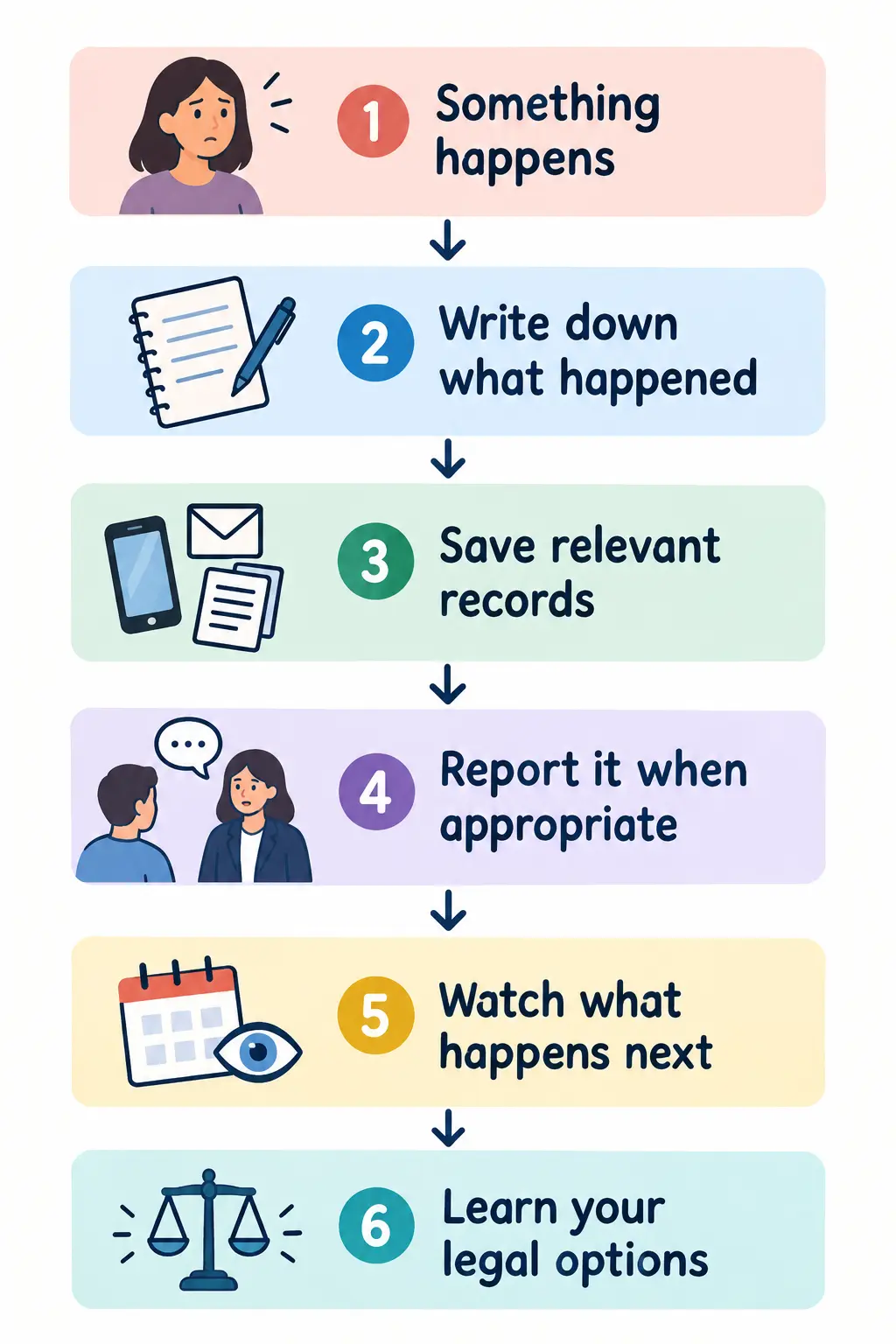
CRD says workers who believe they faced harassment, discrimination, or retaliation may be able to file a complaint. In general, the CRD says an employment discrimination complaint must be filed within three years of the alleged discriminatory act. Different claims can have different deadlines, so the exact facts matter.
That last part is important: Do not guess about a deadline.
Frequently Asked Questions
Key Takeaways
- Sexual harassment can involve words, messages, pictures, touching, or job pressure.
- A boss does not have to be the person doing the harassing.
- What happens after you report harassment can matter, too.
- Save useful records and write down important events while they are fresh.
- A confidential consultation can help you understand your legal options.
You Should Not Have to Guess Where You Stand
Work should be a place where you can do your job.
Not a place where you wonder what your boss will say next.
Not a place where you feel you have to laugh at a sexual joke to keep the peace.
And not a place where speaking up suddenly makes your job harder.
If something happened to you, you may have questions.
- Was it harassment?
- Was my employer responsible?
- Was I punished for speaking up?
- What can I do now?
Blair & Ramirez LLP can help you understand your legal options and what a consultation may tell you about your situation.
Contact Blair & Ramirez LLP to request a confidential case review and learn more about your options.
Attorney Advertising. Matthew P. Blair, California Bar No. 278411.
This article provides general information only. It does not create an attorney-client relationship. Every case is different, and past results do not guarantee or predict a similar outcome in future cases.