

TL;DR
If someone gets hurt, the financial recovery after a rideshare assault can be more than just a medical bill. It might include lost wages, emotional pain, therapy costs, and other things related to the event.
A rideshare should be simple: you open an app on your phone, hop into a car, and think you’re safe.
But what if that trust is shattered? What happens when your ride turns into a nightmare?
Recovering financially after a rideshare assault isn’t just about paying for that one hospital visit. It’s about all the bills that keep coming. It’s about missing work. It’s about facing scary feelings. And it’s like trying to figure out how to put a price on something awful that should never have happened.
And here’s a tough question: who pays for all this when it’s not just the driver who might be at fault?
In California, the law doesn’t just look to see if an assault happened. They dig deeper. They check if someone else had a duty to keep you safe. Did they fail in that duty? Did that failure help cause the harm? For rideshare cases, this can get quite complicated because it’s not just about blaming the driver.
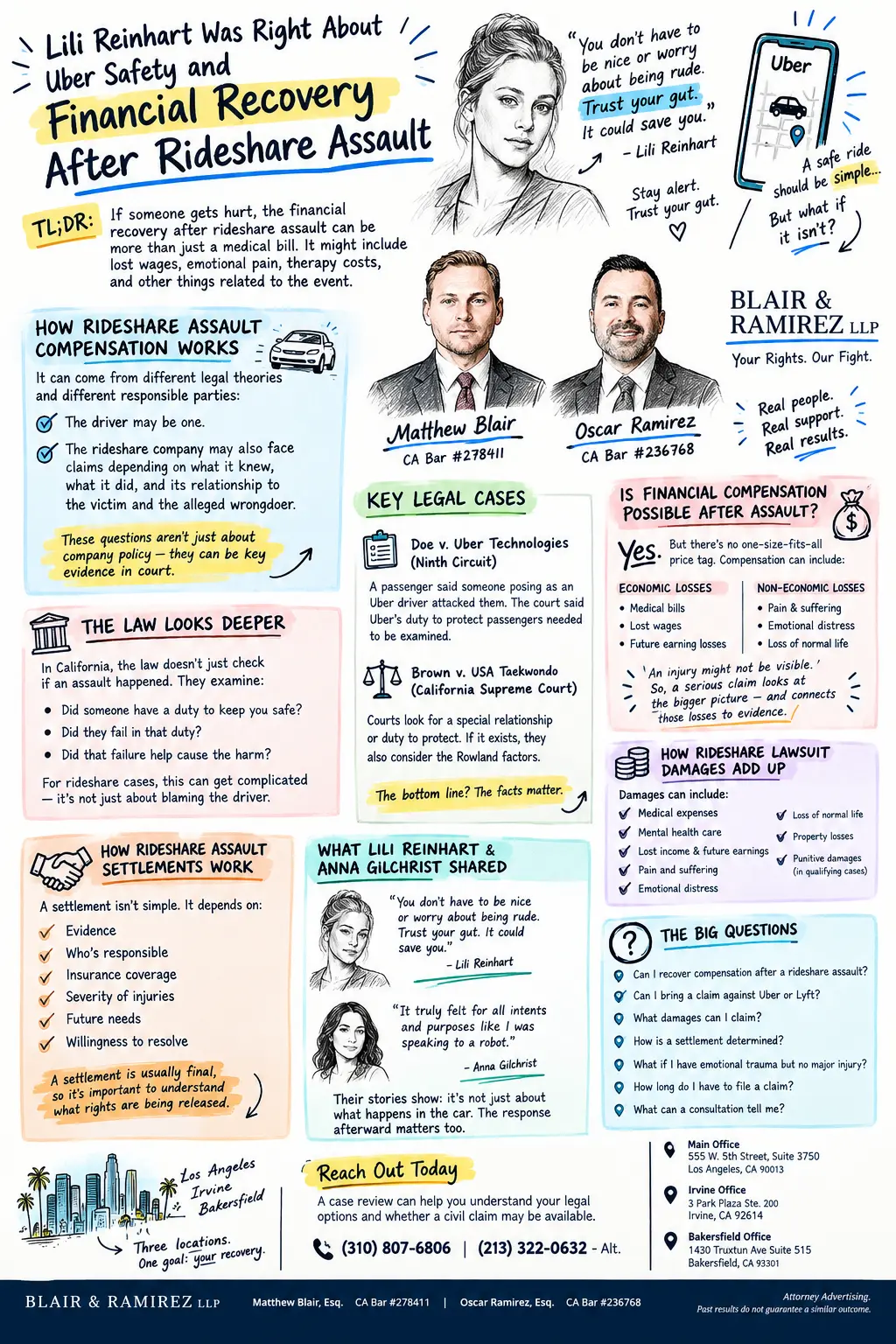
How Rideshare Assault Compensation Works
Rideshare assault compensation can come from different legal theories and different responsible parties. The driver may be one. A rideshare company may also face claims depending on what it knew, what it did, and what its relationship was to the victim and the alleged wrongdoer.
That distinction matters.
Think about a situation where a passenger tells the rideshare company that a driver is acting weird. What does the company do next? Do they take action? Do they check their records? Do they protect other passengers?
These questions are more than just company policy; they can be key evidence in court.
There was a case called the Ninth Circuit’s Doe v. Uber Technologies. A passenger said someone pretending to be an Uber driver attacked them. In this case, the Ninth Circuit Court looked closely at Uber’s responsibility and decided that the case should continue. They said it was important to understand Uber’s duty to protect passengers.
But just because a case is brought against Uber or Lyft doesn’t mean it will always win. The facts are super important.
California’s Supreme Court made a similar point in Brown v. USA Taekwondo. The court explained that when someone seeks to hold an organization responsible for failing to protect them from a third party, courts first examine whether a special relationship or other circumstance creates a duty to protect. If such a duty exists, courts then consider the policy factors from Rowland v. Christian.
In simple words, who could help prevent the harm, and what did they do?
Is Financial Compensation Possible After Assault?
Can you get money after an assault in a rideshare? Yes, you can. But it’s not like there’s a one-size-fits-all price tag.
Compensation for rideshare assault can include two types of losses:
- Economic Losses: Like hospital bills or money lost from missing work.
- Non-Economic Losses: This could be pain, suffering, or feeling very upset.
Think about this: an injury might not be visible. A person might have to go to the emergency room. They might need months of therapy. They could lose a paycheck. They might even avoid rideshares forever because they’re too scared. Can a hospital bill show all this? Not a chance.
So, a serious claim needs to look at the bigger picture. It should connect these emotional and financial losses to evidence.
In California, you usually have two years to file a claim for assault. But there are other time limits for specific situations, like sexual assault.
That is why it’s smart to get help from a lawyer to understand what applies to your situation.
How Rideshare Lawsuit Damages Add Up
Damages in a rideshare assault lawsuit depend on what happened, who is responsible, and the proof you have.
|
Type of damages |
What it can include |
Example |
|
Medical expenses |
Emergency care, doctors, medication, treatment and related care |
A survivor needs medical treatment after an assault |
|
Mental health care |
Therapy, counseling and other appropriate treatment |
Ongoing therapy is needed after the incident |
|
Lost income |
Pay lost because the person could not work |
Several weeks away from work |
|
Future earning losses |
Reduced ability to earn in the future |
Trauma prevents a return to the same job |
|
Pain and suffering |
Physical pain and the broader impact of the injury |
Continuing physical discomfort |
|
Emotional distress |
Fear, anxiety, trauma, humiliation and related harm |
Severe emotional effects after an assault |
|
Loss of normal life |
Changes to activities, routines and relationships |
Someone stops participating in activities they once enjoyed |
|
Property or related losses |
Property damage or other directly connected expenses |
Personal property damaged during the incident |
|
Punitive damages |
Possible additional damages in qualifying cases |
Alleged conduct involving legally defined malice, oppression or fraud |
Let’s talk about punitive damages. These are different from regular compensation. Punitive damages can happen in special cases where there is clear proof of bad behavior, like fraud or malice.
But they can’t just be any big number. For example, in State Farm Mutual Automobile Insurance Co. v. Campbell, the U.S. Supreme Court said punitive damages should not be excessive.
So no, punitive damages are not simply a bigger number someone can ask for because an assault was terrible. The facts and the law have to support them.
How Rideshare Assault Settlements Work
A rideshare assault settlement is an agreement that resolves a civil claim without a trial.
But settlement does not mean the case is simple.
What proof do you have? Who’s to blame? What insurance is involved? How serious are the injuries? These questions matter during negotiations.
Also, the first offer might look good, but does it really cover everything? Future treatments and lost pay could be missing from what they offer.
Finally, once you settle, it’s usually final. That makes understanding what you’re agreeing to super important.
How Lili Reinhart Saw the Risk
California actress Lili Reinhart had a scary experience with rideshare safety back in 2019.
While at an airport, someone pretending to be a professional driver tried to lead her to a car. Lili noticed that the car seemed off, and she decided not to get in. Later, she shared some wise words with her fans:
“You don’t have to be nice or worry about being rude. Trust your gut. It could save you.”
That is good safety advice. But it also raises tough questions:
- What if you did get inside that wrong car?
- What if the driver looked like they belonged to the rideshare app?
- What if the assault started during the ride?
- And what if the driver had a history that should have raised red flags?
These are much bigger questions than just asking if a passenger made a good choice. It’s easy to blame the victim, but it takes effort to look at all the systems around them.
Los Angeles actor and writer Anna Gilchrist described her own frightening experience with a Lyft driver and later said of the company’s response,
“It truly felt for all intents and purposes like I was speaking to a robot.”
That quote is important because what happens after an incident can also matter in a legal claim. What records exist about the ride? Was there a complaint? Did anyone take action? Did the company keep important information?
The answers to these questions can help figure out what really happened and who might be responsible.
How a Rideshare Assault Lawyer Helps
A rideshare assault lawyer can help gather a case using evidence instead of guesswork. They may look into trip records, driver info, app messages, GPS data, complaints, background checks, medical records, lost job income, and other important documents.
Why is this so critical? Memory alone might not tell the full story.
For instance, an app can show exactly where the ride went. A message might explain what happened afterward. Medical records can prove injury, and therapy notes could show lasting emotional distress. Company records might reveal if someone had previously raised concerns about the driver.
California’s Rowland framework (cited above) tells courts to think about things like foreseeability, how a defendant’s actions connect to the injury, and the moral blame involved.
The case Brown v. USA Taekwondo later made it clear that courts follow a two-step approach when deciding who has a duty to protect someone from harm done by someone else.
These cases don’t automatically make a rideshare company responsible, but they show why digging deep into evidence is essential. The question isn’t just “Who hurt me?” It’s also “Who else should have done something to prevent this?”
Questions Survivors Often Ask
Key Takeaways
- Rideshare assault claims often involve more than just the person who hurt someone; other parties’ responsibilities can come into play.
- Compensation can include medical costs, lost income, emotional distress, and other legally supported losses.
- California courts take a close look at duty, foreseeability, control, evidence, and the link between a defendant's actions and the harm caused.
- A settlement should be assessed based on the total picture of past and future losses, not just current bills.
- A private case review can help a survivor understand their legal choices after a rideshare assault.
Your Ride Ended. The Financial Impact May Not Have
A rideshare assault can be over in just minutes, but the results can last much longer.
Bills don’t care how confusing the situation was. Neither does lost income or therapy costs. Emotional harm doesn’t become less real just because it isn’t visible.
Recovering financially after a rideshare assault starts with understanding what happened, keeping evidence safe, and identifying every loss that might be important.
At Blair & Ramirez LLP, a case review can help you learn about your legal options and whether you can file a civil claim. Contact Blair & Ramirez LLP for a free, confidential case review to discuss your experience with a California legal team that understands rideshare and personal injury claims.
Attorney Advertising.
Responsible Attorneys: Matthew P. Blair, Esq. (California Bar No. 278411) and Oscar Ramirez, Esq. (California Bar No. 236768), Blair & Ramirez LLP. The firm’s office address is 555 W. 5th Street, Suite 3750, Los Angeles, CA 90013.
This article offers general information and is not legal advice. Each case depends on its own unique facts and circumstances. Past results do not guarantee similar outcomes in future cases. Every case must be evaluated on its own merits.