

Finding out the other driver has no insurance can feel like hitting a brick wall. But wait. With the right insurance policy, some clever strategies, and a little luck, you still have pathways to get compensated for your injuries and losses.
Most of us think the answer is simple: no insurance means no money coming your way. Right? Not so fast.
Many Californians feel like they’re ready to throw in the towel before they even know their rights. And who can blame them? Medical bills flood in, your car looks like it went through a tornado, and your boss starts wondering where you are. Seems like a real pickle, doesn’t it?
But here’s a little secret that’s easy to overlook. Just because the other driver lacks insurance doesn’t mean you’re out of options.
At Blair & Ramirez LLP, we’ve seen firsthand how one sneaky investigation can turn the tide. Sometimes, your own insurance might come to the rescue. Did a witness see something you missed? Maybe a hidden camera caught the whole thing? Every accident tells a story, and discovering all the chapters is key to getting the help you need.
So before you throw your hands up in frustration, consider this question: What if your case holds more surprises than you think?
Why Does the Other Driver Having No Insurance Matter?
Let’s break this down. Why does a lack of insurance make things tricky after a crash?
Insurance is like a safety net for when things go south. It helps pay for ruined cars, doctor bills, lost paychecks, and more. When a driver with insurance causes an accident, their policy often swoops in to cover the costs. Simple, right? But what happens when that safety net has a hole in it?
Think about it like this: someone accidentally crashes into your parked car. They admit fault, offer a sheepish apology, and reveal they’re uninsured. That apology doesn’t fix your ride.
Now, let’s take it a step further. What if the crash caused serious injuries? Hospital fees won’t just disappear because the driver lacks insurance. Physical therapy still has a price tag. Missing work still means missing out on money.
Uninsured drivers create a tough situation. But getting compensation isn’t impossible, just a bit more complicated. California law requires drivers to have minimum liability insurance, but some people ignore that rule. Some forget to renew. And some choose to drive without coverage. Doesn’t sound fair, does it?
But fairness and real life don’t always dance together. That is precisely why understanding your options is crucial before giving up.
Our team digs deeper than just the first glance. Was another car in the mix? Did a pothole play a part? What about your own insurance? Does it offer hidden coverage that you might not even know about?
Those answers can be eye-opening.
How Can Your Own Insurance Still Help?
Here’s a common question we hear. “If the other driver has no insurance, why should mine matter?”
The answer may lie within your own policy.
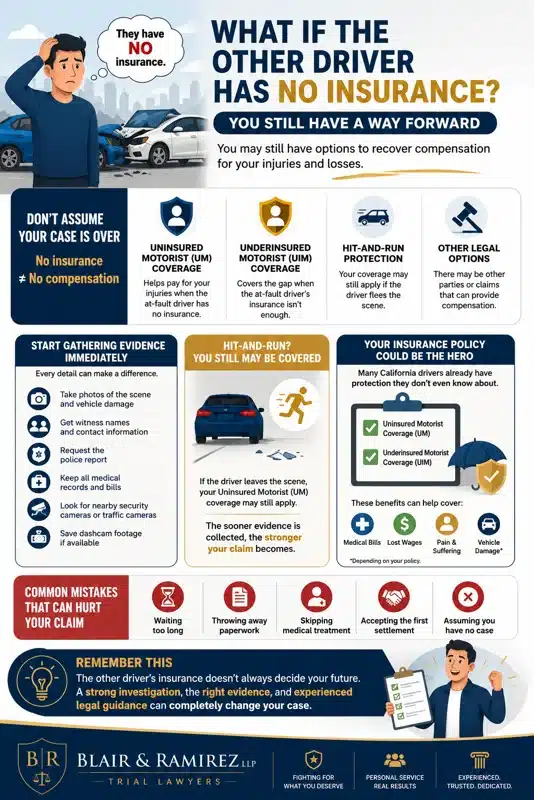
Many Californians have uninsured motorist (UM) or underinsured motorist (UIM) coverage. This is designed for moments just like this one.
Think about it: you buy home insurance hoping your roof never springs a leak. You get health insurance, crossing your fingers you’ll stay healthy. Auto insurance does the same thing. Some parts of your policy step up when someone else drops the ball.
If an uninsured driver causes your injuries, your uninsured motorist coverage may help cover medical costs, lost wages, pain, and more, depending on your policy.
Now let’s toss in a twist. What if the other driver has insurance but doesn’t have enough to cover all your damages? That’s where underinsured motorist coverage plays its part.
The funny thing is, many individuals don’t realize they have these nifty benefits until someone points them out. Some think filing a claim with their own insurance will be a breeze. Sometimes it is. But other times? Not so much.
Insurance companies still investigate claims. They ask about fault, treatment, or how hurt you really are. That is why gathering solid evidence matters from the get-go.
Snaps from your phone, statements from witnesses, police reports, and medical records all boost your claim. A single traffic camera or a shop’s security feed can answer questions that seem impossible to figure out.
A recent decision from the California Court of Appeals really highlights how crucial uninsured motorist coverage can be. In the case of Dameron Hospital Association v. Progressive Casualty Insurance Co. (2025), the court looked at whether a hospital could get payments through uninsured motorist benefits. They dove into California’s uninsured motorist laws and clarified how these benefits really work. While the case focused more on benefit assignments than who was at fault, it stressed a key point: uninsured motorist coverage holds real value and can shine bright after a crash involving an uninsured driver.
That’s why we tell clients not to let just “no insurance” close the book on their case. Those words rarely tell the whole tale. Sometimes, the strongest safety net has been sitting quietly in your policy all along.
Is a Hit-and-Run Accident Treated the Same?
What happens if the other driver doesn’t just lack insurance but vanishes into thin air? Surprise. This situation isn’t as rare as you might think.
Hit-and-run accidents leave people scratching their heads. Who caused the mess? Will the police find this mystery driver? What if they never do?
It can feel like a big, overwhelming cloud of confusion. But don’t jump to conclusions that your case ends there.
Many uninsured motorist policies cover hit-and-run accidents, too. It means your own insurance might protect you if you can show that another vehicle caused the crash.
That is where evidence steps into the spotlight.
Did someone nearby catch the action? Was there a business security camera that recorded what went down? Did a dashcam snap a pic of the license plate before the driver zoomed off?
Even tiny details can turn the tide. A witness might recall the color of the fleeing car. A shop down the street may have security footage, and a broken piece left behind could help identify the rogue vehicle later.
We’ve witnessed cases where investigations revealed crucial facts long after the accident. That’s why acting quickly makes a difference. Video clips can vanish, witnesses forget specifics, and physical evidence can disappear.
The sooner someone starts digging for answers, the better their chances of getting the information they need.
How Can Evidence Make Your Case Stronger?
Consider this: two drivers go through nearly the same accident.
The first driver captures the scene in photos, chats with witnesses, keeps their medical records tidy, and reports every ache to their doctor.
The second driver figures that nothing can be done since the other driver bolted without insurance. They wait weeks to think about gathering any evidence.
Which case seems tougher?
The answer is crystal clear.
Evidence narrates the tale before you ever step into a courtroom.
That’s why our team dives into every accident with a keen eye. We don’t just read the police report and call it a day. We search for video surveillance, traffic cameras, vehicle damage photos, witness statements, medical records, and sometimes reconstruct the accident.
California courts continually underline the importance of facts. Take the case Montrose Chemical Corp. v. Superior Court (1993) as an example. The California Supreme Court, with Justice Stanley Mosk at the helm, emphasized that insurance disputes need careful examination based on policy language and the facts, not just guesses. This case, while not about auto accidents, has shaped how courts across California interpret insurance coverage. The same principle applies after a crash with an uninsured driver. Every word in an insurance policy counts, and every fact can change the outcome.
Then there’s State Farm Mutual Automobile Insurance Co. v. Jacober (1973), another hit in the California Supreme Court. Justice Raymond Sullivan reminded us that insurance policies shouldn’t be read in a way that goes against what policyholders expect when the language is fuzzy. This principle has shaped California insurance law for ages. When it comes to uninsured motorist coverage questions, courts often look at what a policyholder could reasonably anticipate under their policy.
Here’s the takeaway: Never assume your insurance company or anyone else has already cracked the case. A thorough look at the facts and the policy often changes everything.
Why Should You Talk to a Lawyer Early?
It’s tempting to sit back and relax.
Maybe the insurance company will sort everything out for you.
Maybe the bills aren’t too scary yet.
Maybe life will figure itself out.
But what if it doesn’t? Time can quietly work against you.
Witnesses relocate. Camera footage gets wiped. Repair shops toss out damaged parts. Medical records become tougher to link to the crash if treatment takes too long.
The sooner an attorney gets involved, the quicker they can begin protecting the evidence that backs your claim.
At Blair & Ramirez LLP, we know that every accident tells a unique story. Some cases have uninsured drivers, while others involve underinsured drivers, multiple vehicles, or those frustrating hit-and-runs.
No two investigations look alike.
That’s why we don’t throw around assumptions. Instead, we rely on evidence, expertise, and meticulous planning.
If another driver’s lack of insurance has you feeling stuck in a rut, don’t assume you have no options. Let someone go over the facts before you write off your case.
Frequently Asked Questions
What if the other driver has no insurance but admits fault?
An “Oops, my bad” from them helps show who caused the crash, but it doesn’t guarantee payment. You might still lean on your uninsured motorist coverage or other available options, based on your situation.
How do I know if I have uninsured motorist coverage?
The easiest way is to peek at your auto insurance policy or ask your insurance company. An attorney can also break down your policy and tell you if uninsured or underinsured motorist coverage applies.
Can I recover compensation after a hit-and-run accident?
Yes. If your uninsured motorist coverage includes hit-and-run protection and meets your policy’s guidelines, you could still get compensated even if the driver never shows up.
Should I accept the insurance company’s first settlement offer?
Not always! An early offer might not fully cover future medical costs, lost wages, or long-term pain and suffering. It’s often safer to understand the total value of your claim before taking a settlement.
What evidence should I collect after an uninsured driver accident?
Snap photos of the scene, get witness contact info, request the police report, keep all medical records, and save repair estimates and receipts. The more evidence you gather, the stronger your claim can be.
Can I sue an uninsured driver directly?
In some cases, yes. But whether it’s practical hinges on the driver’s finances and your ability to collect on a judgment. An attorney can help assess if a lawsuit makes sense.
Don’t Let One Missing Insurance Card Decide Your Future
Finding out the other driver has no insurance can feel like a brick falling on your dreams. But it doesn’t always tell the whole story. Your insurance policy, the evidence you collect, and the specifics of your accident might unveil options you never knew existed.
At Blair & Ramirez LLP, we believe every client deserves answers before losing hope. We’ll dive into your accident, break down your legal options in straightforward terms, and fight for the compensation you rightfully deserve.
If an uninsured or underinsured driver has caused you harm, reach out to our team today for a free consultation. The sooner we start building your case, the stronger your chances of moving forward become.
Key Takeaways
- No insurance doesn’t mean no compensation. Your legal and insurance options might still be on the table.
- Uninsured and underinsured motorist coverage can protect you when the at-fault driver falls short.
- Evidence is crucial. Photos, witnesses, medical records, and any video can greatly enhance your claim.
- Hit-and-run accidents may qualify for uninsured motorist benefits based on your policy and accident details.
- Talking with an experienced lawyer sooner helps preserve evidence, clarify your rights, and boost your chances of fair compensation.