


TL;DR
The first settlement offer isn’t always the best. Taking time to understand your injuries, gather proof, and negotiate from a solid position can lead to a fairer outcome.
We’ve talked to a lot of people in California who thought the first offer from the insurance company meant their troubles were over. They wanted to put the crash behind them.
Who wouldn’t? But jumping at that offer too quickly can mean you’ll end up paying for someone else’s mistake long after you’ve signed away your rights.
Here’s the truth: Negotiating isn’t about who yells the loudest. It’s about knowing the real value of your claim. That’s where some smart personal injury negotiation tips come in. Taking your time now could save you from regrets later.
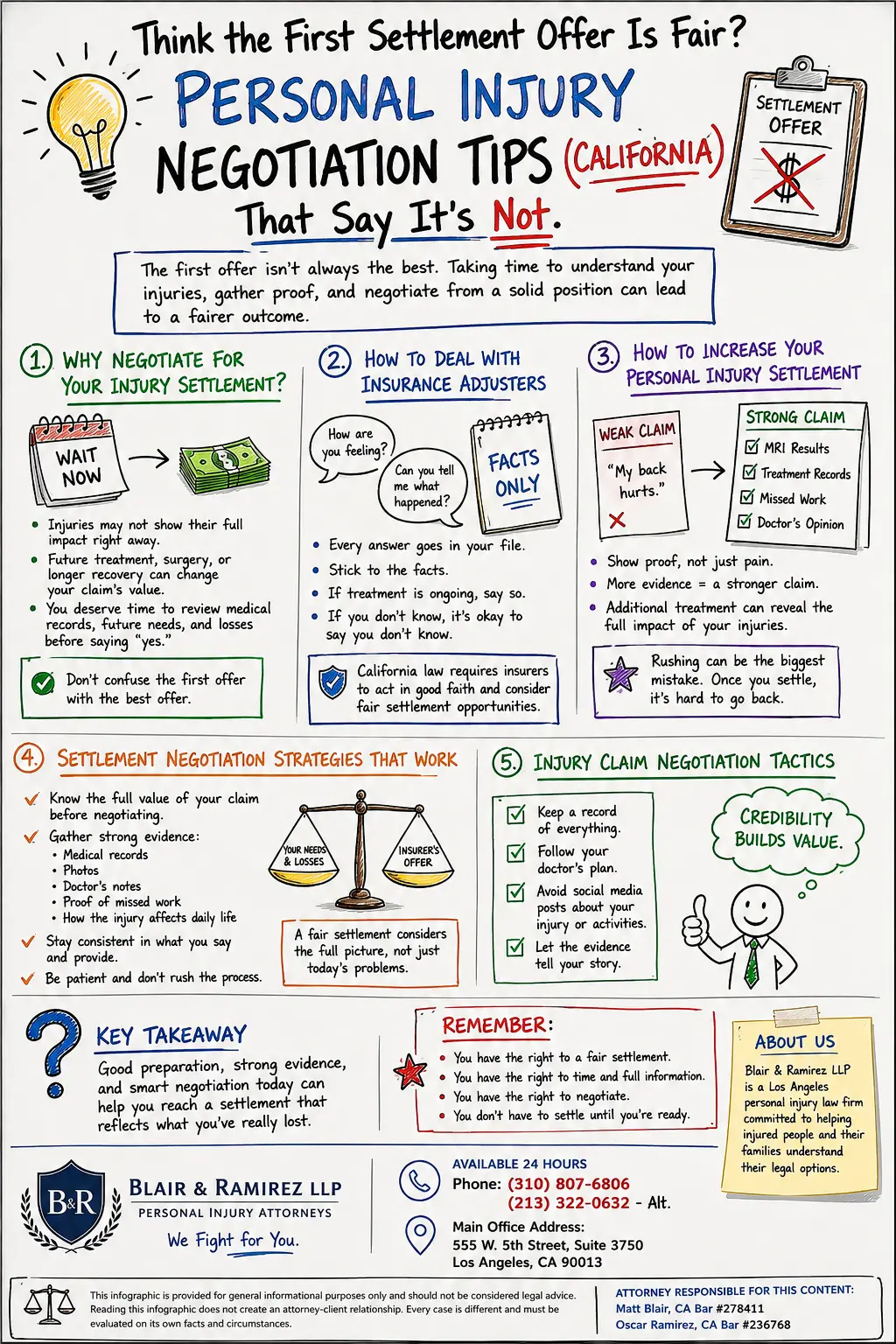
Why Negotiate for Your Injury Settlement?
Why does that first offer seem so great? Because it gives you quick cash, helps you feel like things are getting settled, and makes life a bit easier.
But here’s the twist: your injuries may not tell the whole story yet.
Think about someone who walks away from a rear-end collision with what seems like a sore neck. A week later, the pain spreads down an arm. A month later, an MRI reveals a herniated disc. That first settlement suddenly looks very different.
This happens more often than people think.
Insurance companies know that many people want to settle fast because they’re worried about money. Just because an offer comes quickly, it doesn’t mean it’s a good one. You need to really understand what you’re giving up.
California courts have reinforced that negotiations should be fair. In Brown v. Guarantee Insurance Co. (1957), the court said that insurance companies must act honestly when trying to settle. This matters now just like it did back then.
Good faith means you should have time to look over your medical records, understand what treatments you might need in the future, and figure out what you’ve lost before you accept an offer.
Ask yourself:
- What if your doctor says you need surgery next month?
- What if your physical therapy takes twice as long as you thought?
- What if you can’t go back to work right away?
These situations are more common than you think in California. That’s why it’s important to consider that first settlement offer before saying yes.
How to Deal with Insurance Adjusters
Insurance adjusters ask a lot of questions, and they have reasons for doing so.
Some of their questions might seem innocent, like “How are you feeling today?” or “Can you tell me exactly what happened?”
But every answer gets added to your claim file.
That means what you say really matters.
Let’s say you tell an adjuster, “I’m doing okay.” You might just be trying to stay positive. But later, they could say that means your injuries aren’t that serious when you claim they are. No one wants that kind of confusion.
So, what should you do instead?
Many people find it helpful to stick to the facts. If you’re still getting treatment, say that. If you’re waiting on test results, tell them. And if you don’t know something, just say you aren’t sure. Guessing doesn’t help anyone.
California law says that settlement decisions should be fair and not rushed. In Kelly v. Farmers Insurance Exchange (1989), the court pointed out that an insurance company could be responsible if they turn down a fair settlement without a good reason. This doesn’t mean all adjusters are unfair, but it tells us we need to work with facts, not guesses.
Think about it like this: If someone wanted to buy your house but only looked at the front yard, would you agree to sell it? Probably not. Your personal injury claim deserves just as much care.
How to Increase Your Personal Injury Settlement
Here’s a question people often ask: Can you just ask for more money? Yes, you can.
But it’s even better to ask: “Can you show why your claim should be worth more?”
Negotiating is not just about asking for a bigger number. It’s about backing it up with proof.
Let’s compare two claims:
- One person says, “My back hurts.”
- Another one shows MRI results, treatment records, proof of missed work, and a doctor’s note that explains why lifting is hard for six months.
Which claim sounds stronger? The answer is clear.
California courts have said many times that insurance companies must evaluate settlements fairly. In Kelly v. Farmers Insurance Exchange (cited above), the court said they have to look at your claim with care and consider your needs just as much as their own.
More evidence makes your claim stronger. Sometimes, getting additional treatment can help show the full impact of your injuries.
That is why rushing into a settlement is often the biggest mistake people make. Once you accept an offer, it’s hard to go back if you realize your injuries were worse than you thought.
That’s why these personal injury negotiation tips are crucial. The goal isn’t to just drag things out. It’s to make sure the settlement reflects what you’ve really lost, not just what you’ve lost up to now.
Why Settlement Negotiation Strategies Matter
What makes one negotiation succeed while another fails?
It’s not usually luck; it’s all about preparation.
Think about buying a used car. You wouldn’t agree on a price just because you saw one blurry picture online. You’d want to check the car out, ask questions, and compare prices to make sure you’re really getting a good deal.
Your personal injury claim deserves just as much attention.
Strong negotiation strategies start with knowing what you’ve lost. Some losses come with bills, like hospital costs or car repairs. But other losses, like pain or anxiety, don’t come with receipts. Imagine not being able to pick up your child or take your favorite hike on the weekend. Those things matter too, even if there’s no price for them.
That’s why California law allows people who’ve been hurt to ask for money for both types of damages, those that can be counted (like bills) and those that can’t (like the loss of joy or daily activities).
Courts have also said that settlements should be based on careful thinking, not just rushing to finish things. In Comunale v. Traders & General Insurance Co. (1958), the California Supreme Court made it clear: If an insurer doesn’t accept a fair settlement, they could be responsible for the full amount of what you’re owed.
The takeaway? Negotiations should be about fairness, not how fast you can finish.
How Injury Claim Negotiation Tactics Work
Some people think negotiation means arguing, but that’s not true.
The best negotiation tactics usually involve staying calm, being organized, and letting the facts do the talking.
Let’s say two people had nearly the same car accident. One keeps every bill, sticks to their doctor’s recommendations, writes down missed workdays, and doesn’t post about their injuries on social media. The other person misses doctor appointments, tosses out receipts, and posts vacation photos while still claiming they’re hurt.
Credibility is important here. Every medical record, photo, and statement must tell the same story. That doesn’t mean you should exaggerate your injuries; it means you should share the truth and back it up with evidence.
California courts have repeatedly highlighted that claims with solid proof stand a much better chance than those based on guesses. Negotiation isn’t about creating a better story; it’s about showing the real story.
Why Personal Injury Negotiation Tips in California Matter
California is different from other states. The laws and insurance rules vary, and even how blame is shared can impact your claim.
Here, California follows a “pure comparative negligence” rule. That means you can still get money even if you were partly to blame for the accident; your amount would just be reduced by how much responsibility you share.
The California Supreme Court confirmed this in Li v. Yellow Cab Co. of California (1975), which changed the old rule that would deny you any compensation if you were even a little at fault.
So why is this important in negotiations? Because blame often becomes a hot topic. An insurance company might claim you were 40% responsible, but the evidence could tell a very different story. That is why you must know personal injury negotiation tips. They help you float through tricky situations that could shape the outcome of your settlement discussions long before court comes into play.
The aim isn’t to win every argument; it’s to reach a settlement that truly represents the facts.
Frequently Asked Questions
Key Takeaways
- Don’t assume that the first settlement offer shows the total value of your claim.
- Strong proof can really make a difference during negotiations.
- Stay factual when talking to insurance adjusters, and don’t guess.
- California’s fault laws can change negotiations.
- Talking to a personal injury lawyer can help you figure out your best options before you decide to accept an offer.
Don’t Let the First Offer Write the Last Chapter
No one plans to negotiate a personal injury claim, but when an accident affects your life, every choice matters.
The first settlement offer might look like a quick fix. It might truly reflect your claim’s value, or it might not. The challenge is knowing which one it is before you agree to sign away your rights.
At Blair & Ramirez LLP, we think everyone in California should have the chance to make informed choices, not rushed ones. If you’ve been hurt and are uncertain whether a settlement truly covers your losses, our team can give you a free case review and help explain your legal options based on your situation.
If you have questions about an offer or your legal choices after an accident, reach out to us at Blair & Ramirez LLP. We’re here to help you understand what to do next.
Disclaimer: This article is for general information only and isn’t legal advice. Reading it doesn’t create a lawyer-client relationship. Every case is unique and should be looked at based on its own facts.