


TL;DR
If work suddenly feels different because of your gender, you may have questions about what happened and what you can do. Knowing how to find a gender discrimination lawyer starts with finding someone who can explain your rights in plain English.
Something feels off at work.
Your boss gives a big project to a man who started after you. Your hours change after you speak up about a sexist comment. You ask for a promotion and hear, “You’re not the right fit.”
Then you start asking questions. Was this about my work, or did gender play a part?
If you are wondering how to find a gender discrimination lawyer, do not just pick the first name you see online. You need someone who understands California workplace law and can look closely at what happened.
At Blair & Ramirez LLP, we represent employees in Los Angeles who face workplace discrimination, harassment, and retaliation. Our employment lawyers can review your situation, explain your legal options, and help you understand what comes next.
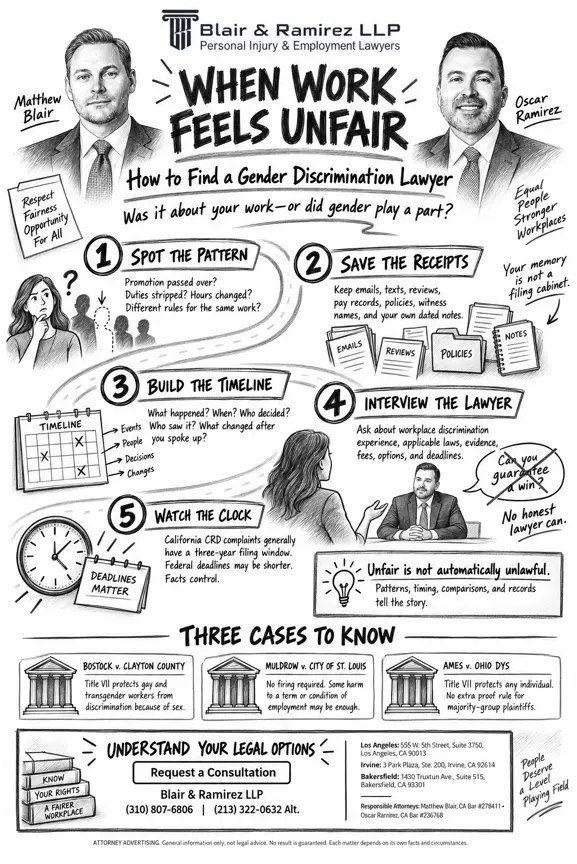
What Does Gender Discrimination at Work Look Like?
Let’s make this simple: Let’s say there are two people doing almost the same job. They have similar work records. Then a promotion opens up.
One gets it.
The other does not.
Is that discrimination?
Not by itself.
Now suppose the person who got the job is a man. The person who did not get it is a woman. And before the decision, the boss said, “Men are better at dealing with tough clients.”
Now there is another question: Did gender play a part in the decision?
That question matters.
Federal law, under Title VII, protects workers from discrimination because of sex. California law also protects workers from discrimination based on sex, gender, gender identity, and gender expression.
The Supreme Court has also said something important.
In Bostock v. Clayton County, the Court ruled that Title VII protects gay and transgender workers from discrimination because of sex.
Why does that matter here?
Because workplace discrimination does not always look the way people expect. The words a boss uses, the timing of a decision, and the way other workers are treated can all matter.
So, what should you do?
Start with the facts.
Write down what happened. Save emails. Keep texts. Save performance reviews. Write down who was there.
You do not need to solve the whole legal case yourself.
You need to understand what happened.
Why Does Muldrow Matter When You Are Looking for a Lawyer?
Here is a question people often ask:
“What if I was not fired?”
Good question.
You may still have a legal issue.
The Supreme Court looked at that question in Muldrow v. City of St. Louis.
Jatonya Muldrow was a police officer. She said she was moved to another job because she was a woman. Her pay and rank did not go down. But her schedule changed. Her work changed. She lost some of the duties and benefits she had before.
The Supreme Court said she did not have to show some huge or life-changing injury. She had to show that the discrimination caused some harm tied to her job.
That can be easier to understand with a simple example.
Suppose your title stays the same. Your pay stays the same.
But suddenly, your boss takes away your best accounts. You stop getting important meetings. Your male co-worker gets the work you used to handle.
Could those changes matter?
They might.
That is one reason your search (how to find a gender discrimination lawyer) starts with finding someone who will look at the whole story.
A good legal review should not focus only on one sentence or one bad day.
It should ask:
- What changed?
- When did it change?
- Who made the decision?
- What happened to other workers?
- What reason did the company give?
Those questions can help put the pieces together.
Is a Workplace Gender Discrimination Lawyer the Right Fit?
The names can get confusing.
You may see “gender discrimination lawyer.”
You may see “gender discrimination attorney.”
You may see “employment discrimination lawyer.”
You may even see “employment law firm.”
What is the difference?
Sometimes, not much.
A lawyer who handles employment discrimination may work on many types of workplace cases. That can include gender discrimination, race discrimination, disability discrimination, retaliation, and harassment.
But experience matters.
Imagine you have a problem with your car.
Would you rather talk to someone who knows cars or someone who has never opened a hood?
Legal problems work the same way.
You want someone who understands the kind of problem you are facing.
Here are some simple questions you can ask during a consultation:
|
Ask this |
Why ask it? |
|
Do you handle workplace discrimination cases? |
You want relevant experience. |
|
What laws might apply to my situation? |
More than one law may matter. |
|
What facts are important? |
Small details can change the picture. |
|
What records should I keep? |
Documents may help explain what happened. |
|
What deadlines should I know about? |
Legal deadlines can matter a lot. |
|
What are my options? |
You deserve a clear picture before making a decision. |
Notice what is missing.
“Can you guarantee that I will win?”
No honest lawyer can promise that.
Every case has its own facts.
How Can You Tell If a Work Decision Was About Gender?
This is where things get tricky.
Most bosses do not say, “I am doing this because you are a woman.”
Wouldn’t that make things much easier?
Instead, a company may give another reason.
- “Your work was not strong enough.”
- “You were not a good fit.”
- “We needed someone with a different style.”
Maybe that reason is true.
Maybe it is not.
So how can you tell?
Look at the pattern.
Suppose a manager tells a woman that she is “too emotional” but praises a man for being “passionate.”
Is that fair?
Suppose a woman gets called “bossy” when she speaks firmly, while a male co-worker gets praised for the same behavior.
What does that mean?
One comment alone may not answer the question. But comments, timing, records, and different treatment can help show the bigger picture.
The Supreme Court dealt with another important point in Ames v. Ohio Department of Youth Services.
In 2025, the Court rejected a special rule that made some workers prove an extra fact before bringing a Title VII discrimination claim. The Court pointed to the law’s protection of “any individual” from discrimination because of protected traits.
Why should you care?
Because the question is not simply, “Does this person belong to a certain group?”
The question is: What happened at work, and was the person treated differently because of a protected trait?
That is a much better place to start.
How Do You Find a Gender Discrimination Lawyer in Los Angeles?
Now we get to the practical part.
You search online.
You see dozens of names.
So, what are you looking for?
Start with experience.
Does the lawyer handle employment cases? Does the firm discuss workplace discrimination? Does the lawyer understand both California and federal law?
Then look at communication.
- Do they explain things in words you understand?
- Do they answer your questions?
- Do they ask questions about your side of the story?
That matters.
You should also be careful with big promises.
A lawyer who says, “You will definitely win,” cannot know that from a short phone call.
A lawyer who says, “Let’s look at the facts and see what the law says,” is giving you a more useful starting point.
Blair & Ramirez LLP handles employment matters in Los Angeles, including workplace discrimination, retaliation, harassment, and hostile work environment claims.
The firm also has a published record of employment-law results, including a gender discrimination and wrongful termination matter. Any past result, however, is specific to that case and does not guarantee or predict what will happen in another case.
What Should You Bring to a Legal Consultation?
You do not need a giant box of papers.
Start small.
Think about what happened.
Then make a simple list:
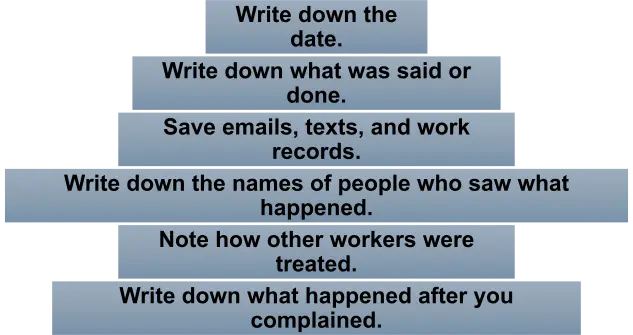
This can help you tell the story in the right order.
For example, maybe your boss made comments about women in March.
You complained in April.
In May, you lost a major account.
In June, you were passed over for a promotion.
Now the timeline is easier to see.
Does that prove discrimination?
No.
But it gives a lawyer something real to review.
And that is much better than saying, “I just feel like my boss does not like me.”
The Supreme Court’s decisions show why details matter. In Muldrow, the Court looked at changes in the worker’s duties, schedule, and other job conditions. In Bostock, the Court looked at whether sex was part of the reason for the employment decision. Different cases can raise different legal questions.
What Should You Do If Something at Work Feels Wrong?
First, take a breath.
You do not have to figure everything out in one day.
Ask yourself a few basic questions:
- What happened?
- When did it happen?
- Who was involved?
- Did anyone see it?
- Did something change after I complained?
- Was someone else treated differently?
Then check the deadlines.
California’s Civil Rights Department says an employment discrimination complaint generally must be filed within three years of the alleged discriminatory act. Federal deadlines can be shorter. The exact deadline can depend on the law and the facts.
That is why timing matters.
It is also why keeping records matters.
You may think, “I will remember all of this.”
Maybe you will.
But six months later, will you remember the exact date? The exact words? Who was in the room?
Probably not.
Write it down while you still remember.
FAQs
Key Takeaways
- Gender discrimination can show up in hiring, pay, promotions, job duties, or termination.
- You do not have to be fired for a workplace decision to raise a discrimination question.
- Keep emails, texts, reviews, and other records that may help explain what happened.
- Write down dates, names, comments, and changes at work while you still remember them.
- A consultation can help you understand your legal options without promising a certain result.
When Work Changes, The Questions Matter
Your hours change. You lose a promotion. Your boss calls you “too emotional” or says you are “not the right fit.”
You start to wonder what is really going on.
What happened? Why did it happen? And did gender play a role?
If you are asking how to find a gender discrimination lawyer, Blair & Ramirez LLP can help you understand your options. Our Los Angeles employment lawyers can review your situation, explain the law, and help you understand what steps may be available based on the facts.
Contact Blair & Ramirez LLP to request a consultation and get a clearer look at your legal options.