

TL;DR
A wrong way accident lawyer in Los Angeles looks at more than just who drove into the wrong lane. In California, courts think about responsibilities, causes, and proof that connects the crash to injuries and losses.
A wrong way accident lawyer in Los Angeles helps with a kind of car crash that sounds strange until it happens to you. Let’s say you are driving on the freeway, following all the rules, when suddenly another car comes toward you in the wrong lane. What can you do? Where can you go? And what if there’s nowhere to escape?
The crash might seem simple. One driver was going the wrong way. But California law asks more tricky questions: Did that driver’s actions cause the injury? Did anything else affect the situation? What losses happened afterward? And what if the driver who got hurt also made a mistake?
California’s Supreme Court has spent many years answering questions like these. The answers are very important after a wrong way crash because California does not see blame as just a simple yes or no.
Why Freeway Accident Attorneys Matter
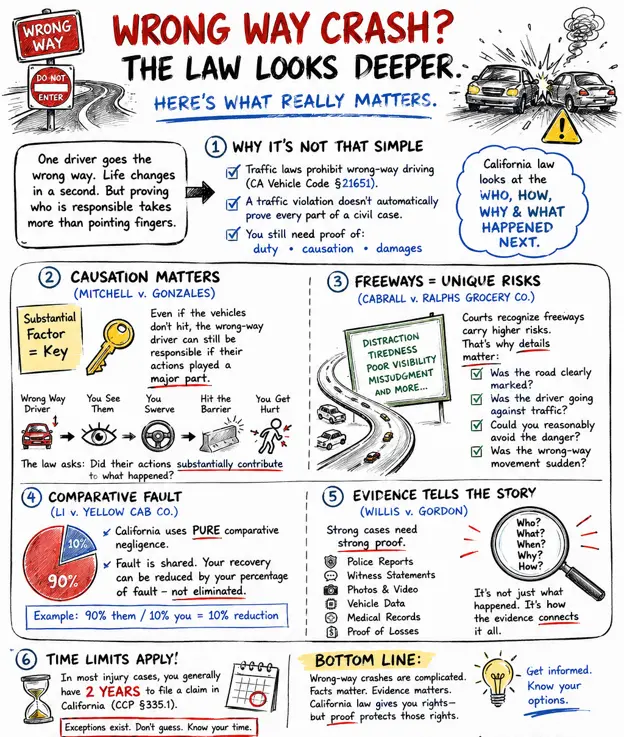
California Vehicle Code section 21651 generally prohibits driving on the wrong side of a divided highway. A willful violation that causes injury or death can also carry criminal consequences.
But here is the key point: breaking a traffic rule doesn’t mean that every part of a civil injury case is automatically proven.
Why is that?
A personal injury case still needs proof. The hurt person usually must show how the other driver’s actions caused their harm and what losses came after.
How Wrong Way Claims Prove Causation
So, how does a wrong way crash injury claim work?
Start by looking at the moments before the crash.
Was there a witness? Was there a camera that caught the accident? Did nearby cars have cameras? Did the police note which way each car was going? Did the wrong way driver show signs of losing control suddenly?
Next, think about the injury.
Suppose a driver sees a car coming toward them and swerves away. The two cars don’t hit, but the driver crashes into a concrete barrier and hurts their back. Can the wrong way driver still be responsible?
Potentially, yes.
The California Supreme Court looked at a similar problem in Mitchell v. Gonzales. The court decided that a driver’s actions can be a cause of injury if they played an important part in what happened.
This is important because a crash doesn’t always happen just one way.
- Driver A goes the wrong way.
- Driver B sees Driver A.
- Driver B swerves.
- Driver B hits a barrier.
- Driver B gets hurt.
The legal question is not just, “Did the two cars hit?” It’s whether Driver A’s actions helped cause the accident.
Is California Highway Liability Different?
A highway accident lawyer in California often has to think about things that regular drivers might not notice: the risks on a freeway are different from those on a quiet neighborhood street.
The California Supreme Court talked about this in Cabral v. Ralphs Grocery Co.
In this case, a truck stopped on the side of a freeway and was hit by another vehicle that left the road. Ralphs argued that they should not be held responsible because they didn’t think it would happen. The Supreme Court disagreed.
The court said vehicles can leave freeways because drivers may be distracted, tired, or unable to see. Why is this important? It’s because accidents on freeways can be very dangerous, especially if a car is driving the wrong way.
But just because there’s a crash doesn’t mean someone is automatically responsible. The details matter.
- Was the road clearly marked?
- Was the driver going the wrong way?
- Could the other driver have avoided the danger?
- Did the wrong way driver make a sudden move?
These questions help explain what happened in the accident and whether someone caused a real danger.
How Serious Freeway Compensation Works
What does it mean to get compensated for serious freeway accidents?
It is more than just a hospital bill.
Economic losses can include medical treatment, therapy, medicine, lost wages, and lower earning ability in the future. There may also be non-economic damages, like physical pain and emotional suffering.
But how can anyone decide what these losses are worth?
There is no exact formula that says a broken bone is worth this much money. Every case is different.
For example, think of two people who had similar accidents. One person goes back to work after a few weeks, while the other needs surgery, lots of therapy, and can’t return to the same job. Their financial losses might be very different.
This is why evidence is important.
Medical records can show what treatment someone got. Work records can show lost income. Expert opinions can help explain how injuries can limit someone in the future. Personal stories can explain how an injury changed their life.
And the rules from the California Supreme Court still matter. If the proof doesn’t link the driver’s actions to the injuries claimed, just having medical bills won’t solve the problem.
Why Comparative Fault Still Matters
Here’s where a wrong way accident lawyer in Los Angeles might face a surprising argument: What if you were partly to blame?
California doesn’t use an all-or-nothing rule for blame. In Li v. Yellow Cab Co., Justice Sullivan and the court decided that blame should be shared based on how much each person is responsible.
Why is this important?
Let’s say a jury thinks the wrong way driver was 90% responsible, while another driver’s actions played a part in causing 10% of the harm. In California, if that happens, the injured person’s compensation may be reduced by that percentage of blame.
This same idea applies even when the injured person is more than half to blame. It doesn’t mean that every insurance company’s percentage is correct, but it does mean that blame can be a big part of the case.
That’s why making a claim should be based on evidence and not just guesses.
How Evidence Can Change the Story
A “wrong way collision lawyer near me” search often starts with a simple story: “The other driver was going the wrong way.”
That might be true. But how do we prove it?
A police report can help. So can pictures, what witnesses say, videos, car data, medical records, and details about how the other driver was acting. California Supreme Court cases also show why proving everything is important.
In Willis v. Gordon, the court explained that a driver’s careless actions don’t have to be the “only reason” for an accident. It can be enough if those actions were an important cause of the crash.
This case is helpful because wrong way accidents can involve many things happening at once:
- A driver goes into the wrong lane.
- Another driver hits the brakes.
- A third car swerves.
- Someone hits a barrier.
- Then someone gets hurt.
Which event matters?
Sometimes, there’s more than one.
The law doesn’t need every case to have just one cause. The evidence must show how all events are connected.
Timing is important, too. In California, injured people generally have two years to file a claim under Code of Civil Procedure section 335.1, but some exceptions can change this timeline. That’s why it’s important to know the deadlines when looking at legal options.
Frequently Asked Questions
Key Takeaways
- California generally bans driving in the wrong lane on divided highways under Vehicle Code section 21651.
- A wrong way crash doesn’t automatically prove every part of a personal injury claim; the evidence is still important.
- California follows pure comparative negligence, meaning an injured person’s blame can reduce their damages rather than completely stopping their claim.
- Supreme Court decisions like Mitchell v. Gonzales and Willis v. Gordon show why causation is important even if it’s clear that the other driver did something wrong.
- A consultation can help someone understand their rights, deadlines, evidence, and legal options after a serious freeway accident.
The Road Is Confusing Enough Without a Legal Maze
A wrong way crash can happen in a flash, but figuring out what to do next can take much longer.
California law gives injured people clear ideas about duties, causes, blame, and damages. Cases like Cabral, Mitchell, Li, and Willis show that courts look beyond the first simple explanation to understand how actions, risks, blame, and responsibility connect with each other.
For anyone thinking about their options after a freeway accident, understanding this is important. A consultation with Blair & Ramirez LLP can provide information about the facts of your possible personal injury claim, the evidence that may help, and the legal options available in California.
Contact Blair & Ramirez LLP to request a free case review.