


TL;DR
Union vs. non-union employee rights in California can look very different when a workplace dispute starts. Union workers often have a contract, grievance process, and representation behind them, while non-union workers usually rely more directly on California and federal employment laws.
David Huerta knows something about the power of a union.
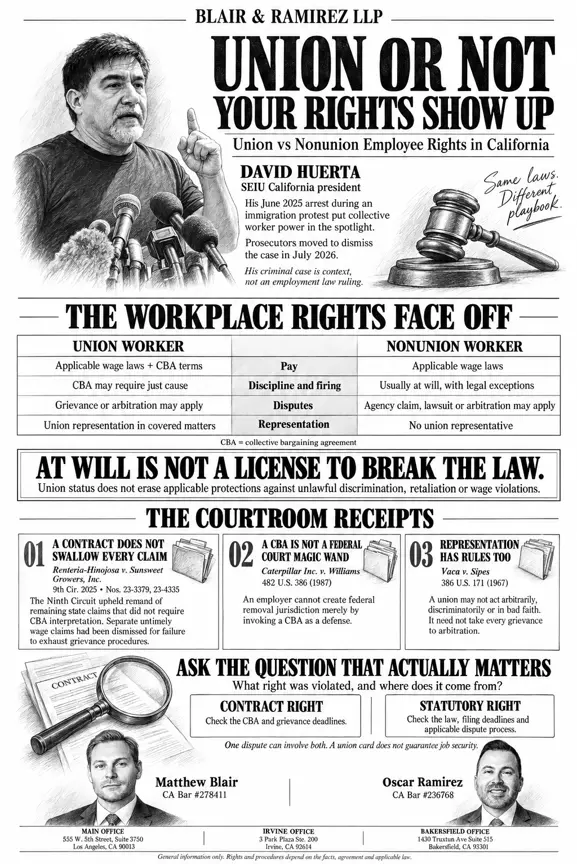
In June 2025, Huerta, the president of SEIU California, was arrested while protesting an immigration raid at a Los Angeles garment warehouse. He was injured, detained, and first faced a federal felony charge. Prosecutors later reduced the charge to a misdemeanor, and in July 2026, prosecutors moved to dismiss the case.
That story is about more than one labor leader. It raises a bigger workplace question: What changes when a worker has a union behind them?
What Changes When a Union Enters the Picture?
Think of two workers who get disciplined for the same mistake.
One has a union contract. The other does not.
Do they have the same rights?
Not always.
A union employee may have rights under a collective bargaining agreement, often called a CBA. The agreement can cover pay, hours, discipline, layoffs, seniority, benefits, and how workplace disputes move through a grievance process.
A non-union employee does not lose legal protection. California law still protects workers from wage violations, discrimination, retaliation, and other unlawful conduct. The California Labor Commissioner confirms that workers have rights involving wages, breaks, and retaliation regardless of union status.
|
Issue |
Union employee |
Non-union employee |
|
Pay and overtime |
Law + CBA |
California/federal law |
|
Discipline |
Often controlled by CBA |
Employer policy + law |
|
Firing |
CBA may require just cause |
Usually at-will, with legal exceptions |
|
Workplace dispute |
Grievance/arbitration may apply |
Agency claim, lawsuit, or other legal process |
|
Union representation |
Usually available in covered matters |
No union representative |
So, which worker has it better?
That depends on the problem. A union contract can add important protections. But it can also require a worker to follow specific grievance steps before going to court.
Collective Bargaining Agreement Rights in California Can Change the Route to Court
Here is where things get interesting.
A CBA is not just a stack of pages collecting dust in a filing cabinet. It can change how a dispute gets handled.
Consider Renteria-Hinojosa v. Sunsweet Growers, Inc., decided by the Ninth Circuit on August 14, 2025.
Renteria-Hinojosa worked for a California company and was represented by the Teamsters. Her CBA covered matters such as overtime, sick leave, and meal and rest breaks. She sued over several California labor-law claims, including wage, break, reimbursement, and retaliation claims.
The employer argued that the CBA pushed those claims into federal labor law and the contract’s grievance process.
The Ninth Circuit drew an important line. Some claims tied directly to the CBA had to go through the contractual process. But many California-law claims did not require interpretation of the CBA, so they were not preempted.
The lesson?
Having a union does not erase California labor rights. But the CBA can affect where and how a worker pursues those rights.
Can Non-Union Employees Be Fired at Will?
Usually, yes.
But “at will” does not mean “anything goes.”
California Labor Code section 2922 creates the general rule that employment without a specified term can be ended by either side.
So, can non-union employees be fired at will? Generally, an employer can fire an at-will employee for a good reason, a bad reason, or no reason at all, as long as the firing does not violate another law or an enforceable employment agreement.
For example, an employer cannot legally fire someone because they reported unpaid wages or exercised another protected workplace right. California also prohibits retaliation for certain protected activities.
Union workers can have another layer of protection. Their CBA may say the employer needs “just cause” before imposing certain discipline or termination.
But even that is not automatic.
Look at City & County of San Francisco v. Public Employment Relations Board (June 22, 2026). The case involved roughly 500 city attorneys represented by a union. They were classified as at-will employees, and the union tried to negotiate just-cause protections and arbitration for discipline and termination. The Court of Appeal held that the city charter prevented those proposals from going through binding interest arbitration.
So, a union contract can offer strong protections. But the exact contract, public-sector rules, and governing law still matter.
Four New Cases Show Why the Details Matter
The recent cases tell a pretty clear story: union rights are powerful, but they are not unlimited.
|
Case |
What happened |
Why it matters |
|
A union worker brought wage and retaliation claims against her employer. |
Some claims had to follow the CBA, while others remained California-law claims. |
|
|
L.A. College Faculty Guild v. L.A. Community College District (2025) |
A union sought arbitration over several grievances, including faculty termination. |
The court found some disputes outside the CBA’s arbitration scope. |
|
Dept. of Human Resources v. California Correctional Peace Officers Association (2026) |
A union representative challenged a long suspension through a grievance and arbitration. |
The court upheld the arbitrator’s authority to provide a remedy under the MOU. |
|
A union sought just-cause protections for at-will city attorneys. |
The court said the city charter blocked binding interest arbitration over those protections. |
Take L.A. College Faculty Guild v. L.A. Community College District. The California Court of Appeal ruled in May 2025 that several grievances were outside the reach of the CBA’s arbitration clause. One involved the termination of a faculty member. Another involved construction work. A retirement-benefit dispute could proceed only in part.
Then there is Department of Human Resources v. California Correctional Peace Officers Association (May 2026).
A correctional officer and union representative received a 60-workday suspension. Her union filed a grievance, arguing that the discipline violated the parties’ MOU and protections for union activity. An arbitrator sided with her and ordered the discipline rescinded, with back pay and restored benefits. The Court of Appeal held that the arbitrator had not exceeded her authority.
That is the other side of the story.
A grievance is not just a complaint. When the contract gives an arbitrator power to decide a dispute, the process can produce a binding remedy.
Union Grievance vs Lawsuit in California Is Not Always an Either-Or Question
So, what happens when a union worker believes an employer broke the law?
Do they file a lawsuit?
Do they file a grievance?
Sometimes the answer depends on the claim.
A grievance usually focuses on rights created by the CBA. A lawsuit can involve rights created by state or federal law. Sometimes both systems overlap.
That is why Renteria-Hinojosa matters. The Ninth Circuit said some claims were tied closely enough to the CBA to require the contractual process, while other California-law claims did not require interpretation of the agreement.
There is another important point. The National Labor Relations Board says a union generally has a duty to represent employees fairly, in good faith, and without discrimination, including in grievance handling.
In simple words, a union cannot simply shrug and say, “Good luck.”
What David Huerta’s Story Says About Worker Power
David Huerta’s 2025 arrest put a familiar labor question into a very public spotlight.
Huerta was observing and protesting an ICE operation in Los Angeles when he was injured and arrested. He spent three nights in detention before a judge released him on a $50,000 bond. Prosecutors later reduced the original felony charge to a misdemeanor and moved to dismiss the case in July 2026.
The point here is not whether you agree with Huerta or the government.
It is simpler than that.
Workers sometimes act together because one worker alone has less power. A union can provide collective bargaining, representation, and contractual rights. A non-union worker can still have strong protections under California law.
The question is not simply, “Union or non-union?”
The better question is, “What right was violated, and where does that right come from?”
Frequently Asked Questions
Key Takeaways
- Union employees may have contractual protections that non-union employees do not have.
- Non-union workers still receive important protections under California employment laws.
- A CBA can require an employee to use a grievance or arbitration process before pursuing certain claims in court.
- Recent 2025–2026 cases show that courts look closely at the exact language of the CBA and the source of the employee’s rights.
- Whether a worker is union or non-union is only the starting point. The real question is what right was violated and what law or agreement protects it.
Your Workplace Rights Deserve a Closer Look
Workplace law is full of small words with big consequences.
At will. Just cause. Grievance. Arbitration. Retaliation.
One word in a contract can change the path of a dispute.
If you are trying to understand union vs. non-union employee rights in California, Blair & Ramirez LLP can help you understand the legal options that may apply to your situation. The right answer starts with the facts, the employment agreement, the CBA if there is one, and the law that protects the worker.
Contact Blair & Ramirez LLP to request a consultation and learn more about your legal options.