


TL;DR
The pay transparency law in California gives workers and job seekers more information about wages. It requires covered employers to share salary ranges in job postings and gives workers ways to ask about pay. Knowing these rules can help you spot problems and understand your rights.
A job offer can change your life. But how do you know whether the salary is fair? And why should you have to sit through three interviews before learning that the pay will not cover your rent?
California has taken steps to make pay more open. The pay transparency law in California requires covered employers to disclose salary ranges in job postings. It also gives employees the right to ask about pay scales. Still, knowing what a job pays does not always tell you whether an employer treats workers fairly.
At Blair & Ramirez LLP, we understand that workplace disputes can raise difficult questions about fairness, income, and your future. Clear information matters. So does knowing what the law protects, what it does not, and what you can do when something seems wrong.
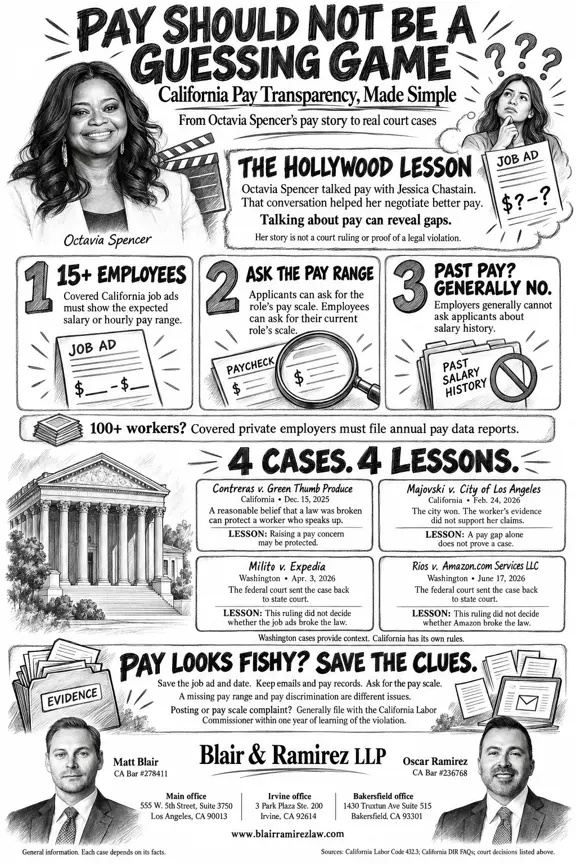
Why Octavia Spencer’s Pay Story Still Matters
Hollywood loves success stories. But what happens when two actors bring talent, hard work, and star power to the table, yet their paychecks tell different stories?
In September 2026, Oscar-winning actor Octavia Spencer revisited Hollywood’s pay gap during a conversation with Keke Palmer. Spencer discussed how talking about pay with her former The Help co-star Jessica Chastain helped her push for fair compensation on a Christmas film they planned to make together.
Spencer’s experience highlights a simple problem. Workers cannot judge fairness when they lack basic information about pay. Open conversations can help people spot gaps and negotiate better terms.
[Read the September 2026 report on Octavia Spencer’s comments.]
Of course, a Hollywood salary negotiation is not the same as a California job posting dispute. Spencer’s story does not establish a legal violation. But it shows why pay transparency in California matters, whether someone works on a movie set or at a neighborhood office.
What Does California’s Pay Transparency Law Require?
California’s rules grew stronger under Senate Bill 1162, which took effect in 2023. The law amended California Labor Code Section 432.3 and expanded salary disclosure and pay data reporting rules.
Here is a simple breakdown.
|
Rule |
What it means |
|
Salary range in job postings |
Employers with 15 or more employees must include the pay scale in covered job postings. |
|
Pay scale requests |
Applicants can request the pay scale for a position. Current employees can request the pay scale for their own positions. |
|
Salary history |
Employers generally cannot ask applicants about their past pay or use it to set an offer. |
|
Pay data reporting |
Covered private employers with 100 or more employees, including certain workers hired through labor contractors, must submit annual pay data reports. |
[The California Labor Commissioner explains these rules in its official Equal Pay Act and Pay Transparency Law FAQs.]
One detail matters: the posted range should reflect what the employer genuinely expects to pay when hiring. A company should not advertise a range so wide that it tells applicants almost nothing.
And what if a posting says, “Competitive salary”? That phrase does not replace the required range when the law applies.
What Happens When an Employer Breaks the Rules?
A job posting can leave out the salary range. A recruiter can ask for an applicant’s salary history. A company can also ignore a request for a pay scale.
Each situation raises different legal questions.
California Labor Code Section 432.3 allows an aggrieved person to file a complaint with the Labor Commissioner within one year after learning of an alleged pay transparency violation. A person may also seek court relief under the statute.
|
Possible problem |
Why it matters |
|
Missing salary range |
A covered employer may violate posting requirements. |
|
Request for past salary |
The employer may violate the salary history restriction. |
|
Refusal to provide a required pay scale |
The employee or applicant may have grounds to complain. |
|
Missing pay data report |
A covered employer may face state enforcement and civil penalties. |
The law sets penalties of $100 to $10,000 for violations of its job-posting requirements, depending on the circumstances. Pay data reporting violations carry separate penalties, which can reach $200 per employee.
But not every mistake leads to the same result. The facts, the type of violation, and the enforcement process all matter. An employer’s failure to post a salary range also does not automatically prove that it discriminated against a worker.
Four Recent Cases That Shed Light on Pay Rights
A quick research note matters here. The following cases were decided in 2025 or 2026, but they do not all interpret California’s salary-posting law. Two concern California employment rights, while two involve Washington’s separate pay transparency law. Together, they offer useful lessons about evidence, retaliation, and salary disclosure.
1. Contreras v. Green Thumb Produce, Inc. (December 15, 2025)
Manuel Contreras believed his employer paid him less than coworkers who performed similar work. He raised his concerns and consulted the Labor Commissioner’s Office. After he presented his concerns to human resources, the company fired him.
A jury found in his favor, but the trial court later removed the jury’s finding on his whistleblower claim. The California Court of Appeal reversed that ruling. It explained that a worker can receive whistleblower protection when they reasonably believe a legal violation occurred, even if their understanding of the law turns out to be wrong.
The lesson? Workers who raise genuine concerns about pay may have rights beyond the underlying wage dispute. But a pay difference alone does not prove unlawful discrimination.
[Read Contreras v. Green Thumb Produce, Inc.]
2. Majovski v. City of Los Angeles (February 24, 2026)
Karen Majovski, a deputy city attorney, alleged gender discrimination, unequal pay, and retaliation. Her salary depended on her job classification and pay step. She argued that the city treated her unfairly in pay and promotion decisions.
The California Court of Appeal upheld summary judgment for the city. The court found that her evidence did not establish the required connection between her pay and gender discrimination.
This case offers an important reminder: pay differences deserve attention, but a successful equal-pay claim requires evidence that meets the law’s standards. Job duties, experience, classification, and valid pay reasons can all matter.
[Read Majovski v. City of Los Angeles]
3. Milito v. Expedia, Inc. et al. (April 3, 2026)
John Milito brought a proposed class action alleging that Expedia job postings failed to include salary ranges and other compensation information required by Washington law.
The federal court sent the case back to state court because the defendants had not established the federal court’s jurisdiction. The decision addressed standing and jurisdiction, not whether Expedia had violated the pay disclosure law.
Why include it? It shows that a missing salary range can become the subject of litigation, while also reminding readers that procedural rulings do not decide the underlying allegations.
[Read Milito v. Expedia, Inc.]
4. Rios v. Amazon.com Services LLC (June 17, 2026)
Christine Rios alleged that Amazon job postings failed to disclose salary ranges under Washington’s pay transparency law. She brought the case on behalf of herself and a proposed group of applicants.
The federal court remanded the case to state court because the defendants failed to establish the concrete injury needed for federal jurisdiction. The ruling did not decide whether Amazon violated the disclosure law.
[Read Rios v. Amazon.com Services LLC.]
For California readers, these Washington cases provide context, not controlling legal authority. California has its own statute and enforcement process, so anyone assessing a possible violation must apply California law to the facts.
What Should You Do If a Job Posting Hides the Pay?
Start with the facts. Save a copy of the job posting, including its URL and the date you viewed it. Keep emails or messages with recruiters, and write down what happened during pay discussions.
If you already work for the company, you can request the pay scale for your current position. If you apply for a job, you can request the pay scale for that role.
You should also separate two questions. Did the employer follow the disclosure rules? And do you have evidence of unequal pay or retaliation? These issues can overlap, but they are not the same.
Blair & Ramirez LLP can help people understand employment disputes and evaluate their legal options based on the facts of their situation.
Frequently Asked Questions
Key Takeaways
- Covered California employers with 15 or more employees must include salary ranges in job postings.
- Employees can request the pay scale for their current position.
- California generally prohibits employers from asking applicants about salary history.
- Pay transparency violations and unlawful pay discrimination are different legal issues.
- Keep job postings, emails, and pay records if you suspect a violation.
Fair Pay Starts With Clear Information
Pay should not be a guessing game. Whether you are applying for your first job, changing careers, or trying to understand why a coworker earns more, clear salary information can help you make better decisions.
California’s rules offer important protections, but understanding them is only the first step. If you have questions about a missing salary range, unequal pay, or possible retaliation, contact Blair & Ramirez LLP to request a consultation and discuss your legal options. The facts matter, and a careful review can help you understand the next steps available to you.