


TL;DR
In California, there isn’t just one rule for the maximum punishment for “harassment and simple assault.” Usually, simple assault is a small crime, but if it involves things like weapons or serious harm, the punishment can be worse.
A rideshare trip, like in an Uber or Lyft, can turn bad really fast. If something goes wrong, is it harassment? Is it a simple assault? Can someone go to jail? And if many things happen during one ride, does California see them as one problem or many?
The answer is tricky. California looks at simple assault and harassment as different crimes, and how serious the punishment is depends on the situation, the person hurt, and other stuff. If someone gets hurt during a rideshare trip, they can also try to get money to help pay for doctor bills, lost wages, or feelings hurt.
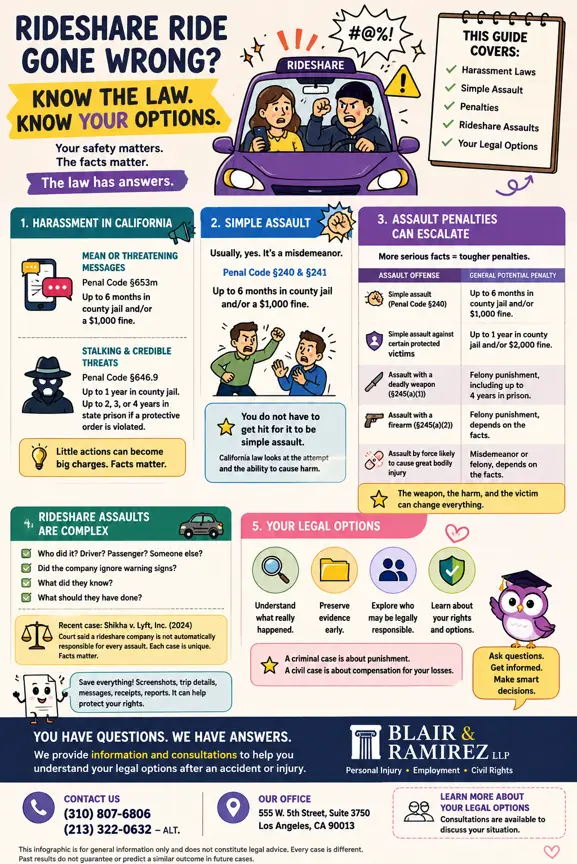
How Do California Harassment Laws Work?
First, what does “harassment” mean?
California has laws about harassment. For example, Penal Code section 653m says that sending many scary or mean messages can be punished by up to six months in county jail or a fine of up to $1,000.
Stalking is different. California Penal Code section 646.9 says that if someone follows another person and makes real threats that scare them, it can be worse. If the stalker gets caught, they can spend up to a year in county jail or face bigger punishments if they broke a protective order.
Thinking about this with rideshare cases: If a passenger keeps sending scary messages to a driver after the ride, that’s one problem. But if the passenger follows the driver and keeps threatening them even after getting a warning, that’s a much bigger situation.
So, trying to figure out the worst-case punishment without knowing the exact situation can be misleading.
Is Simple Assault a Misdemeanor?
Usually, yes.
California Penal Code section 240 defines simple assault as an unlawful attempt, coupled with the present ability, to commit a violent injury against another person. Under Penal Code section 241, ordinary simple assault is punishable by a fine of up to $1,000, up to six months in county jail, or both. Certain assaults against protected workers and emergency personnel can carry a higher maximum of one year in county jail.
But here is the part people often miss: an injury does not have to happen for simple assault to occur.
Suppose a rideshare passenger raises a fist and moves toward a driver as if preparing to hit him, while standing close enough to do it. The driver may never get punched. The conduct can still raise an assault issue because California law focuses on the unlawful attempt and the present ability to cause violent injury.
Recent California case law also shows why the details matter. In People v. Lynch, decided by the California Supreme Court in 2024, the court examined how aggravating facts can affect an upper-term sentence. The court explained that current California law creates a “presumption against the upper term” and requires certain aggravating facts to be properly proven before that higher term can be imposed.
That is an important lesson for anyone asking about the maximum sentence for harassment and simple assault. The statutory maximum is only part of the picture. The actual sentence can depend on facts that make the offense more serious.
How Do Assault Penalties Escalate?
Simple assault is not the end of the road.
California has many ways to categorize assaults. The punishment can get much worse if someone uses a dangerous weapon, hurts someone badly, or if the victim is someone special like a police officer. [For more information about how these issues can apply to rideshare assault cases, see our guide to rideshare assault claims.]
Here’s a simple chart of penalties:
|
Assault offense |
General potential penalty |
|
Simple assault under Penal Code § 240 |
Up to 6 months in county jail and/or $1,000 fine. |
|
Simple assault against certain protected victims |
Up to 1 year in county jail and/or $2,000 fine. |
|
Assault with a deadly weapon under § 245(a)(1) |
Can carry felony punishment, including imprisonment for up to 4 years. |
|
Assault with a firearm under § 245(a)(2) |
Can carry felony punishment, depending on the facts and circumstances. |
|
Assault by force likely to produce great bodily injury |
Can be charged as a misdemeanor or felony depending on the statute and facts. |
The difference can be huge.
In People v. Lattin, a 2024 California Court of Appeal case, a jury convicted the defendant of one assault with a firearm and three counts of simple assault. The trial court imposed an upper term for the firearm assault and concurrent six-month terms for the simple assault convictions. The appellate court explained that the elements of simple assault and assault with a firearm are nearly identical, except for the firearm requirement.
Why should you care about this if you are in a rideshare? Because “simple assault” doesn’t tell the full story. If someone just tries to hit, it might be a small crime. But if they pull out a weapon, it’s far more serious.
Why Does a Rideshare Assault Matter?
When something happens in a rideshare, it can be different than regular street violence.
Who caused the problem? Was it the driver? Another passenger? Did a stranger get in? Did the rideshare company know if the passenger was dangerous? Did they do enough checks before the ride?
California courts have recently looked at some of these questions.
In Shikha v. Lyft, Inc., decided in 2024, a Lyft driver was attacked by a passenger who repeatedly stabbed him during a ride. The driver sued Lyft, arguing that the company should have checked passengers better. But the court said Lyft didn’t have to. They needed better proof to show that Lyft was responsible.
That doesn’t mean rideshare companies can never be in trouble after an assault. It just means each situation needs to be looked at carefully.
California law also requires rideshare companies to have rules to handle problems like sexual harassment by drivers or passengers. They should know what to do if someone is unsafe. [If you want to understand how rideshare assault cases can raise questions about responsibility, evidence, and legal options, see our guide to rideshare assault claims in California.]
That makes evidence important. App records, trip information, messages, driver information, witness statements, police reports, medical records, and complaints made to the company may all help establish what happened.
How Can a Harassment Lawyer Help?
A harassment and assault lawyer can help answer the question that a sentencing chart cannot: What legal claim fits what happened to you?
Maybe the person threatened you but never touched you. Maybe they tried to hit you but missed. Maybe they struck you. Maybe they kept contacting you after the ride. And if the incident involved sexual assault, different legal issues may come into play. [We provide information about sexual assault cases in Los Angeles, including the legal options that may be available.]
Those differences matter.
A lawyer can also look beyond the criminal charge. If you were injured during a rideshare trip, you may have a civil claim against the person who harmed you and, depending on the facts, potentially against other responsible parties.
Consider a rider who leaves a vehicle with a broken wrist after an assault. The criminal case may focus on whether the driver committed assault and what punishment applies. The civil case asks a different question: who should pay for the rider’s medical bills, lost wages, pain, emotional distress, and other losses?
Those are separate legal questions.
And timing matters. Rideshare cases can involve digital evidence that may become harder to obtain as time passes. A lawyer can work to preserve trip records, app information, messages, video, witness evidence, and other records before important details disappear.
Understanding your legal options can also help clarify what evidence may matter and what types of claims may be available. A consultation can provide an opportunity to discuss the circumstances of a rideshare assault and ask questions about the legal process without assuming what the outcome will be.
How Should You Protect Your Claim?
First things first:
- Be Safe: Get to a safe place. If you need help, get medical care right away. If it’s safe to do so, tell the police what happened.
- Keep Evidence: Save important things like messages, emails, receipts, and details about your ride.
Don’t think that the rideshare company’s report gives you the whole picture.
Next, write down what happened as soon as you can. Try to remember:
- What time the ride started
- Where the driver picked you up
- Where you were sitting
- Who else was in the car
- What the person said or did
- If anyone else saw it
- If you reported it in the app
These details might seem small now, but they can become very important later. [For more information about documenting an assault and understanding your legal options, read How to File a Rideshare Assault Claim in California.]
Remember, just because it’s called “simple assault” doesn’t mean it’s easy to deal with. It can still have serious effects, and bigger charges can lead to much worse punishments.
The important question is: Who is responsible for what happened to you?
Frequently Asked Questions About Rideshare Assault
Key Takeaways
- Simple assault can lead to up to six months in jail and/or a $1,000 fine.
- Harassment includes different offenses with various punishments.
- Rideshare assaults can lead to criminal and civil cases.
- The specific facts of each case matter a lot.
- Knowing your legal options can help you make smart decisions about what to do next.
Your Ride Should Not Become Your Fight for Justice
You took a rideshare to go somewhere safe, not to be threatened or hurt. When something goes wrong, it’s important to ask not just about punishments but also about the laws and who is responsible.
At Blair & Ramirez LLP, we help people understand their legal options after bad incidents. If you’ve faced an assault during a rideshare, let us help you figure out what to do next and what matters in your case. Learn about your legal options.