

TL;DR
The mass layoff WARN Act in California generally requires covered employers to give 60 days’ notice before certain large layoffs, closures, and relocations. When an employer fails to follow the rules, workers may have a right to back pay and lost benefits.
Hollywood makes movies, TV shows, and big dreams. But behind every production are real people with rent, groceries, and families to support. What happens when a major company cuts jobs and workers suddenly face an uncertain future?
In July 2026, NBCUniversal filed layoff notices covering 87 workers at one Universal City building and 55 at another. Both notices listed August 28 as the effective date. The notices gave workers 42 days between the listed notice and layoff dates, not the usual 60 days. Does that prove NBCUniversal broke the law? No. But it raises a fair question about how California’s layoff rules work.
At Blair & Ramirez LLP, workers’ rights matter because a lost job can affect them far more than a paycheck. California law gives workers certain protection when companies plan large layoffs. Understanding those rules can help workers know what questions to ask and which records to keep.
What Does California’s 60-Day Layoff Notice Rule Mean?
California’s Worker Adjustment and Retraining Notification Act, known as Cal-WARN, helps workers prepare for certain major job cuts.
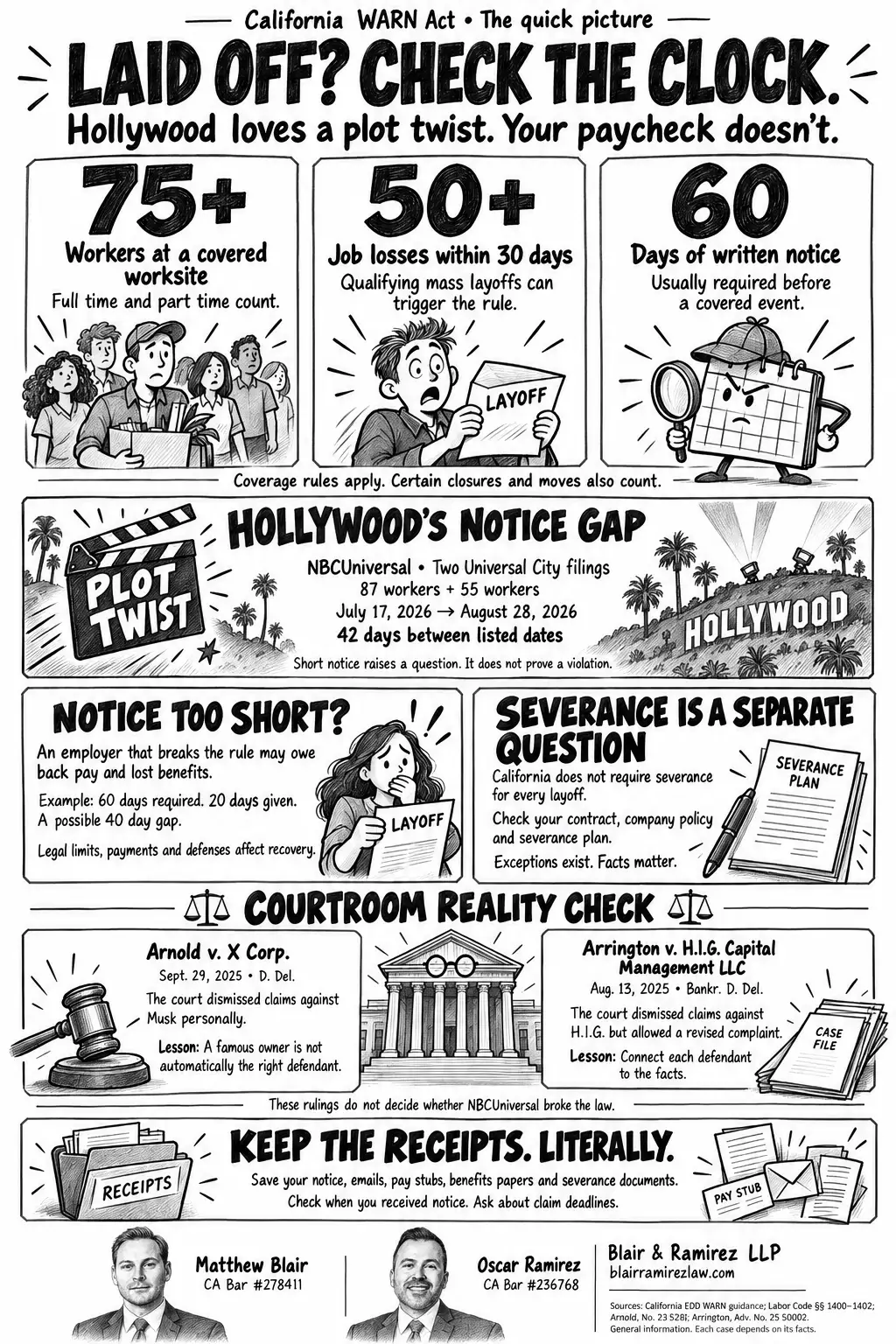
In general, covered employers with 75 or more employees must give written notice at least 60 days before a qualifying layoff, closure, or relocation. California’s rules can cover events that federal WARN rules do not cover.
Here are the basics.
|
Question |
Simple answer |
|
How many employees must a company have? |
Generally, at least 75 full-time or part-time employees |
|
How many job losses can trigger the rule? |
Generally, 50 or more employees at a covered worksite within 30 days |
|
How much notice must the company give? |
Usually 60 days |
|
Who receives the notice? |
Affected workers and required state and local officials |
|
What if the company gives too little notice? |
It could owe workers back pay and lost benefits |
The law also covers certain plant closures and relocations. California’s rules differ from federal WARN rules, so workers should not assume that the same test applies to both.
[For the full rules, visit the California Employment Development Department’s WARN page.]
What NBCUniversal’s 2026 Layoffs Teach Us
NBCUniversal’s July 2026 filings give us a real example of why notice dates matter.
The company filed two notices for its Universal City facilities in Los Angeles County. One listed 87 affected workers at Building 1440. The other listed 55 workers at Building 1460. Both notices carried a July 17 filing date and an August 28 effective date.
You can check the records here:
The dates leave an important question. Why did the listed period fall short of 60 days?
The public records alone do not answer that question. A shorter notice period does not automatically prove an illegal layoff. The employer’s legal duties, the exact event, and any valid exception all matter.
Still, the example shows why workers should check the details. Did the company give them written notice? When did they receive it? Did the notice explain the planned job cuts? Did the company claim an exception?
California also added a notice requirement for 2026. Employers must now explain what support services they will offer affected workers and how workers can access those services. This gives employees more information as they prepare for a job change.
Can You Sue Over a WARN Act Violation in California?
A sudden layoff can leave workers asking two big questions. Did the company follow the law? And what happens if it did not?
A WARN Act violation lawsuit in California can seek relief when an employer fails to provide notice required by law.
Under California Labor Code Section 1402, an employer that breaks the notice rule can owe affected workers back pay and the value of lost benefits. The amount generally cannot exceed 60 days or half the number of days the worker was employed, whichever is less. Certain payments can reduce the amount owed.
Here is a simple example. A covered employer gives a worker only 20 days’ notice when the law requires 60 days. That leaves a 40-day gap. The worker could have a claim for the notice shortfall, depending on the facts and any valid defense.
The law does not mean every worker automatically wins a claim. The employer must fall under the law, the event must qualify, and the facts must support the claim.
Keep your termination letter, emails, pay records, benefits documents, and any written notice from the company. These records can help show what happened and when.
[Read the California Labor Commissioner’s Cal-WARN guidance for details about the law and possible remedies.]
What Recent Court Cases Tell Workers
Court cases show why the details matter. They also show that a claim against a company does not always work the same way as a claim against its owner.
Arnold v. X Corp. (September 2025)
Former Twitter employees brought claims tied to the company’s mass layoffs, including claims under California’s WARN Act. They named Elon Musk along with company entities. The court dismissed the claims against Musk personally because the employees had not pleaded enough facts to support personal liability.
The ruling did not mean that every claim against the company had failed. It showed that workers must identify the right legal party and support their claims with facts.
[Read Arnold v. X Corp.]
Neal v. United Furniture Industries (April 2025)
This bankruptcy case involved claims tied to United Furniture Industries’ shutdown and the company’s notice duties. The court examined whether California’s broader definition of an employer could apply to parties beyond the main operating company. It also addressed claims against related parties and individuals.
The decision shows why a company’s ownership structure can matter. A worker may need to establish which party owned or operated the covered worksite and which party had the legal duty to provide notice.
[Read Neal v. United Furniture Industries.]
Arrington v. H.I.G. Capital Management LLC (August 2025)
Former Jenny Craig employees brought claims after the company shut down. They alleged that they did not receive the required advance notice and raised other claims tied to wages and benefits. The court dismissed the claims against H.I.G. but allowed the employees to amend their complaint.
That result matters. A court’s decision to dismiss a claim does not always end the dispute. The court may allow workers to revise their complaint and try again. The ruling also reminds workers that they must connect each defendant to the legal duty or conduct at issue.
[Read Arrington v. H.I.G. Capital Management LLC.]
These cases do not prove that NBCUniversal violated California law. Each case turns on its own facts. Together, however, they show why the identity of the employer, the notice timeline, and the evidence matter.
What About Severance and WARN Act Exceptions?
Here is a common mix-up. Severance pay and WARN Act notice are not the same thing.
California does not generally require every employer to pay severance just because it lays off workers. A worker’s mass layoff severance rights in California can depend on an employment contract, a written severance plan, a company policy, or another legal rule.
WARN Act claims are different. They focus on whether the employer gave the required notice and whether the law allows workers to seek back pay or lost benefits.
California WARN Act exceptions also matter. The law has specific exceptions, including certain physical calamities and acts of war. Other legal rules can apply to particular types of work or events. Employers cannot simply skip notice because layoffs are difficult or costly.
The key question is not just whether workers lost their jobs. It is whether the employer had a legal duty to give notice and whether it met that duty.
Frequently Asked Questions
Key Takeaways
- California generally requires covered employers to give 60 days’ notice before qualifying mass layoffs, closures, and relocations.
- NBCUniversal filed 2026 layoff notices covering 87 workers at one Universal City facility and 55 at another.
- A short notice period raises questions but does not, by itself, prove a legal violation.
- Workers may seek back pay and lost benefits when an employer breaks the law, subject to legal limits.
- Keep layoff notices, emails, pay records, and employment agreements to help understand your rights.
A Layoff Should Not Leave You in the Dark
Losing a job is hard enough. Losing it without enough time to prepare can make a difficult situation even worse.
California’s WARN Act gives workers advance notice before certain major job cuts. But the law has specific rules, and the facts matter. NBCUniversal’s 2026 notices show why workers should look closely at dates, written notices, and the reasons an employer gives.
Blair & Ramirez LLP helps workers understand their employment rights and legal options. If a layoff has left you with questions about notice, pay, or benefits, contact Blair & Ramirez LLP to request a consultation and discuss your situation.