


TL;DR
A crash may last seconds, but future medical expenses can stick around for years. Before you settle, ask yourself one question: Will this cover the care you haven’t needed yet—but probably will?
A crash lasts a few seconds. The bills? They can follow you for years.
People often zoom in on the dramatic stuff: the sirens, the emergency room hustle, or the cast on your arm. Then, life tries to get back to normal. But wait. A few weeks later, the pain crept back like an unexpected visitor. Physical therapy becomes a never-ending saga. A doctor suggests another procedure, and soon enough, you hear the dreaded words: long-term medication. Suddenly, the accident isn’t just behind you; it’s looming right there at your kitchen table every month, munching away on your finances.
At Blair & Ramirez LLP, we’ve seen it all. A person walks in thinking they only need help with today’s medical bills. Then, we hit them with a simple question: “What about next year? Five years from now?” And their whole perspective changes.
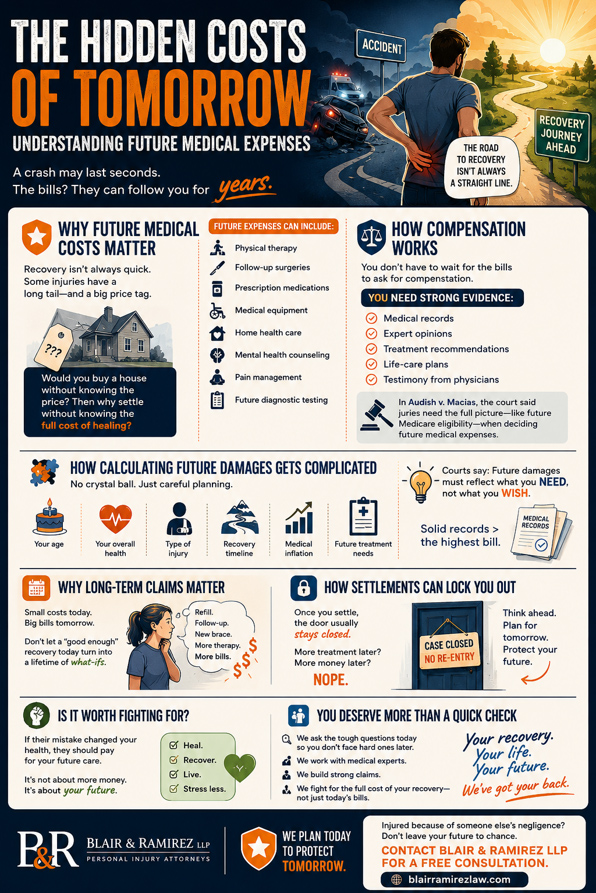
Why Future Medical Costs After an Accident Matter
Here’s the biggie: many people think their injury claims wrap up once they feel all better. But what if better is a long, winding road?
Think about this: Someone injures their back in a car accident. They bounce out of the hospital after two days, and everyone thinks they’re all set. But six months later, they're still at the therapist’s office like it's their second home. A year later, injections become part of their routine, and eventually surgery is the only answer. Did the accident really end? No.
Future medical expenses can cover all sorts of things:
- Physical therapy
- Follow-up surgeries
- Prescription medications
- Medical equipment
- Home health care
- Mental health counseling
- Pain management
- Future diagnostic testing
Every injury has a unique story. That’s why we take time to plan and not just wing it with rough estimates.
Would you buy a house without knowing its price tag? Of course not. So, why would you settle an injury claim without knowing the full cost of healing?
How Compensation for Future Medical Treatment Works
What do people often ask? “If I haven’t seen those bills yet, how can I ask for money?” A totally fair question.
In California, you don’t have to wait until every single treatment is done. You just need to show that future care is likely to be necessary because of your injury. And that means piling up some solid evidence. You’ll want:
- Medical records (the proof is in the pudding)
- Expert opinions
- Treatment recommendations
- Life-care plans
- Testimony from physicians
Now, insurance companies love to poke holes in future costs. Why? Because they want to pay less. They might argue your recovery will be speedier. Or they might claim you don’t really need that fancy new treatment. That is why having strong medical evidence is key.
Consider the recent case of Audish v. Macias. The court ruled that jurors could hear about the plaintiff's future Medicare eligibility, showing juries need full context when they evaluate future medical expenses.
Strong evidence equals stronger claims. So, let’s put on our detective hats and gather the best proof we can.
How Calculating Future Medical Damages Gets Complicated
Wouldn’t it be great if future surgeries came with blinking neon price tags? But alas, that’s not how it works.
Doctors can’t see the future. Costs change, and everybody recovers differently. Calculating future medical damages? It’s like solving a puzzle where nobody has all the pieces.
When experts sit down to calculate, they consider:
- Your age (because you’re not getting younger)
- Your health in general
- The type of injury you have
- How long is the road to recovery
- Medical inflation (because prices NEVER go down)
- Future treatment needs
For example, someone’s knee might bounce back in six months, while another person's injury could scream for a replacement in ten years. That’s a huge difference.
California courts say future damages must reflect what you really need—not what you *wish* for or random guesses. Court cases like Howell v. Hamilton Meats & Provisions remind us that future value should come from solid medical records, not merely the highest bill.
Rushing might feel good at the moment. But what if your doctor says another surgery is just around the corner? Or your daughter needs long-term therapy because of an injury? Those are big-time questions.
Why Long-Term Medical Expenses Injury Claim Matters
Here’s a twist: not all injuries wave a big, red flag. A neck strain might seem harmless, but weeks later, it turns into a pain party with headaches and numbness. Suddenly, daily tasks feel like climbing a mountain.
We see this play out far too often. Long-term medical expenses can pile up in sneaky ways. Think of a small prescription refill here, a follow-up visit there, or a new brace. Suddenly, those little bills add up to thousands.
Take someone who slips and falls, injuring their shoulder. They feel good enough to return to work, and everyone thinks, “What a recovery.” But then winter rolls in, and that pain returns like an uninvited guest. They might need injections or, worse, surgery.
Is it fair that they get stuck with those bills if they settle too soon? We don’t think so either.
How Future Care Costs in Personal Injury Settlements Affect You
When you settle, you’re like the big kid on the block: you close your case but also shut the door on asking for more cash later. Surprised? It happens.
Think of accepting an insurance company’s offer, thinking it’s fair. Six months go by, and your doctor mentions surgery. Can you go back for more cash? Almost always, the answer is NO way.
That’s why future care costs need careful attention before you sign anything. A proper settlement should cover today’s needs and tomorrow’s surprises.
California courts consistently say future medical costs must rest on helpful evidence—no guessing. That’s why we look to medical experts. They help lay out what treatment you will likely need and why those costs make sense.
Insurance companies love quick closures. We have a different mission: ensuring your future matters.
Are Future Medical Expenses Worth Fighting For
Let’s put it this way: if someone else’s oops changed your health for the long haul, shouldn't they also foot the bill for that future care? We think yes.
Future medical expenses aren’t just about extra dollars; they’re about making sure you can heal without stressing over the next doctor appointment or prescription.
No one wakes up planning to rush into an accident. No one thinks they’ll be visiting doctors for years just because another driver couldn’t wait to check their phone. Yet, it happens every day.
When it does, you deserve a team that digs deep for more than just today’s bills. You deserve advocates who ask tough questions now, so you don’t face tricky ones in the future.
At Blair & Ramirez LLP, that’s exactly how we approach every personal injury case.
Frequently Asked Questions
Your Recovery Deserves More Than a Quick Settlement
Accidents may only momentarily thud! But their impacts can echo for years. Future medical expenses need thorough attention from the beginning. Only focusing on today’s medical bills tells just part of the story.
So let’s tackle the real question: What will it take to help you heal tomorrow, next year, and years later?
At Blair & Ramirez LLP, we fight to ensure those crucial answers don’t slip through the cracks. We partner with medical pros, build strong claims, and pursue compensation that captures the whole cost of your healing, not just the bills you’ve already faced.
If someone else’s mistake has impacted your life, don’t leave your future up to chance. Contact Blair & Ramirez LLP for a free consultation. Let’s chase down the compensation you need to move forward with confidence.
Key Takeaways
- Future medical expenses include the cost of ongoing care, such as therapy, surgeries, medications, mental health treatment, and medical equipment.
- In California, you can seek compensation for future medical treatment if you have strong medical evidence showing that future care is reasonably necessary.
- Insurance companies often challenge projected medical costs, making expert opinions, medical records, and life-care plans essential to a strong claim.
- Accepting a settlement usually means you can’t ask for more money later, even if your condition worsens or you need additional treatment.
- At Blair & Ramirez LLP, we build claims that account for both today's medical bills and tomorrow's healthcare needs, helping clients pursue compensation that truly supports their recovery.