


After an accident, a lot of people have one big question on their minds: “Will my case go to court?” You might find yourself wondering this after endless medical appointments, frustrating phone calls from the insurance company, and a towering stack of bills on your kitchen counter. It’s completely normal to feel anxious about it.
Most people have never plunged into the deep end of a lawsuit before. They might picture dramatic courtroom scenes reminiscent of TV shows. A judge pounds a gavel, witnesses step boldly onto the stand, and weeks of stress roll like a heavy wave. But here’s a reality check: real-life personal injury cases are nothing like that.
Most of the time, these cases settle before anyone ever steps foot in a courtroom. Why? Because when it boils down to it, no one wants the hassle of a lengthy trial. That said, sometimes the thought of going to trial is precisely what nudges insurance companies into making a fair offer instead of a lowball one.
Think about it: If insurance companies know they can get away with offering you a pittance, why should they bother to offer a fair amount?
This is where being prepared becomes your secret weapon. At Blair & Ramirez LLP, we tackle each case as if it might go to trial. Not because we want every case to end up there, but because that hard work lays out a path to a fair settlement.
So, what truly determines whether your case will end up in court? And how can you tell if a trial is in your future?
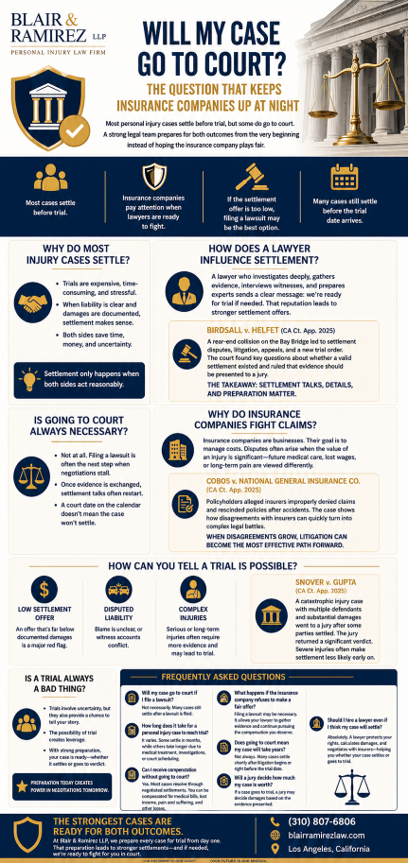
Why Do Most Injury Cases Settle?
The answer is simple: time and money. Trials don’t come cheap. They demand preparation, scheduling, expert witnesses, and endless hours of work. Everyone knows this (insurance companies and injured people alike). When both sides can agree on a fair number, settling often makes sense.
Let’s say someone breaks a leg in a car crash. The medical records clearly show the injury, and liability is obvious. The insurance company takes a peek at the evidence and offers reasonable compensation. Do you think anyone benefits from dragging that case through a drawn-out trial? Absolutely not.
That is why most personal injury claims get wrapped up through negotiations rather than verdicts. But that only works when both sides act reasonably. The moment an insurance company refuses to recognize the true value of a claim, the talk can take a sharp turn.
How Does a Lawyer Influence Settlement?
Insurance adjusters watch reputations closely. They know which law firms accept lousy offers and which ones are ready to take a case to a jury. This difference matters a lot.
A lawyer who digs deep into an accident, collects evidence, interviews witnesses, and prepares expert testimony sends a clear message: the case is “go-time” if necessary. And let’s look at Birdsall v. Helfet, a California Court of Appeal decision, for a prime example.
This case started with a settlement offer after a rear-end collision on the Bay Bridge. Disputes about those settlements nudged the case into litigation, appeals, and eventually a new trial order. The court uncovered important questions about whether a valid settlement even existed. It became super clear that the way forward included presenting evidence to a jury. This case shows how settlement talks can morph into full-blown courtroom proceedings when disagreements refuse to budge.
The takeaway here? Settlement talks matter. The details matter. Preparation? Oh, that really matters.
Is Going to Court Always Necessary?
Not even close. Many people hear “lawsuit” and instantly think a trial is just around the corner. But hold your horses: That’s not how most cases unfold.
Filing a lawsuit can often just be the next step when negotiations hit a dead end. Once both sides exchange evidence and gather information, discussions for settling frequently kick back into gear. And why is that? Because both parties finally see the strengths and weaknesses of their cases. New evidence might pop up. Testimonies from witnesses could get clearer. Expert opinions may lean in favor of the injured person.
Sometimes, simply filing a lawsuit shakes up how an insurer evaluates risk. Sure, a court date might show up on the calendar, but that doesn’t mean the case can’t settle days or even hours before the trial kicks off.
Why Do Insurance Companies Fight Claims?
Let’s dive into an honest answer here: insurance companies are businesses. Their top goal isn’t solely about paying claims; it also focuses on managing costs. That doesn’t mean every insurer plays dirty. Many claims float smoothly along. But bumps often pop up when the injury’s value skyrockets.
Think about a person needing future medical treatment, missing months of work, or living with constant pain. The insurer might see those losses in a totally different light than the injured person does.
Cobos v. National General Insurance Co. is one such case. This 2025 appellate decision revealed how policyholders alleged insurers improperly denied claims and rescinded policies after accidents. While this case zeroed in on class certification issues, it highlighted how quickly disagreements with insurers can steamroll into complex disputes.
When issues grow large enough, litigation can become the most effective road ahead.
How Can You Tell a Trial Is Possible?
While there’s no magical crystal ball, certain signs can suggest a case might inch closer to trial. One of the big red flags is a settlement offer that’s far below the documented damages. Another might be when liability remains disputed. Are both drivers pointing fingers at each other? Are witness accounts all over the map?
Complex injuries create their own set of challenges. Take, for example, Snover v. Gupta, a California case that dealt with catastrophic injuries, multiple defendants, and significant damages. After some parties settled, the remainder of the dispute went to trial, where a jury evaluated the evidence and returned a hefty verdict. It’s clear that cases involving severe injuries often need a deeper dive into the facts and may be less likely to wrap up early.
Does that mean your case will follow the same tricky path? Not at all. But it does show how crucial experienced trial preparation is right from the beginning.
Is a Trial Always a Bad Thing?
Let’s face it: most people would rather avoid a trial. And that makes sense. Trials come with their own load of patience, uncertainty, and intimidation.
But here’s the flip side: A trial can give injured people a chance to tell their story when negotiations fail. Sometimes, that possibility can shift the tables. It can push insurance companies into accountability. And—this is big—it might lead to a settlement that never would’ve shown up during negotiations.
The key here? Readiness. When insurance companies sense that a legal team has crafted a solid case, prepped witnesses, organized evidence, and developed a persuasive presentation, they often alter how they approach negotiations.
So, when clients ask, “Will my case go to court?” we focus less on trying to guess the future and more on creating the strongest case possible today.
Frequently Asked Questions
Will my case go to court if I file a lawsuit?
Not necessarily. Filing a lawsuit starts a formal legal process, but many cases still reach settlements afterward. In fact, discussions often become more fruitful once both sides exchange evidence.
How long does it take for a personal injury case to reach trial?
Every case moves at its own speed. Some wrap up in a few months, while others stretch longer due to medical treatments, investigations, or court schedules. Complex cases generally require more time than those that are straightforward.
Can I receive compensation without going to court?
Certainly. Most personal injury claims close in on negotiated settlements. A solid settlement can cover medical expenses, missed income, pain and suffering, and other losses without ever hitting the courtroom.
What if the insurance company refuses to give a fair offer?
If negotiations stall, you might need to file a lawsuit. This gives your legal team the power to gather evidence through formal procedures and continue chasing the compensation you deserve.
Does going to court mean I’m in for a years-long battle?
Not always. Some cases settle soon after litigation kicks in, while others resolve before the trial date even arrives. Court involvement doesn’t automatically mean a slow-moving courtroom drama.
Will a jury decide how much my case is worth?
If your case reaches trial, a jury will evaluate the evidence and decide on damages. They’ll consider factors like medical costs, lost earnings, future care needs, and how injuries impact daily life.
Should I hire a lawyer even if I think my case will settle?
Yes. A lawyer can help gather evidence, crunch numbers for damages, negotiate with insurers, and protect your rights through the entire journey. Strong legal support improves your position whether the case settles or goes to court.
The Strongest Cases Are Ready for Both Outcomes
So, instead of asking, “Will my case go to court?” maybe a better question is: What happens if the insurance company refuses to step up?
Preparation becomes your mightiest tool. A case built for trial often stands in a stronger position during settlement talks. Insurance companies definitely notice when a legal team puts in the hard work. They can see when evidence is well-organized, facts are clear, and attorneys stand poised to present their case to a jury.
At Blair & Ramirez LLP, we gear up for both outcomes from the very start. Whether your claim settles through negotiation or takes the litigation path, our primary goal stays the same: securing the compensation you need to move forward with confidence.
If you’ve been injured and want straightforward answers about your legal options, reach out to Blair & Ramirez LLP today. The sooner you grasp your position, the sooner you can embark on your journey toward recovery.