

TL;DR
In California, the amount for a wrongful death settlement changes based on unique details of each case, not a statewide average. Courts look at financial losses, family relationships, evidence available, and how the death affects loved ones. While no attorney can guarantee a certain result, understanding the process helps families make informed decisions during a challenging time.
When someone else’s mistake takes away a loved one, a big question pops up: “What’s a fair wrongful death settlement?” It feels like an easy question, right? But it’s actually a real head-scratcher.
Have you ever seen news about families getting millions of dollars for their loss, only to find out another family got much less for what seems like the same thing? Why is that?
It’s simple: no two wrongful death cases are exactly alike.
At Blair & Ramirez LLP, we’ve learned that each family’s story is different. California law considers lots of details before deciding what fair compensation might be. Things like:
- How close was your relationship with the person who died?
- What financial losses did you face?
- How deeply did their absence affect you emotionally?
- And even, how strong is the evidence showing that someone else caused the death?
The good news is that knowing how these aspects affect a wrongful death settlement can help you make smart choices instead of just guessing what’s true. Let’s dive in.
Why Is Every Wrongful Death Settlement Different?
Think about it: Two families sadly lose a loved one in car accidents. Both situations are heartbreaking, but one family might get way more money than the other. Why does that happen?
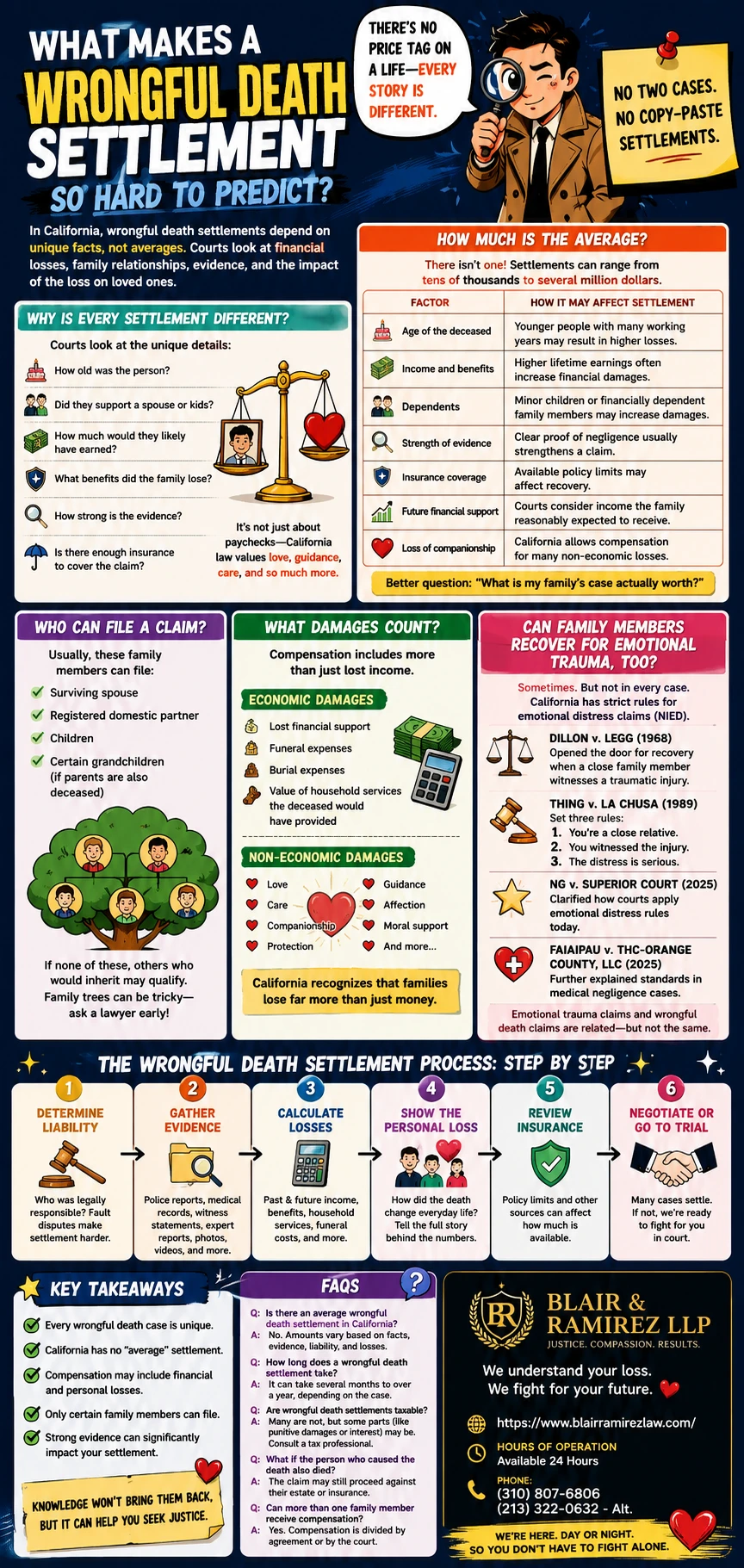
California courts don’t have a fixed price tag for a person’s life. They look at the unique details of each case, like:
- How old was the person?
- Did they support a spouse or kids?
- How much money would they likely have earned in their lifetime?
- What benefits did the family lose?
- Is there enough insurance to cover the claim?
These questions can completely change the result. Even similar accidents can lead to different outcomes.
And here’s something many people don’t know: settlements aren’t just about the money someone earned. California law also values everything else the family loses, like love, guidance, and care. That's why it's important to show the full picture of what your family has lost, not just the financial side. Every detail can help explain how the loss has changed your family’s life.
How Much Is the Average Wrongful Death Settlement in California?
Many people look for an “average” settlement. But guess what? There isn’t a solid average that tells you what your case might be worth. Some cases settle for tens of thousands, while others can reach several million. It all depends on the unique facts of your case.
Here’s a simple overview.
|
Factor |
How It May Affect Settlement |
|
Age of the deceased |
Younger people with many expected working years may result in higher economic losses. |
|
Income and benefits |
Higher lifetime earnings often increase financial damages. |
|
Dependents |
Minor children or financially dependent family members may increase damages. |
|
Strength of evidence |
Clear proof of negligence usually strengthens a claim. |
|
Insurance coverage |
Available policy limits may affect recovery. |
|
Future financial support |
Courts consider income the family reasonably expected to receive. |
|
Loss of companionship |
California allows compensation for many non-economic family losses. |
Instead of asking, “What’s the average?” try asking, “What is my family’s case actually worth?” That's a question that depends on the unique facts, evidence, and losses involved in your family’s case.
Who Can File a Wrongful Death Claim?
Not every family member can just file a wrongful death lawsuit. California law has rules (see Code of Civil Procedure § 377.60) about who can actually bring the claim. Usually, the people who can file include:
- A surviving spouse
- A registered domestic partner
- Children
- Certain grandchildren (if their parents have also passed away)
If there aren’t any of those relatives, some others who would inherit could sometimes qualify, too. Family trees can be tricky, and California law has specific rules about who can file a claim.
What Damages Count in a Wrongful Death Lawsuit?
Many people think compensation only covers lost income. But California laws allow for so much more. Wrongful death damages fall into two main categories:
Economic Damages
These are the dollar-and-cents losses. Examples include:
- Lost financial support
- Funeral costs
- Burial expenses
- The value of household tasks the deceased would have done.
Experts can help figure out how much those losses will add up to over time.
Non-Economic Damages
These are trickier because they don’t come with invoices. They include things like:
- Love
- Companionship
- Care
- Protection
- Guidance for kids
California knows families lose way more than just money after a wrongful death. Often, the emotional losses matter the most.
But remember, California doesn’t allow survivors to recover for their own grief in these cases. Those claims have different rules.
Can Family Members Recover from Emotional Trauma, Too?
Sometimes. But not in every wrongful death lawsuit. California has special rules for something called negligent infliction of emotional distress (NIED) that apply in specific situations.
In one important case, Dillon v. Legg (1968), the court decided that if you see a close family member in a bad accident, you might be able to claim for the emotional harm you experience. This was a big shift from strict rules to more focus on what’s reasonable to expect.
Later, in Thing v. La Chusa (1989), the court made the rules clearer. To qualify for emotional distress claims, you generally need three things:
- You’re a close relative of the injured person.
- You witnessed the injury happening.
- The emotional distress is serious.
This decision created clearer limits on when emotional distress claims may proceed.
More recently, California courts have continued refining these principles.
In Ng v. Superior Court (2025), the court addressed important questions involving emotional distress claims connected to fatal injuries, helping clarify how California applies these long-standing rules in modern cases.
Likewise, Faiaipau v. THC-Orange County, LLC (2025) examined issues involving emotional distress claims arising from medical negligence and further explained how courts analyze these situations.
These cases remind families that emotional trauma claims and wrongful death claims are related, but they are not the same lawsuit. Whether you can file for emotional distress depends on the specific facts and California laws.
How Does Wrongful Death Compensation in California Work?
When a family files a wrongful death claim, they often wonder, “How do you really figure out the compensation?” Great question. But there’s no magic calculator or fixed dollar amount.
It All Starts With Evidence
Think of evidence as the building blocks of your case. Insurance companies, lawyers, and even a jury will look at all the losses the family faced due to the death. Some losses have clear receipts, while others need stories from family, financial experts, or economists to show how the death changed everything.
And then there are economic and non-economic damages (as discussed above).
The more solid the evidence for these losses, the stronger the claim can be.
How Do Factors Affecting Wrongful Death Settlements Change Your Case?
Sometimes, two families experience heartbreaking losses, but their settlements can be worlds apart. Why? Several factors can affect how much a claim is worth. Here’s how the process often goes:
Step 1: Figure Out Who’s Responsible
Everything begins with figuring out who caused the death. Did someone act negligently, like a careless driver or a property owner?
If it’s unclear who’s at fault, making a settlement can get tougher.
Step 2: Gather the Evidence
Strong evidence means a stronger case. Evidence in a wrongful death case often includes:
- Police reports
- Medical records
- Accident reconstruction reports
- Witness statements
- Photos and videos
Missing evidence can really weaken even a valid case, so gathering everything is super important.
Step 3: Calculate Financial Losses
Next comes the math part. Attorneys will review:
- Past earnings
- Future earning potential
- Employee benefits
- Household services the deceased provided
- Funeral costs
In bigger cases, experts might estimate what the family would have received over the deceased’s expected lifetime.
Step 4: Show the Personal Loss
But wait: numbers alone don’t tell the whole story.
Family members can explain how the death changed their daily lives. Who used to help with the kids? Who cared for aging parents? Who managed the household?
These details help show losses that aren’t on a paycheck.
Step 5: Review Insurance Coverage
Sometimes, even a strong case can run into insurance limits. Insurance policies often dictate how much cash is available to settle a claim.
In some situations, there might be other defendants or sources of compensation, too.
Step 6: Negotiate—Or Go to Trial
Many wrongful death cases settle before going to trial. Settlements can save time and stress, plus give families more certainty. Some cases settle through negotiations, while others move forward to trial. It all depends on the facts of the case and how the claim develops.
At Blair & Ramirez LLP, we carefully prepare every case by reviewing the facts, gathering evidence, and helping families understand their legal options throughout the process.
Frequently Asked Questions
Blair & Ramirez LLP Can Help You Understand Your Options
Losing someone you love changes everything. The legal process can’t fill that void, but it can help bring financial stability and hold the responsible party accountable.
At Blair & Ramirez LLP, we take the time to understand your family's story, explain your legal options in plain language, and help you understand the claims process. Whether you’re just starting to think about a claim or ready to take the next steps, our team is here to answer all your questions and guide you through every part of the journey.
Contact Blair & Ramirez LLP for a confidential consultation if you’d like to learn more about your legal options and the wrongful death claims process.
Key Takeaways
- Every wrongful death case is one-of-a-kind.
- California doesn’t have a set “average” settlement you can rely on.
- Compensation includes both financial and personal losses.
- Only certain family members can file a wrongful death claim.
- Strong evidence plays a big role in settlement outcomes.
- Recent California court decisions keep shaping how wrongful death and emotional distress claims are viewed.