


TL;DR
A pain and suffering calculator can give you a helpful guess, but it cannot find the real value of your claim. In California, strong proof (not a formula) is what really matters for fair compensation for pain and suffering.
You can’t put a price on feeling bad for a day, a week, or even a whole year. Maybe you hurt so much you miss fun times, like your child’s birthday, because you can barely get out of bed. Or maybe you feel upset about scars from a crash that you never wanted.
A pain and suffering calculator might say it can give you a quick answer. You just enter a few numbers, press a button, and get an estimate. Sounds easy, right? But hold on.
California law doesn’t use a magic formula to decide how much someone should get for pain and suffering. Insurance companies know this. Judges and juries know it too. The real question is not “What does the calculator say?” but “How did this injury really change your life?” That’s where a good lawyer can help.
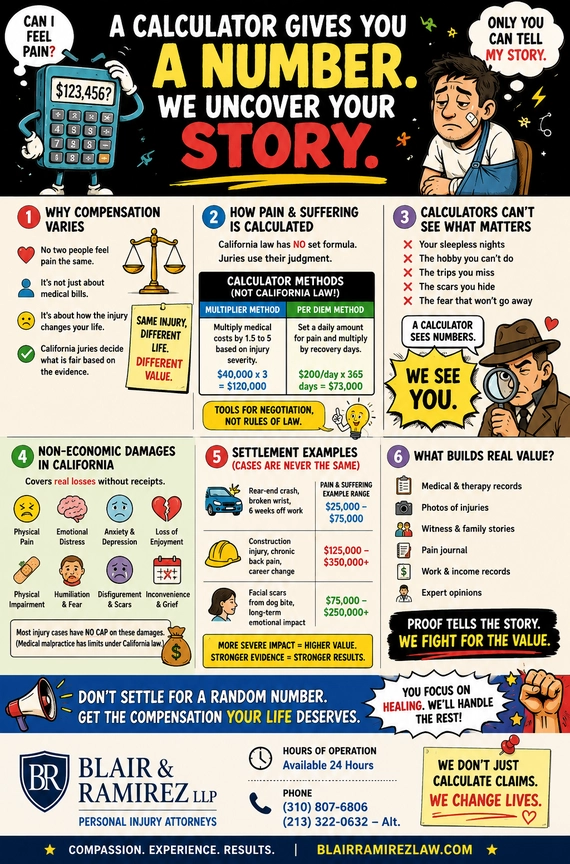
Why Pain and Suffering Compensation Varies
You might wonder why two people with similar injuries can get different amounts of money. It’s a good question with a simple answer: No two people feel pain the same way.
Let’s say two neighbors break the same bone. One neighbor heals in six weeks and goes back to work. The other neighbor feels nerve pain, can’t sleep, and misses months of income. They have the same injury, but their lives are very different.
That’s why money for pain and suffering isn’t just based on medical bills. In California, these payments are called non-economic damages. They cover losses that don’t come with receipts.
Think about things like physical pain, feeling sad, being anxious, or not finding the fun in daily life anymore. It could mean missing family trips or giving up hobbies you once loved. It can mean living with scars forever.
The Judicial Council of California tells juries in personal injury trials (CACI No. 3905A) that they must decide on an amount that fairly helps someone with their suffering based on the evidence they see. There isn’t a special math formula. Instead, they ask a much harder question: “What is this person really going through?”
That’s why two amounts of money from settlements are rarely the same. Insurance companies look at numbers, but we focus on people. We talk about how an injury changes someone’s daily life. Did you stop coaching your child’s soccer team? Can you no longer lift your little one? Do you have panic attacks that make driving too scary? These details tell your story.
California courts also say that non-economic damages pay for real losses that can’t just be counted with receipts. For example, in a case called Johnson v. Monsanto Co., the court explained that damages should fairly help someone who got hurt, based on the proof shown during the trial. The judge, Justice Elena J. Duarte, noted that juries have an important job in looking at the evidence to decide on amounts. They also check to make sure that awards aren’t too high or too low.
This is important because it shows a key point. A pain and suffering calculator can give you a rough idea, but it can’t replace real proof. And it definitely can’t replace what a jury decides.
How Pain and Suffering Is Calculated
Here’s a question everyone asks: “Is there a formula to find out how much?” The answer is yes and no.
California law does not require any set formula for figuring out pain and suffering. Jurors get told there is no fixed standard, so they have to use their judgment based on the evidence they see.
But where do calculators get their numbers? Most use one of these two methods:
|
Method |
How it works |
Example |
|
Multiplier Method |
This means you multiply the money amount for medical costs by a number, usually between 1.5 and 5, depending on how bad the injury is. |
For example, if someone has $40,000 in medical bills and the multiplier is 3, the estimate for pain and suffering would be $120,000. |
|
Per Diem Method |
This method means you figure out a daily dollar amount for pain and multiply it by the number of days needed to heal. |
For instance, if you say $200 a day for pain and you take a whole year to recover, then it would be $200 times 365 days, which equals $73,000. |
These methods are common when trying to settle claims, but they aren’t California law. Let’s say someone has a torn shoulder from a car crash. They have $35,000 in medical costs and lost another $15,000 in wages. A calculator might say their pain and suffering is $150,000, which seems reasonable.
But what if this person is a concert pianist? The injury affects not just their visits to the doctor but also their career and something they love.
Now think of someone else with the same bills who heals quickly. Should they both get paid the same amount? Probably not.
That’s why experienced lawyers don’t just rely on calculators. They gather evidence, like medical records, therapy notes, photos, witness statements, family stories, work records, and daily journals about pain. Every piece of information helps answer one important question: “How did this injury change your life?”
California juries make these decisions every day. The rules (CACI No. 3905A) say that jurors should pick an amount that fairly helps for pain in the body, sadness in the mind, and other feelings like anxiety or embarrassment. They think about all the ways a person suffers.
But online calculators often miss important details. They can’t show how scared you get before a doctor’s visit or how awkward it feels to need help getting dressed. They also can’t tell how frustrating it is to watch your family have fun while you stay home because your knee hurts and you can’t go out.
These feelings matter a lot. A pain and suffering calculator might give you a guess of what you could get, but it can’t show everything about how an injury changes your life. That’s why having a good lawyer and strong proof is much better than any online estimate.
Is a Personal Injury Damages Calculator Enough
Let’s be honest: If calculators always got it right, there wouldn’t be so many lawsuits. A personal injury damages calculator can be helpful. It gives you a rough idea based on the numbers you put in. That’s all it does.
What it can’t do is ask important questions:
- Did your injury take away a hobby you loved?
- Do you wake up at night because your shoulder hurts?
- Are you scared to drive again because you feel anxious?
These details often make a big difference.
Insurance adjusters know this. They don’t just look at medical bills. They read your doctor’s notes, check your treatments, and look at your work history. They want to see things that help or hurt your claim.
The same goes for court.
In California, juries don’t get a calculator. They only see the evidence. That’s why the strongest claims don’t start with a calculator. They start with a story backed by proof.
Think about someone who slips in a grocery store. One person heals in a few weeks. Another person gets long-lasting back pain, needs to go to physical therapy for a year, and can’t lift their grandchild anymore.
Should both of them get the same money? Of course not.
The calculator might see similar medical bills. But the law sees two different lives.
So, we tell clients not to think of online estimates as promises. Think of them as a starting point for conversation. The real value of your case depends on the evidence, the law, and how well your attorney presents both.
How Non-Economic Damages Work in California
Some losses come with bills we can see. Others don’t.
If you fix a car, you know the cost. If you go to physical therapy for three months, you can add up the bills.
But what about the panic attack you have every time you hear a loud noise from the street? What about the scar that makes you feel uncomfortable? What about the family trip you had to cancel because walking became too painful?
Those losses matter, too.
In California, we call them non-economic damages. They often include:
- Physical pain
- Emotional distress
- Anxiety and depression
- Fear
- Humiliation
- Problems with everyday life
- Changes in how you enjoy life
- Grief and trouble
California understands that families lose much more than just money after an injury.
The California Legislature has important rules about these damages. Under Proposition 51 (Civil Code sections 1431.1–1431.5), different responsibilities apply to economic damages (the ones with bills) and non-economic damages. Knowing these rules is important because they can change how much money each person responsible has to pay.
Another rule is about medical malpractice claims. In these cases [California’s Civil Code section 3333.2, as amended by the MICRA modernization legislation (AB 35)], there are limits on how much non-economic damages you can get. But these limits don’t apply to car accidents, slip-and-fall cases, or most other personal injury cases.
Many people get confused and think all injury cases have limits. But that’s not true. Knowing the right rules can greatly affect the value of a claim.
How Pain and Suffering Settlement Examples Compare
Everyone wants examples. That’s natural.
But examples are just examples. No lawyer can promise how much your case will settle for. Every injury, person, and piece of evidence is different.
Still, looking at examples can help explain how claims are evaluated.
Think about a teacher who gets a broken wrist in a car accident. She has surgery and misses six weeks of work. After she heals, she goes back to teaching with only a little pain. Her pain and suffering damages may be significant, but her long-term problems are small.
Now, think of a construction worker with a similar wrist injury. He can’t handle heavy tools anymore. He develops ongoing pain and changes careers because he cannot work like he used to.
Same injury. Different outcome.
Or consider a college student who gets facial scars after a dog bite. The medical bills stop, but the emotional impact doesn’t. Years later, he still feels anxious during job interviews. Social situations make him uncomfortable, and he feels less confident.
These losses are important to think about because they don’t go away quickly.
California courts understand that juries have a big role in deciding non-economic damages. In a recent case, Phipps v. Copeland Corp. LLC (2021), the court talked about how jury decisions are often respected unless the amount seems too high based on the facts. This rule shows why strong evidence is important, not just a calculator.
Another example is from Pearl v. City of Los Angeles (2019). This case looked at damages and how to support them with evidence. While every case is different, it teaches us that good evidence helps juries understand losses.
See the pattern? It’s all about evidence, not guesses, calculators, or wishful thinking.
The stronger your proof, the stronger your claim.
Frequently Asked Questions
Key Takeaways
- A pain and suffering calculator only offers a rough guess, not a certain amount.
- California law does not need a formula for figuring out non-economic damages.
- Medical records by themselves usually don’t tell the whole story; proof of how the injury changed your daily life is also very important.
- Every pain and suffering claim is special because everyone’s experience is different.
- An experienced personal injury attorney can help gather the proof you need to get the money you deserve.
Your Story Deserves More Than a Calculator
A number is easy to get. A story is much harder to tell. That’s why a pain and suffering calculator can only help up to a point. It cannot explain the nights you couldn’t sleep. It cannot show the hobbies you had to stop doing. It cannot tell how an injury affected your family, career, or future.
At Blair & Ramirez LLP, we believe every injury has its own story. Our job is to make sure insurance companies, judges, and juries know that story and fight for the money you deserve under California law.
If someone else caused your injury, don’t settle for just an online guess. Let us review your case, explain your legal choices, and pursue the full compensation you may be able to recover.